
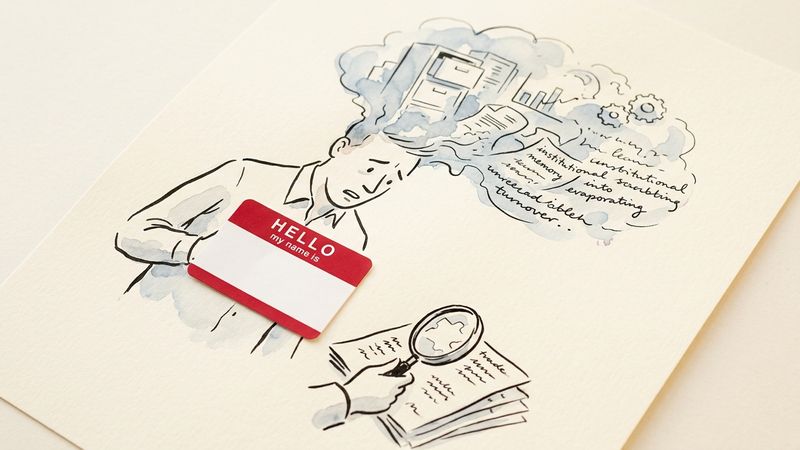
A trade reporter asked a simple question in a briefing last year: "How is this different from what you tried in 2015?" The room went silent. Not defensive silence. Blank silence. Nobody on that marketing team had been at the company in 2015. Nobody had read the old coverage. The reporter, who'd covered enterprise martech for a decade, knew the company's history better than the people paid to tell it.
That anecdote, shared recently by Content Marketing Institute, is the cleanest demonstration of a problem we're all dancing around but haven't named properly. I'd like to give it a shot: the expertise illusion.
What We're Actually Talking About
The expertise illusion is the mistake of equating access to information with actual expertise. It's not new. It probably started with the printing press. But we've been perfecting it ever since, and in 2026, we've achieved something close to mastery.
Here's the setup: you ask Claude or Gemini for a competitor summary, a category history, and a set of "key trends." Forty seconds later, you have something that looks perfectly competent. You feel informed. You are not. You know where to find information, which is a fundamentally different skill from knowing things.
Cognitive scientist Daniel Willingham nailed this years ago: "The processes of thinking are intertwined with the content of thought." Critical thinking isn't a portable skill you carry from domain to domain like a Swiss Army knife. It runs on domain knowledge. An expert reads a situation and sees the deep structure. A novice sees the surface features. AI hands you a summary with the surface features and calls it a briefing.
Consider this scenario: a competitor cuts its price by 20%. The marketer new to the category sees what's on the page: an aggressive move, a threat, a reason to call a meeting. The marketer who has studied this category for ten years knows the same competitor did something similar in 2019 right before retiring a product line. The cut wasn't about winning customers. It was about clearing inventory. Same press release, two readings, and only one is useful.
The Real Cost Isn't Abstract
A business owner recently shared on LinkedIn what happens when the expertise illusion meets actual money. He hired someone claiming to be a marketing specialist, confident in their capabilities, promising strong conversions. In practice, most campaigns were rejected by Meta. The few that ran performed near zero.
The kicker? This person actively publishes polished narratives across social media, presenting a curated image of competence in fluent English, while being unable to construct two grammatically correct sentences in direct communication.
His financial loss was around $10,000. Relatively minor, he noted. But the potential risk to brand, strategy, and reputation could have been far greater.
This pattern isn't limited to freelancers overselling their skills. It's appearing in consulting, business coaching, training, and optimization services. We're entering an era where form routinely overtakes substance, and that comes with a real cost that doesn't show up on dashboards.
The Volume Trap
Here's where it gets uncomfortable for those of us running marketing teams. According to a 2025 Forrester Research report, 63% of CMOs admit that their content volume has increased while their qualified lead flow has stagnated or declined. The industry's obsession with speed and output has created a paradox: in trying to say everything, brands are saying nothing.
I've sat in enough planning meetings to recognize the seduction. AI tools promise more content, more visibility, more growth. The math seems obvious. But two years into this experiment, the equation no longer holds. The digital landscape is flooded with content, yet real conversion rates are shrinking.
As Kieran Flanagan put it on Marketing Against the Grain
: "Most marketing teams are scaling with AI right now, and the output is getting worse and worse." The tools have never been more powerful. The strategic thinking behind them has rarely been weaker.Building Real Domain Knowledge (Not Just Faster Summaries)
So what do we actually do about this? I've been thinking about it for months, and I keep coming back to a few principles that feel unglamorous but necessary.
First, stop treating AI outputs as finished products. They're starting points. The competitor summary your AI generates is a hypothesis, not a conclusion. The real work begins when you ask: what does this miss? What happened before? What's the context that doesn't show up in a 40-second synthesis?
Second, invest in institutional memory. That reporter knew the 2015 launch because she'd covered it. Your team doesn't have that advantage unless you build it deliberately. Document not just what you did, but why it worked or didn't. Create searchable archives of past campaigns, competitive moves, and market shifts. Make it someone's job to know the history.
Third, hire for curiosity, not just capability. The marketers who will thrive in an AI-saturated environment are the ones who ask "why" after the AI gives them "what." They're the ones who read the trade press, attend the conferences, talk to customers, and build mental models of how their category actually works. You can't prompt your way to that.
Fourth, create friction on purpose. This sounds counterintuitive in an efficiency-obsessed culture, but hear me out. Before your team publishes that AI-assisted analysis, require them to identify three things the AI might have gotten wrong. Before they send that competitive brief, ask them to explain the historical context in their own words. The friction forces engagement with the material, not just the output.
Fifth, measure expertise, not just activity. Can your team explain why your category exists? Can they name the three biggest failures in your space and what caused them? Can they predict how a specific competitor will respond to a market shift? These aren't trick questions. They're the baseline for actual expertise.
The Uncomfortable Truth
Here's what I keep coming back to: AI is a spectacular tool for people who already know things. It accelerates research, surfaces patterns, and handles the mechanical work that used to eat hours. But for people who don't know things, it's a confidence machine. It makes you feel informed without making you informed.
The expertise illusion isn't going away. If anything, the tools will get better at producing plausible-sounding content, and the gap between access and understanding will widen. The marketers who win won't be the ones who prompt faster. They'll be the ones who know their domain deeply enough to recognize when the AI is wrong, when the summary misses the point, and when the "key trend" is actually a recycled insight from 2019.
Marketing has always been a team sport. But the team that wins in 2026 isn't the one with the best AI stack. It's the one where someone in the room can answer the question: "How is this different from what you tried in 2015?"
And actually know the answer.


