
Last week, a CMO friend of mine asked ChatGPT to describe her company's flagship product. The AI confidently explained a feature set the company had deprecated eighteen months ago. Worse, it cited her own company's website as the source. The problem? An old PDF buried three clicks deep in the support section still described the legacy version.
Welcome to the new brand reputation crisis, and it's not what you think.
The Problem Isn't Visibility. It's Contradiction.
Most marketing teams are obsessing over the wrong question. They're asking, "How do we get mentioned in AI search?" when they should be asking, "What version of our brand is AI search finding?"
According to Search Engine Journal, the real threat isn't a lack of data about your brand. It's too much data. Your website says one thing. An old PDF says another. Product documentation uses language the marketing team abandoned two years ago. Executive biographies preserve titles that no longer exist. Partner pages describe features that have changed.
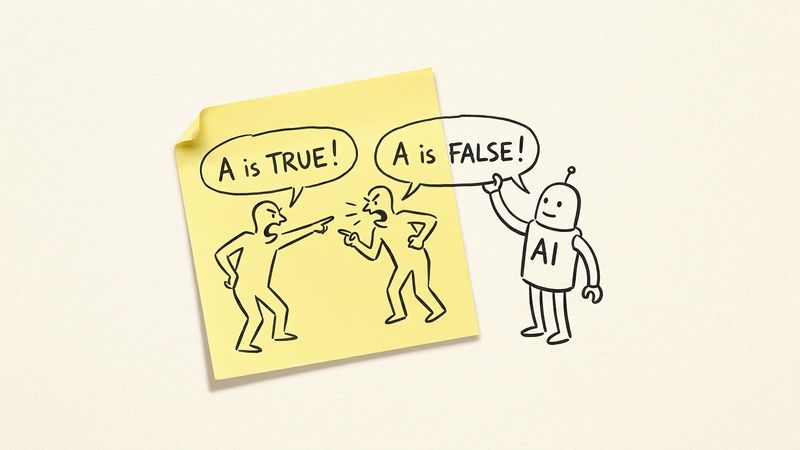
Traditional search could rank several of those pages simultaneously and leave the user to decide which one was current. AI search doesn't work that way. It retrieves sources and constructs a single answer. That answer looks settled even when the underlying evidence is a mess.
Research from seoClarity found that 40% of AI responses contain inaccuracies regarding brand-specific questions. That's not a rounding error. That's nearly half of all branded queries returning something wrong.
Why Your Own Content Is Working Against You
Here's the uncomfortable truth: AI systems aren't hallucinating about your brand because they're broken. They're hallucinating because you gave them conflicting evidence.
MarGen's analysis breaks down the mechanics: if your website says you're based in Sheffield but an old directory listing says Manchester, the AI may state either or merge them incorrectly. If your business changed name, location, services, or ownership, the AI may cite the old information. When an AI model has very little data about your business, it infers details based on patterns from similar businesses. This inference can produce plausible but incorrect statements.
The prompt determines which version of the truth gets retrieved. When someone asks an LLM a question, the prompt supplies the frame and much of the vocabulary used to find supporting information. If someone asks, "Who is the CEO of [Company]?" they assume the company still has a CEO. They don't know enough to ask who currently "leads the brand," whether leadership moved to a parent company, or which newer role carries the closest equivalent responsibility.
A search centered on the company name and the word "CEO" will naturally favor pages containing that exact relationship. Old biographies, press releases, interviews, conference profiles, and acquisition announcements may all name a former CEO. The current leadership page might use different language that doesn't map to "CEO."
The Trust Erosion Is Already Happening
Consumer sentiment toward AI search is eroding fast. Fractl's 2026 AI Search Consumer Trust Study found that in 2025, 82% of consumers found AI more helpful than traditional search. In 2026, that number dropped to 54%. A 28-point collapse in twelve months.
The most counterintuitive finding: Baby Boomers (63%) are now more likely than Gen Z (47%) to find AI more helpful. The audience with the most exposure is the most disillusioned.
What does this mean for brands? It means the window for establishing AI credibility is narrowing. Consumers are becoming more skeptical, which means the brands that get their information right will stand out even more. The brands that don't will be dismissed along with the AI that misrepresented them.
The Visibility Paradox
Omni Eclipse's 2026 AI Search Visibility Report checked 1,700 businesses across 32 industries and found that 88% don't appear in ChatGPT recommendations at all. Of the businesses that rank on Google page one, only 23% also appeared in ChatGPT.
But here's the paradox: being invisible might actually be safer than being visible with wrong information. At least if you're invisible, you're not actively damaging your brand. If ChatGPT confidently tells a prospect that your product does something it doesn't, or that your pricing is different from reality, or that you're headquartered in a city you left five years ago, you've lost that prospect before they ever visited your site.
AirOps' State of AI Search report found that only 30% of brands stay visible from one AI answer to the next, and just 20% remain present across five consecutive runs. Pages not updated quarterly are 3x more likely to lose citations. The churn is relentless.
This Is a Governance Problem, Not a Content Problem
The instinct for most marketing teams is to create more content. More FAQs. More comparison pages. More "authoritative" explanations. But you cannot fix incorrect or outdated information in the LLMs by simply publishing more authoritative pages.
This is a retrieval and content governance problem. It requires an audit of every place your brand information lives: your website, old PDFs, partner pages, directory listings, press releases, executive bios, product documentation, marketplace listings, and third-party review sites.
Semrush's guide to fixing AI brand misinformation recommends systematic monitoring across multiple AI platforms. Manual spot-checks aren't reliable enough to catch the full picture. AI tools like ChatGPT, Google AI Overviews, and Perplexity don't all return the same answers, and responses shift as models update.
The tactical roadmap looks something like this:
Document the Errors
Systematically test what AI systems say about your business. Search for your business name in ChatGPT, Perplexity, Google AI Overviews, and Claude. Document every incorrect statement with screenshots.
Trace the Sources
Identify which third-party sources are feeding the wrong details into AI responses. AI systems learn from the content they're trained on, and in some cases, retrieve from the live web. If AI is describing your brand incorrectly, a source somewhere is likely the reason why.
Clean the Evidence Chain
Update or remove outdated content. Ensure consistency across all owned properties. Request corrections from third-party sites where possible.
Establish Freshness Signals
AirOps found that sequential headings and rich schema correlate with 2.8x higher citation rates. About 48% of citations come from community platforms like Reddit and YouTube, and 85% of brand mentions originate from third-party pages rather than owned domains.
The New Brand Hygiene
McKinsey's research projects that by 2028, $750 billion in US revenue will funnel through AI-powered search. Unprepared brands may experience a decline in traffic from traditional search channels anywhere from 20 to 50 percent.
The brands that win in this environment won't be the ones with the most content. They'll be the ones with the cleanest evidence chain. The ones where every page, every PDF, every partner listing, every executive bio tells the same story.
Marketing is like dating, as I've said before. You don't propose on the first ad impression. But in AI search, you might not even get a first date if the AI already told your prospect something wrong about you.
The math here isn't complicated. If 40% of branded AI queries return inaccurate information, and 50% of consumers are now using AI for buying decisions, you're losing prospects to misinformation before they ever see your actual marketing.
Data tells you the what, but brand tells you the why. In AI search, your brand is whatever the AI can find and verify. Make sure it's finding the right version.


