
Three stories crossed my feed last week that, on the surface, have nothing to do with each other. A novelist teaching at MIT. A study about how much of the web is now AI-generated. And data on freelance creatives watching their budgets evaporate. Different sources, different angles, different agendas.
Same punchline.
If you're running marketing strategy in 2026, these three data points aren't just interesting reading. They're a fork in the road, and the sign says choose now.
The MIT Confession Booth
Micah Nathan, a novelist and MIT writing lecturer, recently published a piece about confronting his students over AI use in their essays. What followed wasn't a disciplinary hearing. It was, by his account, one of the most productive teaching moments of his eight years there.
His insight cuts deeper than academic integrity debates. Nathan described AI prose as faultily faultless, icily regular, splendidly null, borrowing Tennyson's description of a beautiful but empty face. The output looks like thought. It reads like thought. But it's what Nathan calls simulacra of thought, generated via pattern recognition learned from millions of human-penned words, rooted in no particular experience by no particular person.
Here's the line that should be tattooed on every content marketer's forearm: Writing isn't just the production of sentences. It's the training of endurance by way of sustained attention. It's a way of learning what one thinks by attempting to say it.
Pattern recognition learns from what humans wrote. It cannot replicate why they wrote it.
For those of us in B2B marketing, this isn't a philosophical musing. It's a precise description of the quality signal that Google's helpful content systems have been hunting since 2022. The algorithm is looking for evidence of a mind actively grappling with a specific problem from a specific experience. That's exactly what Nathan says AI cannot produce.
The 50% Plateau
The second story comes from Graphite, a digital marketing agency that analyzed the composition of new web content. Their finding: AI-generated articles now make up roughly half of all new content published online. And that number has plateaued.
Let that sink in. We're not in the AI is coming phase anymore. We're in the AI is here and has claimed its territory phase. Half the web. That's the new baseline.
But here's the interesting part: it plateaued. The feared total takeover hasn't happened. The web didn't become 70%, 80%, 90% AI-generated. It hit 50% and stopped.
Why? My read: the market is sorting itself. There's a ceiling on how much AI-generated content the ecosystem can absorb before the returns diminish. Search engines get better at detecting it. Readers develop a sixth sense for the splendidly null. Clients who tried the cheap route start noticing their engagement metrics look like a flatline.
The content divide isn't theoretical. It's structural. Half the web went one direction. The other half is holding the line.
The Freelancer Squeeze
The third story is the human cost. Data from The Accountancy Partnership shows that half of freelance creatives report rising stress affecting their work, as client budgets for human creative services shrink.
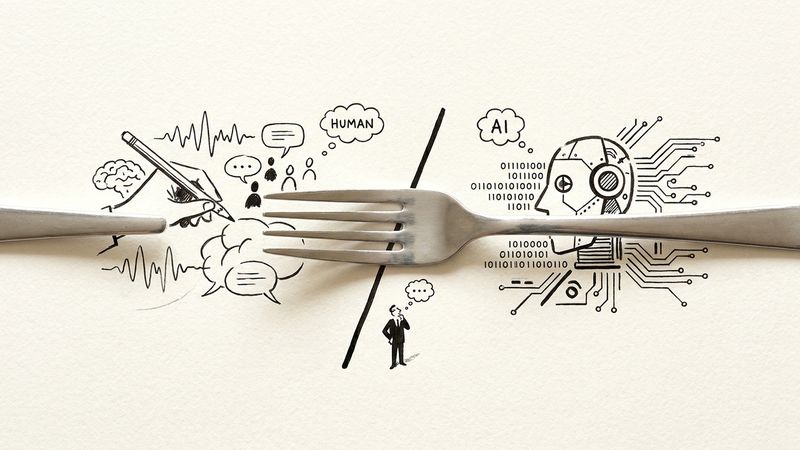
This is where the content divide stops being an abstract market trend and starts being a workforce reality. The middle tier of content creation is getting hollowed out. Clients who used to pay $500 for a blog post are now paying $50 for an AI draft and $100 for a human to clean it up. The math doesn't work for the freelancer. The quality doesn't work for the client. But the budget line item looks better in the quarterly review, so here we are.
I've seen this movie before. It's the same pattern that hit stock photography, then graphic design templates, then basic video editing. The commodity layer gets automated. The premium layer survives. The middle gets crushed.
The Signal in the Noise
Read these three stories together and the argument writes itself.
AI content has claimed half the web. That content, by its nature, is rooted in no particular experience by no particular person. The humans who used to create the middle tier are being squeezed out. And the systems designed to surface quality content are actively hunting for the thing AI cannot produce: evidence of genuine expertise and specific experience.
If you're a CMO or marketing leader, this is your strategic question for 2026: Are you building a content operation that competes in the commodity half, or the differentiated half?
The commodity play is tempting. Lower costs, faster output, easier to scale. But you're competing against everyone else who made the same calculation, and you're betting that search engines and audiences won't get better at detecting the splendidly null. That's a bet against the direction of travel.
The differentiated play is harder. It requires actual expertise, specific experience, and the willingness to let humans do the slow work of figuring out what they actually think. It costs more. It scales worse. But it's the only play that builds compounding value over time.
The Question Nobody Wants to Answer
Here's what I keep asking marketing leaders: When you read your own company's content, can you tell who wrote it? Not the byline. The voice. The perspective. The specific experience that shaped the argument.
If you can't, neither can your audience. And neither can the algorithm.
The content divide isn't about AI versus human. It's about whether your content carries the signal of genuine thought or just the appearance of it. Nathan's students learned that the value of writing lies not only in the object produced but in the transformation that occurs during its making.
Marketing content works the same way. The brands that will win the next five years are the ones whose content reflects actual transformation: real problems solved, real expertise earned, real perspectives developed through the struggle of figuring things out.
The other half of the web is already taken. The question is whether you're building something worth reading, or just adding to the pile.


