
Your paid search dashboard says CTR dropped 40% last quarter. The CFO wants to know why cost per acquisition climbed while spend stayed flat. You pull the usual levers: adjust bids, tighten targeting, refresh creative. Nothing moves. The problem isn't your campaign structure. The problem is that your dashboard is missing half the picture.
AI Overviews now appear on roughly 48% of tracked queries, up from 30% a year ago. When they appear, paid CTR crashes: Seer Interactive's September 2025 study found paid CTR dropped from 19.7% to 6.34% on queries with AI Overviews present. That's a 68% decline. Organic CTR fell 61% on the same queries. The math is brutal, but it's also incomplete without understanding where your brand sits in those AI-generated answers.
The Attribution Gap Your CFO Doesn't Know Exists
Traditional PPC reporting assumes a linear path: impression, click, conversion. AI search breaks that model. Adobe's research on AI search behavior identifies a growing attribution gap where buyers form preferences inside AI-generated answers before they ever reach your landing page. Your CRM captures the conversion, but the influence happened upstream in a channel you're not measuring.
The scale of this blind spot is significant. Dreamdata's 2026 benchmarks show the average B2B buyer journey now spans 272 days and 88 touchpoints, with 81% of that journey happening before a lead enters the sales pipeline. Most attribution windows capture 30 or 90 days. The math doesn't work.
Here's what makes this operationally relevant: brands cited in AI Overviews earn 35% more organic clicks and 91% more paid clicks than brands that aren't cited. Citation isn't just a visibility metric. It's a multiplier on your paid performance.
What AI Visibility Actually Measures
The IAB released standardized guidelines this month for AI visibility measurement, identifying four dimensions: presence (are you mentioned?), prominence (where in the answer?), portrayal (how are you described?), and persuasion (does the mention drive action?). The framework exists because the IAB found more than 20 vendors offering AI visibility tools with little consistency between methodologies.
For PPC operators, the practical question is simpler: when someone searches a query you're bidding on, does the AI Overview mention your brand, your competitor, or neither? That context changes how you interpret every metric in your paid dashboard.
Consider a query where you're bidding $8 per click and seeing 4% CTR. If the AI Overview cites your competitor as the category leader, that 4% CTR might actually be strong performance given the headwind. If the AI Overview cites you, that same 4% CTR suggests creative or landing page problems. Same data, different diagnosis, different action.
The Forecast Implications
Gartner predicted traditional search engine volume would drop 25% by 2026 as AI chatbots absorbed query share. The traffic data from publishers and enterprise sites suggests that prediction was conservative for certain verticals. B2B technology queries now trigger AI Overviews 82% of the time. Healthcare queries: 88%.
This creates a forecasting problem. If you're modeling next quarter's pipeline based on historical paid search conversion rates, you're extrapolating from a world that no longer exists. The queries that used to convert at 3% might now convert at 1.5% because the AI Overview is answering the question before the click happens.
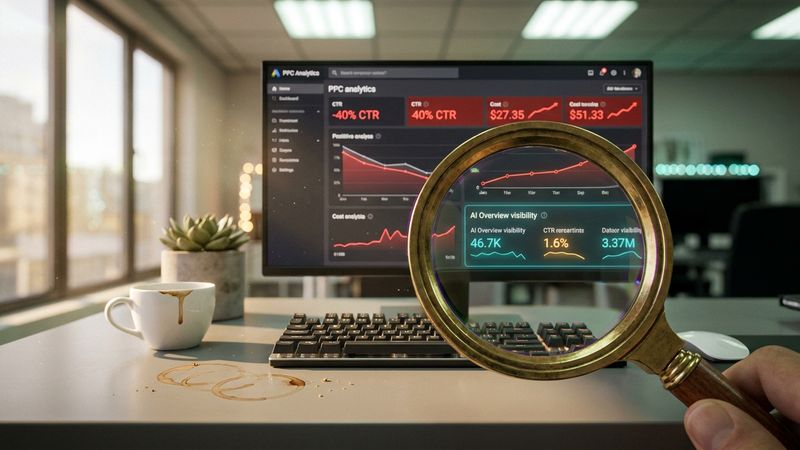
The fix isn't to abandon paid search. It's to layer AI visibility data into your performance model. Track which of your target queries trigger AI Overviews. Monitor whether you're cited. Segment your conversion rates by AI Overview presence. Build the sensitivity table your CFO needs to understand why CAC payback is shifting.
The Operational Playbook
Start with a query audit. Pull your top 100 converting keywords and manually check AI Overview presence and citation status. This takes an afternoon. The output is a segmentation that explains variance your dashboard can't.
Next, instrument the gap. AI referral traffic is fragmenting: ChatGPT's share of B2B AI referrals dropped from 89% to 63% over eight months, with Claude, Gemini, and Perplexity absorbing the difference. Your GA4 setup probably isn't capturing this cleanly. Fix the tracking before you try to optimize.
Then adjust your bid strategy. Queries where you're cited in AI Overviews deserve different treatment than queries where you're not. The former are working with a tailwind; the latter are fighting a headwind. Bid accordingly.
Finally, update your board narrative. The story isn't "paid search is broken." The story is "the search landscape restructured, we've instrumented the new variables, and here's how we're adapting." That's a CFO-safe message because it shows you understand the model, not just the symptoms.
The Uncomfortable Math
Ahrefs found that position-one CTR drops 58% when an AI Overview appears, up from 34.5% a year earlier. The trend line isn't stabilizing. Semrush projects AI/LLM search traffic will reach 48% of total search by 2027 and 75% by 2028.
If your paid search strategy doesn't account for AI visibility, you're optimizing a shrinking slice of the pie while ignoring the slice that's growing. The CFO will eventually ask why acquisition costs keep climbing despite stable spend. The answer is that the denominator changed. Clicks are worth less when the answer happens before the click.
AI visibility isn't a replacement for PPC. It's the context that makes PPC performance legible. Without it, you're reading half the spreadsheet and wondering why the numbers don't add up.


