
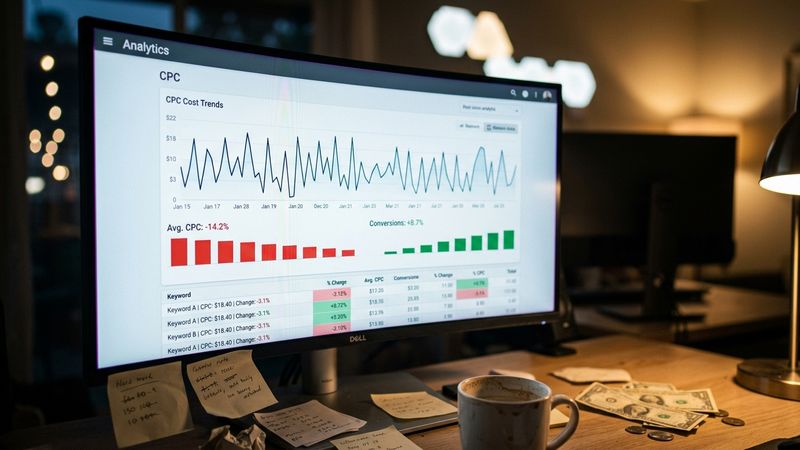
CPCs ranging from $3 to $22 across advertisers on the same platform, with no published benchmarks to explain the spread. That's not a pricing model; that's a forecasting nightmare.
Six months into ChatGPT Ads, we have real spend data, real conversion numbers, and real confusion. Search Engine Journal's latest analysis captures the core problem: advertisers can measure their own campaigns, but they have almost no context for deciding whether those numbers are good, bad, or somewhere in between. OpenAI hasn't published performance benchmarks across industries, campaign types, or advertiser cohorts. There's no Auction Insights equivalent. No Impression Share reporting. No competitive visibility into why one advertiser pays four times what another does for ostensibly similar placements.
For anyone who has to defend a channel allocation in a pipeline review, this is the kind of opacity that makes CFOs reach for the red pen.
The Measurement Stack Exists, But Context Doesn't
Let's be clear about what ChatGPT Ads Manager actually provides. The basics are there: impressions, clicks, spend, CTR, average CPC, CPM, and conversions. You can track purchases, leads, and sign-ups through the OpenAI Pixel and Conversions API. Ecommerce advertisers can see attributed sales and ROAS when the data is available. You can export to CSV and run your own analysis.
That's table stakes. The problem isn't measurement mechanics; it's interpretation.
When your CPC comes in at $13 and a peer reports $3, what do you do with that information? Without auction-level reporting, you can't tell whether the gap reflects targeting differences, creative quality, category competition, or something structural in how OpenAI's relevance-weighted second-price auction actually works. You're left running sensitivity analyses against your own historical data, which tells you whether you're improving but not whether you're competitive.
GrowByData's June tracking found that 9.2% of monitored ChatGPT prompts returned a sponsored ad. That's not a majority of conversations, but it's not negligible either. It's a real, measurable share of commercial intent that most performance marketing teams currently have zero visibility into from their existing ad intelligence tools. The placements live inside chat responses, invisible to systems built to watch a traditional search results page.
The Audience Math Is Lopsided
Before you model CAC payback on this channel, understand who actually sees the ads. OpenAI's own documentation confirms that ads appear only on Free and Go subscription tiers. Plus, Pro, Business, Enterprise, and Education users don't see them.
Explore Digital's analysis estimates roughly 109 million free U.S. users and 6 million paid users, based on EMARKETER's forecast of 115 million U.S. ChatGPT users and OpenAI's reported 95% free-tier global split. That's a large addressable audience, but it skews heavily toward users who haven't converted to paid plans. For B2B advertisers targeting enterprise buyers, the question is whether your ICP is actually in that pool or whether they're on Plus/Pro accounts that never see your creative.
Academic research from Lurie et al. adds another wrinkle: lower-income accounts, regardless of race, are more likely to receive ads. If your product sells to budget-constrained buyers, that's potentially useful. If you're selling six-figure enterprise software, you're paying for impressions that may never reach a decision-maker.
What "Good" Would Actually Look Like
Here's what a board-ready ChatGPT Ads evaluation would require, and what we don't have:
Industry-specific CPC and CPM benchmarks. Google Ads has two decades of published data. Meta provides advertiser benchmarks by vertical. OpenAI has published nothing. You can't model efficient spend without knowing what efficient looks like in your category.
Auction transparency. The relevance-weighted second-price auction sounds familiar, but without Impression Share or competitive reporting, you can't diagnose why your costs are high. Is it creative relevance? Targeting overlap? Category saturation? You're guessing.
Intent-stage mapping. Early hypotheses suggest ChatGPT users engage in longer, more exploratory conversations than traditional search users. That's potentially valuable for consideration-stage influence, but we don't have data on where in the funnel these impressions actually land or how they correlate with downstream conversion.
Cross-channel attribution clarity. If a prospect sees your ChatGPT ad, then searches your brand on Google, then converts through a retargeting campaign, who gets credit? The current measurement stack doesn't answer this, and most MMM models haven't been calibrated to include ChatGPT as a channel.
The Pilot Framework for Right Now
Given the constraints, here's how I'd structure a ChatGPT Ads test that Finance can actually evaluate:
Assumption 1: Your ICP overlaps meaningfully with the Free/Go user base. If you're selling to enterprise IT buyers, validate this before spending. If you're selling to SMB owners or individual contributors, the overlap is more plausible.
Assumption 2: You can isolate the channel cleanly enough to measure incremental lift. That means geographic holdouts, time-based holdouts, or brand search lift studies. Don't rely on last-click attribution in a channel this new.
Assumption 3: You're willing to treat the first 90 days as a learning investment, not a performance benchmark. Your goal is to establish your own baseline, not to hit a target that doesn't exist yet.
Pilot structure: Cap spend at a level where a total loss wouldn't damage the quarter. Run for 8 to 12 weeks. Measure CPC, CPL, and cost per qualified opportunity against your existing paid search and paid social benchmarks. Track brand search lift as a secondary signal. Document everything, because you're building the benchmark OpenAI hasn't published.
Risk mitigation: Set a CPC ceiling based on your blended paid search CPC plus a 30% premium for channel novelty. If costs exceed that ceiling consistently, pause and reassess. Don't chase volume in an auction you can't see.
The Uncomfortable Truth
Ben Thompson's observation that advertising is always the consumer business model is correct, and it explains why OpenAI is building this. But "big business opportunity for OpenAI" and "efficient channel for your pipeline" are different claims.
Six months in, ChatGPT Ads is a channel with real scale, real spend, and real uncertainty. The advertisers who will win here are the ones building their own benchmarks while everyone else waits for OpenAI to publish theirs. That's not a comfortable position, but it's the only honest one.
Model the assumptions. Run the holdouts. Document the learning. And don't let anyone tell you a $22 CPC is "good" or "bad" until you can prove what it actually produced.


