
Somewhere between the third quarter of 2025 and now, a strange thing happened in B2B marketing: Connected TV stopped being the channel you tested with leftover budget and became the channel your CFO actually asks about.
The numbers tell the story. According to Demandbase's 2026 playbook, 73% of B2B organizations have moved beyond CTV experimentation and integrated it into their core performance marketing stacks. Only 4% say they have no plans to use it at all. That's not a trend. That's a migration.
But here's what makes this interesting: B2B marketers aren't just buying streaming inventory because their audiences shifted there (though they did, spending over two hours daily on CTV content). They're buying it because the old playbook is showing cracks. Google Search dominance has dipped below 90%. Social advertising has become crowded, expensive, and increasingly distrusted. Cookie deprecation keeps narrowing the window for targeted display.
The question every B2B marketing leader is asking: can CTV actually perform like search and social, or is it just expensive brand awareness with better production values?
The Performance Pivot
For years, CTV measurement was the industry's polite fiction. You'd run a campaign, watch completion rates, and hope something good happened downstream. That's changing fast.
EMARKETER forecasts CTV advertising spend will hit $37.95 billion in 2026, a 15% jump that puts it on track to overtake traditional TV by 2028. But the real shift isn't in spend; it's in accountability. As Emodo's Alistair Goodman recently argued, CTV is entering what he calls its "Outcomes Era." Buyers are asking a simple question: "Will this perform as well as Search and Social?"
Meeting that standard requires systems built for performance: AI-optimized creative, predictive audiences, transparent measurement, and continuous feedback loops tied to business impact. Completion rates and household reach won't cut it anymore. CFOs don't ask about completion rates. They want to know if the spend moved pipeline.
Retargeting Changes Everything
The breakthrough for B2B isn't prospecting on CTV. It's retargeting.
According to Exit Five's analysis, every B2B company should be retargeting their audience on CTV, including LinkedIn and website visitors. The math works once you hit roughly 10,000 unique monthly visitors. And here's the kicker: as little as $50 per day can bring results.
Think about what that means. Your prospect visits your pricing page on Tuesday. By Thursday evening, they're watching a documentary on Tubi, and your 30-second spot appears. No skip button. Full attention. Premium environment. That's not spray-and-pray brand awareness. That's surgical reinforcement at a moment when their guard is down and their attention is high.
MarketingProfs reports that B2B purchases require seven to ten meaningful touchpoints spread across months, and companies that nail lead nurturing generate 50% more sales-ready leads. CTV retargeting adds a high-impact touchpoint that display advertising simply cannot match. You get 15 or 30 unskippable seconds on the largest screen in your prospect's household, with full performance tracking through metrics like site visits, form conversions, and pipeline impact.
The LinkedIn Connection
LinkedIn's entry into CTV has been a quiet game-changer for B2B. LinkedIn's CTV Ads let you reach the same professional audiences you target in the feed, but on streaming platforms like Disney+, Hulu, Roku, and ESPN.
The early data is compelling. LinkedIn's internal research shows a decrease in cost-per-lead for audiences first reached by CTV ads, and Carnegie's testing found lead form completion rates increased by 47% for users who were also exposed to LinkedIn CTV ads compared to those who weren't.
The targeting precision matters here. You're not buying a time slot and hoping your audience is watching. You're targeting by job title, industry, company size, and seniority, then serving ads on premium streaming content. The CFO watching Bloomberg. The VP of IT streaming industry documentaries. The marketing director catching up on YouTube TV. They're all reachable through the same connected environments once reserved for B2C campaigns.
Measurement That Actually Works
The dirty secret of CTV measurement has always been view-through attribution. It credits a conversion to TV if a viewer was exposed to your ad and later converted, regardless of whether TV caused the conversion. If someone sees your streaming ad on Tuesday and buys on Thursday because they got a promotional email, view-through attribution credits TV. That's not measurement. That's wishful thinking.
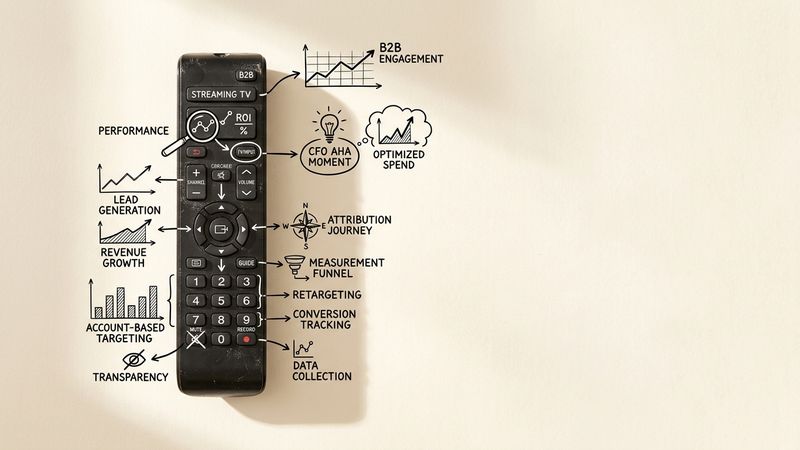
Vibe's 2026 measurement guide makes the case for holdout-based incrementality testing: randomly splitting your target audience into an exposed group that sees your ads and a control group that doesn't, then comparing conversion rates. The difference is what TV actually caused.
This is achievable at any budget for CTV. For linear TV, it requires third-party brand lift studies or geo-matched market tests. The metrics that matter: incrementality lift percentage, cost per incremental conversion, completion rate, and reach/frequency against your target audience.
Monks' case study with Paycor shows what this looks like in practice. The B2B SaaS company ran systematic CTV tests with incrementality measurement and saw a 10x increase in MQLs in test DMAs versus control markets, plus 70% more site sessions versus controls. That's not brand awareness. That's pipeline.
The Creative Question
Here's where most B2B marketers stumble. They treat CTV creative like a miniature webinar or a stretched LinkedIn ad. Both approaches miss the point.
CTV is a storytelling medium. You have 15 or 30 uninterrupted seconds to make an impression on someone who's relaxed, paying attention, and not actively trying to skip past you. That's a different creative challenge than a six-second bumper ad or a static display banner.
Tatari's best-performing spot is just their CEO, Philippe, looking straight at the camera, explaining why the company exists. No fancy production. No elaborate animation. Just a human being telling a story. Their other top-performing format: mashups featuring multiple customers talking about the same thing, similar successes, results, and wins. When a few people reinforce each other's message, it becomes more believable.
If you're already recording customer feedback via video calls, you're halfway there. You don't need a full film crew to make this work.
The Integration Play
CTV doesn't replace your existing channels. It amplifies them.
Demandbase's targeting strategies guide outlines how first-party data targeting becomes the foundation of high-performing CTV strategy. You use data you already own, from CRM records, website visitors, event registrants, email subscribers, or past customers, to deliver ads to your most relevant audiences across connected TV platforms.
The applications are broader than most marketers realize:
- Account-based targeting to reach buying committees within key accounts
- Lead nurturing for prospects who've downloaded resources or visited pricing pages
- Customer retention campaigns announcing updates or renewals
- Upsell and expansion based on product usage signals
- Event promotion to drive webinar attendance
- Churn prevention for disengaged customers
Each of these use cases connects CTV to outcomes your CFO actually cares about.
What Comes Next
The B2B marketers winning with CTV in 2026 aren't treating it as a separate line item or experimental budget. They're treating it as the connective tissue between brand and demand, the high-attention touchpoint that makes everything else work harder.
StackAdapt's research shows that marketers on average reallocated 36% of linear TV ad spend to CTV in 2025. That reallocation is accelerating. Nearly half of advertisers now expect CTV inventory to be biddable, reflecting the rapid shift toward programmatic activation.
The question isn't whether CTV belongs in your B2B marketing mix. The question is whether you're measuring it like a performance channel or still treating it like a brand awareness experiment. The CFO knows the difference. So should you.


