
The most qualified buyers your pipeline has ever seen are arriving at your website right now. They've already compared you to three competitors, understand your category, and know exactly what problem they're solving. They haven't filled out a single form, attended a webinar, or downloaded your white paper.
They've been talking to ChatGPT instead.
And your funnel, that beautiful, meticulously optimized funnel you've spent years building? It has absolutely no idea what to do with them.
The Number That Should Keep You Up Tonight
Here's the stat that made me put down my coffee this morning: according to data from The Pedowitz Group, LLM-sourced traffic converts at 4.4 to 4.5 times the rate of any other traffic source. These visitors spend three to three and a half minutes on page, not browsing, but confirming what they've already decided.
That's not a marginal improvement. That's a different species of buyer.
Seer Interactive's analysis of nearly 11,000 AI search sessions found ChatGPT traffic converting at 15.9% compared to 1.76% for Google organic. That's a 9x multiplier. Even Gemini, the lowest-performing AI source in their study, beat Google by 70%.
The mechanism is straightforward: LLM users don't browse. They ask a specific question, receive a synthesized answer with recommendations, and click through only when they've already decided to evaluate. By the time they reach your site, the awareness and consideration phases are done. They're in decision mode.
Yet this channel represents just over 1% of total website traffic for most companies. Small volume. Disproportionate value. And most marketing teams are treating it like cold traffic from a banner ad.
Your Funnel Was Built for a Buyer Who No Longer Exists
Jeff Pedowitz, President and CEO of The Pedowitz Group, put it bluntly at a recent CMO Huddles Strategy Lab:
The funnel has nothing to do with our customers. It's an artificial construct that we use so that we can have something predictable to run our business.
Jeff Pedowitz
This isn't an argument against forecasting. It's an observation about what the funnel actually optimizes for. The stages, the handoffs, the qualification criteria, the nurture tracks: they're all designed around the company's need to predict revenue, not around how a buyer actually experiences research and purchase.
Buyers have always found this mildly annoying. They don't think of themselves as MQLs. They don't experience a handoff from marketing to sales as a milestone. They don't want to repeat their story to five different people.
AI isn't creating this problem. It's accelerating a dynamic that's been building for 15 years. The buyer was already 80 to 90 percent through their journey before wanting to talk to sales. AI is pushing that number higher, compressing the visible part of the research process further, and making the invisible part larger and more consequential.
The Mismatch That's Killing Your Conversion Rate
Most B2B landing pages are designed for a visitor who needs convincing. LLM-referred visitors need confirmation. That distinction is the entire problem.
Christian Lehman's analysis across multiple B2B verticals reveals a consistent failure mode: the visitor arrives pre-qualified, lands on a page built for someone who's never heard of the brand, and hits a gated content wall or a six-field form before they can take the action they came to take.
Think about what that looks like in practice. Someone asks Claude, "What's the best revenue operations platform for mid-market SaaS companies?" Claude gives them a synthesized answer, compares three options, and recommends yours. They click through, ready to book a demo.
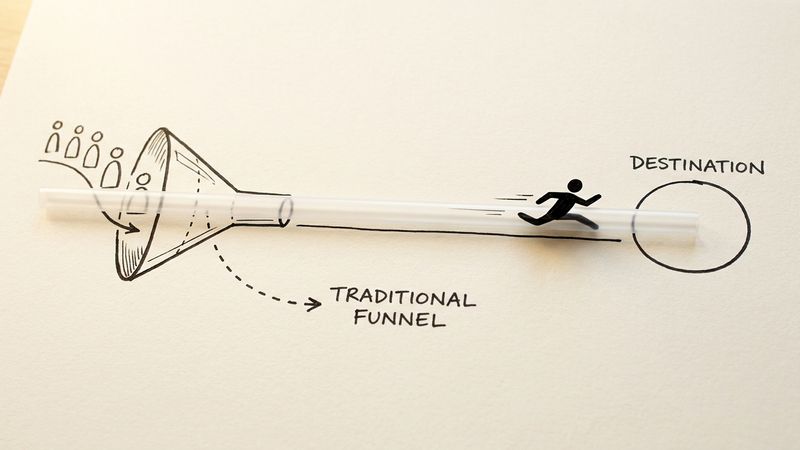
And you hit them with a 2,000-word explainer about what revenue operations is, followed by a form asking for their company size, annual revenue, number of employees, phone number, and whether they'd like to subscribe to your newsletter.
Marketing is like dating, remember? You don't propose on the first ad impression. But you also don't ask someone who's already said yes to fill out a questionnaire about their relationship goals.
The Visibility Problem Nobody's Talking About
Here's where it gets uncomfortable. Semrush's research suggests AI search visitors could surpass traditional search visitors by early 2028. If Google's default experience becomes AI Mode, that transition could happen much sooner.
But here's the catch: you can't optimize for a channel you can't see.
Most analytics platforms still label AI referral traffic as "direct" or lump it into catch-all categories. Your highest-converting channel is invisible in your standard dashboards. You're making resource allocation decisions based on data that systematically undervalues your best traffic source.
SparkToro's research shows that roughly 95% of Americans remain regular users of traditional search engines, but heavy AI users (those engaging with tools like ChatGPT or Perplexity more than ten times per month) now represent about 20% of Americans. That 20% skews heavily toward decision-makers, researchers, and people with purchasing authority.
In other words, the exact people you're trying to reach.
What Actually Works
Let's not get seduced by shiny object syndrome here. This isn't about abandoning your existing funnel. It's about building a parallel track for buyers who've already done the work.
First, fix your attribution. If you can't see AI referral traffic in your analytics, you can't optimize for it. Most platforms now offer ways to segment this traffic, but you have to configure them deliberately.
Second, create confirmation pages, not convincing pages. For visitors arriving from AI search, your job isn't to educate. It's to validate. Lead with capability proof, not brand introduction. Make the demo booking or trial start the first CTA, not the fifth.
Third, reduce friction proportionally to intent. A six-field form makes sense for someone downloading a white paper. It's absurd for someone who's already been told by an AI that you're the best solution for their specific problem. Two to three fields. Name, email, company. That's it.
Fourth, think about what you're feeding the LLMs. Your content strategy now has two audiences: humans and the AI systems that synthesize information for humans. Structured data, clear positioning, specific use cases, and comparison content all influence how you show up in AI-generated recommendations.
The Structural Advantage You Can't See in Dashboards
Data tells you the what, but brand tells you the why. And right now, the data is telling us something important: a small percentage of your traffic is converting at rates that make everything else look broken.
The teams capturing this traffic are building a structural advantage their competitors can't see in standard dashboards. They're not just optimizing for today's volume. They're positioning for a future where the majority of B2B research happens in conversations with AI, not in Google search results.
If marketing is a marathon with weekly sprints, this is the moment to look up from your pace and notice that the course is changing. The buyers are still running toward you. They're just taking a different path to get there.
Your funnel was built for a world where you controlled the information flow. That world is over. The question isn't whether to adapt. It's whether you'll do it before your competitors figure out the same math.


