
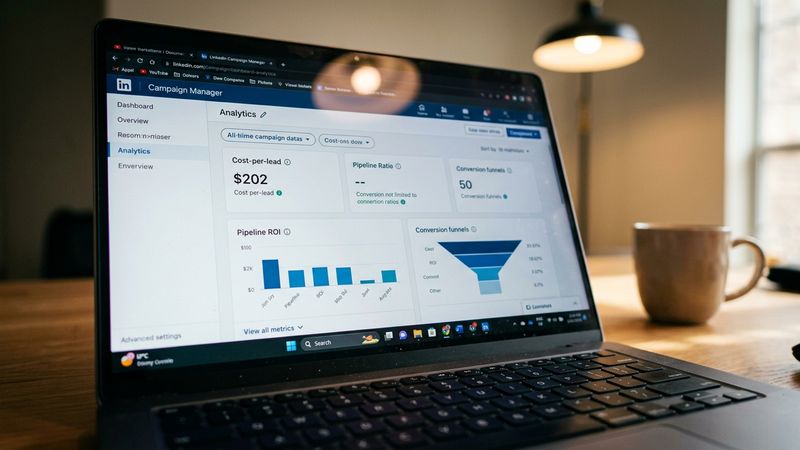
A $202 cost per lead sounds expensive until you trace it to $10.20 of sourced pipeline per dollar spent. That ratio, pulled from Metadata's 2026 B2B Paid Media Benchmark covering $57.6 million in ad spend, explains why LinkedIn now commands 41% of B2B advertising budgets, more than any single Google channel. The platform is no longer optional for enterprise GTM teams. It is the primary account-influence channel for deals that close in quarters, not days.
But the math only works if you set it up correctly. Most B2B marketers abandon LinkedIn after one campaign because they optimized for the wrong objective, ignored the economics of their deal size, and measured success with last-click attribution on a 272-day buyer journey. This guide covers what actually moves pipeline: the economic filter that determines whether LinkedIn belongs in your mix, the formats and targeting that reduce cost per company influenced, and the measurement framework that connects impressions to closed revenue.
The Economic Filter: Does Your Deal Size Justify the CPCs?
LinkedIn's auction rewards precision over volume. According to Improvado's 2026 advertising guide, expect $18 to $45 CPCs for narrow B2B targeting. A $24 click converting at 8% to sales-qualified leads costs $300 per SQL. For a $50,000 average deal size with a 15% close rate, that's $7,500 in revenue per SQL, a 25:1 return before sales costs. For a $3,000 deal, the same math produces a loss.
The viability table is straightforward. Enterprise SaaS with $50K+ lifetime value and 90-day-plus cycles: ideal, budget $8K to $15K monthly. Mid-market B2B with $15K to $50K LTV and 30 to 90-day cycles: viable with tight targeting, budget $5K to $10K. SMB or high-velocity deals under $5K LTV with sub-30-day cycles: wrong channel entirely. Facebook Lead Ads or Google Search will outperform on unit economics.
Run this filter before building a single campaign. LinkedIn's premium pricing is a feature, not a bug, but only when your customer economics can absorb it.
Targeting: Buying Groups, Not Job Titles
The average B2B deal now involves 10 stakeholders, up from 6.8 a year ago, according to Dreamdata's 2026 LinkedIn Ads Benchmarks. Targeting a single VP of Marketing and hoping they carry the deal through procurement, legal, and finance is a strategy from 2019.
LinkedIn's matched audience capabilities let you upload account lists and expand to buying groups within those accounts. Layer job function, seniority, and company size to reach the CFO, the IT security lead, and the end-user champion simultaneously. The cost per company influenced dropped 54% year-over-year, from €154 to €70, for advertisers who shifted from persona-based targeting to account-based activation.
The practical move: export your CRM's open opportunities, match them to LinkedIn company pages, and run coordinated campaigns across the buying committee. Measure account movement through pipeline stages, not individual lead volume.
Formats That Convert: Lead Gen Forms Beat Landing Pages
Metadata's benchmark data shows LinkedIn lead gen forms cost $193 per lead versus $346 for landing pages. The 44% cost reduction comes from friction removal: forms auto-populate with profile data, eliminating the drop-off that occurs when prospects land on an external page and decide the content isn't worth typing their email.
Document Ads outperform video on cost per lead. Thought Leader Ads, which amplify posts from employee profiles rather than company pages, generate 2 to 3 times higher engagement than brand-page ads according to Percuity's 2026 benchmarks. The algorithm rewards content that looks organic, and prospects trust people more than logos.
For awareness campaigns with $8K-plus monthly budgets, video still works for brand storytelling. For lead generation, make the in-feed form the default and test Document Ads against single-image Sponsored Content.
Measurement: 281 Days From Impression to Revenue
The average B2B customer journey now spans 272 days, with 81% of that journey occurring before a deal hits the sales pipeline. LinkedIn's influence is strongest closer to close: the platform drives 30.2% of sessions at the SQL stage, not just top-of-funnel awareness.
Last-click attribution misses this entirely. Dreamdata's analysis found that factoring in engagement data, views, likes, and clicks, attributes 7.7 times more revenue to LinkedIn than tracking conversions alone. The average time from first LinkedIn ad impression to revenue is 281 days.
The measurement framework that works: connect LinkedIn's Conversions API to your CRM. Advertisers using CAPI see 20% lower CPA and 31% more attributed conversions. Track cost per company influenced, not cost per lead. Report pipeline sourced per dollar to the board alongside CPL. Nearly one in five closed deals include a LinkedIn Company Page view before close, a signal that brand presence compounds over time.
The Retargeting Multiplier
Retargeting sourced 9.6 times pipeline per dollar at $196 per lead, compared to cold prospecting at $187 per lead. The cost difference is marginal; the pipeline difference is not.
Fund retargeting on pipeline per dollar, not on cost per lead. A slightly more expensive lead that closes at 3 times the rate is the better investment. Build retargeting audiences from website visitors, video viewers, and lead gen form openers. Coordinate messaging across LinkedIn, display, CTV, and BDR outreach so the account sees consistent positioning at every touchpoint.
The Two-Week Pilot
Start with a $5K to $10K test budget over 14 days. Upload your top 200 target accounts from CRM. Build a matched audience expanded to buying groups. Run Document Ads with lead gen forms against a single high-intent offer, a benchmark report, a diagnostic tool, or a consultation. Measure cost per company influenced and pipeline sourced, not impressions or CTR.
If cost per company influenced exceeds $150 and no pipeline movement occurs within 30 days, the issue is likely targeting precision or offer relevance, not the channel. Tighten the audience, test a different asset, and run again.
LinkedIn rewards consistency more than any other channel. Among top-performing advertisers, ROAS jumps to 279%. The compounding effect requires sustained presence, not one-off campaigns. Budget accordingly, measure correctly, and let the 281-day attribution window do its work.


