
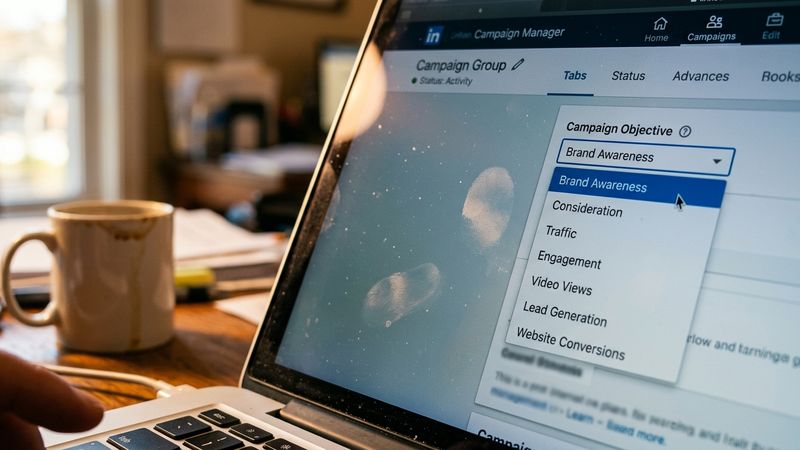
Most B2B marketers treat LinkedIn's campaign objectives like a restaurant menu. Want leads? Select Lead Generation. Need conversions? Click Website Conversions. The platform even organizes them into a tidy funnel: Awareness, Consideration, Conversions. Pick your outcome, and LinkedIn delivers.
Except that's not how it works. The objective you select doesn't just tell LinkedIn what you want. It tells the algorithm which subset of your audience to show your ads to. And that distinction is costing teams 2x to 5x more per qualified lead than necessary.
The Algorithm Needs Volume You Probably Don't Have
When you select a conversion-focused objective, you're instructing LinkedIn's machine learning system to optimize delivery using conversion events as its primary training signal. The system needs to observe enough outcomes to distinguish signal from noise, to learn which members in your audience are likely to convert and which are just scrolling.
Sagum's analysis puts the threshold at approximately 50 conversion events per week per campaign. Below that, the algorithm is starving. It can't build a reliable model of your ideal converter, so it compensates by broadening delivery to a less qualified slice of your audience. Your cost per lead climbs. Quality drops. And you conclude that LinkedIn is simply too expensive for your business.
The math is unforgiving. Say you're generating 8 leads per week at $75 each with a Lead Generation objective. You're spending $600 weekly, which sounds reasonable. But your algorithm is operating on 16% of the data it needs. LinkedIn's system is essentially guessing, and guessing at $75 per attempt gets expensive fast.
This isn't unique to LinkedIn. Meta's learning phase requires the same 50-event threshold, and advertisers there face identical economics. The difference is that LinkedIn's CPCs run 3x to 5x higher than Meta's, so the penalty for starving the algorithm is proportionally brutal.
The Objective Determines Who Sees Your Ad
Here's what the platform documentation doesn't emphasize: each objective creates a different delivery pool within your targeting criteria. When you select Website Visits, LinkedIn shows your ad to members most likely to click. When you select Lead Generation, it shows to members most likely to submit a form. When you select Engagement, it optimizes for likes, comments, and shares.
These are not the same people.
Tim Davidson's testing across multiple clients found that the Engagement objective sometimes delivers landing page clicks at $19 less than Website Visits, and sometimes at $18 more. In his last 10 tests, Website Visits won 5 times, Engagement won 3 times, and 2 were statistically tied. The variance is client-specific, audience-specific, and unpredictable without testing.
The implication is uncomfortable: you can't know in advance which objective will reach the right people at the right cost. You have to run the experiment. And most teams don't, because the objective dropdown feels like a strategic decision rather than a hypothesis to validate.
Why Website Conversions Is Usually the Wrong Choice
Davidson calls the Website Conversions objective a "trap" for most B2B advertisers. The logic is seductive: you want website conversions, so you select the objective that says it optimizes for website conversions. But LinkedIn's algorithm needs substantial conversion volume to optimize effectively, and most B2B campaigns don't generate that volume.
The result is fewer conversions than you'd get with a Website Visits objective, at a higher cost per conversion. The algorithm, lacking sufficient data, makes poor delivery decisions. You pay premium prices for an optimization layer that's actually degrading performance.
Max Herzeg, a former LinkedIn employee, is direct about this: "If you want to bring people to your website and educate them, use website visits. If you want people to sign up for a demo, use website visits." Not Website Conversions. Not Lead Generation. Website Visits with manual CPC bidding gives you cost control while the algorithm finds click-prone members in your audience.
The Sequencing Strategy Most Teams Skip
Campaign objectives shouldn't stay locked in place. They should follow a deliberate sequence based on where your algorithm is in its learning curve.
The Sagum approach starts with high-volume objectives to train the algorithm, then shifts to conversion objectives once the system has learned your audience. Run Website Visits or Engagement first. Generate 400+ clicks or 2,000+ engagements per week. The algorithm learns who your people are. Then, when you switch to conversion optimization, it already has a model to work from.
This is counterintuitive. You want leads, so you start by optimizing for something other than leads. But the alternative is paying the algorithm's tuition in the form of expensive, low-quality conversions while it figures out your audience from scratch.
Audience Expansion and Predictive Audiences Compound the Problem
Audience Expansion is enabled by default in many campaign types. It allows LinkedIn to show your ads to members outside your targeting criteria who share "similar attributes" with your target audience. The platform positions this as a reach benefit, but it also means you're ceding control over who sees your ads.
Sam Kuehnle, VP of Marketing at Loxo, warns against trusting platform-generated audiences: "Go run a campaign for a few days using a lookalike audience. Then go look at the demographics report to see who the ads have been served to. The companies of the members. Their job titles. Their locations. Now you see why this isn't a good idea."
LinkedIn discontinued lookalike audiences in February 2024 and replaced them with Predictive Audiences. The new feature uses AI to identify members likely to take actions similar to your source data. But the underlying dynamic remains: you're trusting the platform's model of "similar" rather than defining your audience explicitly.
For teams with tight ICP definitions, this is a problem. LinkedIn's algorithm optimizes for delivery and engagement, not for your specific qualification criteria. A member who looks similar to your converters by LinkedIn's metrics may not match your actual buyer profile.
The CFO-Safe Approach
If you're presenting LinkedIn performance to finance, here's the framework that survives scrutiny:
Start with assumptions. Document your expected conversion rate, your target cost per lead, and the weekly budget required to hit 50 conversions at that cost. If the math doesn't clear, you're not running a conversion campaign. You're running an awareness or consideration campaign that happens to capture some conversions.
Run the objective test. Launch parallel campaigns with identical creative and targeting, differing only in objective. Measure cost per landing page click, not just clicks (the Engagement objective counts any interaction as a click). Run for two weeks minimum before drawing conclusions.
Sequence deliberately. If your conversion volume is below threshold, start with Website Visits or Engagement to train the algorithm. Document the learning phase as an investment in future performance, not a failure to generate leads.
Disable Audience Expansion unless you're explicitly testing reach. Review demographic reports weekly to verify delivery matches your ICP. If LinkedIn is showing your ads to the wrong titles or company sizes, the objective isn't the only problem.
The uncomfortable truth is that LinkedIn's objective-based advertising system is designed around the platform's optimization capabilities, not your business goals. The objectives that sound most aligned with what you want often perform worst for B2B campaigns with limited conversion volume. The path to efficient spend runs through understanding what the algorithm needs, not just what you want it to deliver.
Model the math before you launch. Test the objective before you scale. And remember that the dropdown menu is choosing your audience whether you realize it or not.


