
Your paid search team just delivered a 47% increase in click-through rate. The CMO deck looks great. The CFO asks one question: "What happened to pipeline?" Silence.
This is the visibility problem that kills marketing credibility. You're measuring the top of the funnel in one system, middle-funnel engagement in another, and closed revenue somewhere else entirely. When the board asks why CAC payback stretched from 14 months to 19, you're reconstructing the story from fragments. Funnel analysis for PPC campaigns isn't a reporting exercise. It's the difference between defending your budget and losing it.
Where the Money Actually Leaks
Most PPC programs track impressions, clicks, and cost per click with religious precision. Then the data goes dark. A prospect clicks your ad, lands on a page, and enters a nurture sequence. Somewhere between that first touch and a signed contract, 94% of them disappear. The question isn't whether you have leakage. The question is whether you can locate it precisely enough to fix it.
According to Landingi's analysis, landing pages are where the biggest drop-offs occur in most funnels. That's not surprising. What's surprising is how few teams measure the specific friction points on those pages with the same rigor they apply to bid optimization. You're running sophisticated auction strategies to win clicks, then dumping those clicks onto pages you haven't touched in six months.
The four stages of a conversion funnel (awareness, interest, desire, action) are well documented. Bloomreach's framework maps these stages clearly, and the logic applies whether you're selling enterprise software or consumer goods. But B2B funnels have a complication: the buying committee. Your PPC campaign might generate a click from a practitioner who has no budget authority. That click looks identical in your ad platform to one from a VP with a signed purchase order in hand. Funnel analysis has to account for lead quality, not just lead volume.
The Metrics That Actually Matter to Finance
I've sat in enough pipeline reviews to know which numbers make CFOs lean forward and which make them check their phones. Four metrics reveal funnel health in terms finance understands.
Traffic volume tells you how many prospects enter the top of your paid funnel. More is better, but only if quality holds. Ten qualified leads beat a hundred unqualified ones every time, and your cost per qualified lead is the number that matters, not cost per click.
Conversion rate at each stage shows the percentage of leads moving forward. As funnel analysis practitioners note
, even a small lift here creates outsized revenue impact. Going from 2% to 3% conversion means 50% more customers from the same traffic. That's the kind of math that gets budget approved.Customer acquisition cost shows what you spend to win each customer, fully loaded. If CAC rises without corresponding increases in deal size or lifetime value, you have an efficiency problem that will eventually show up in gross margin.
Pipeline velocity measures how fast opportunities move from first touch to closed deal. Slow velocity means friction somewhere in your process. It also means your cash conversion cycle is longer than it needs to be, which is a CFO concern, not just a marketing concern.
Building the Funnel Visualization Your Team Can Act On
CXL's approach to funnel analysis starts with identifying the exact pages that serve as entry points to your funnel. For most B2B PPC campaigns, that's a landing page or product page. From there, the funnel should function like a single-line railroad: prospects can only move forward or exit. Every branch point is a measurement opportunity.
The practical challenge is stitching together data from your ad platform, your landing page tool, your marketing automation system, and your CRM. Most teams I work with have at least four systems that don't talk to each other cleanly. The result is a funnel visualization that's more fiction than fact.
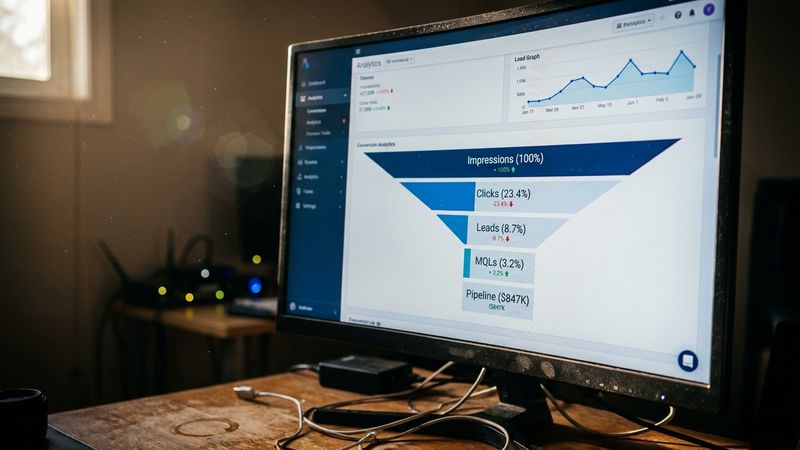
Here's what a board-ready funnel analysis actually requires:
Consistent definitions across systems. A "lead" in your ad platform should mean the same thing as a "lead" in your CRM. If your ad platform counts form fills and your CRM counts only sales-accepted leads, your conversion rates will be meaningless.
Stage-by-stage drop-off rates with dollar values attached. Knowing that 60% of leads drop off between MQL and SQL is useful. Knowing that drop-off represents $2.4M in potential pipeline is actionable.
Cohort analysis by campaign and channel. Your branded search campaigns will have different funnel dynamics than your competitor conquest campaigns. Blending them together hides the signal.
Unbounce's framework emphasizes that a well-optimized conversion funnel isn't a one-off attempt. It's a holistic approach that ties marketing and sales activities into one streamlined system. That's the right aspiration. The execution requires weekly reviews of stage-by-stage conversion rates, with clear ownership for each transition point.
The Two-Week Pilot That Proves the Model
If you're not currently running rigorous funnel analysis on your PPC campaigns, here's a pilot design that will generate board-ready data in 14 days.
Week one: Instrument your highest-spend campaign with stage-by-stage tracking. Define five stages (click, landing page engagement, form fill, sales acceptance, opportunity creation) and measure the conversion rate and average time at each transition. Calculate the dollar value of each stage based on your average deal size and historical close rates.
Week two: Identify the single largest drop-off point and run one intervention. If landing page to form fill is your biggest leak, test a single variable (headline, form length, social proof placement). Measure the lift in conversion rate and translate it to pipeline impact.
The risk is that you discover your PPC program has been generating volume without quality. That's uncomfortable, but it's better to know now than to discover it in a board meeting when someone asks why revenue didn't follow the lead growth you reported.
As Hawksearch's analysis notes, people flow through your site all the time, but how many actually become customers? Funnel analysis answers that question with precision. For PPC campaigns specifically, it answers the harder question: which dollars are generating customers, and which are generating noise?
The CMO who can answer that question in CFO language doesn't just keep their budget. They expand it.


