
The $100 Click Reality Check for Enterprise Startups
Netta Kivilis once offered $1,000 to anyone who could prove LinkedIn campaigns were working for early-stage enterprise B2B startups. The post went semi-viral. The DMs flooded in. Nobody collected.
That was a few years ago. She's updated her position, and the revision is worth modeling. Not because she's suddenly bullish on paid social for seed-stage companies, but because she's drawn a cleaner line between "this will burn your runway" and "this belongs in your channel mix." The distinction comes down to math, not marketing philosophy.
The $100 Click Problem
The core economics haven't changed. Targeting US executives on LinkedIn still runs $100+ per click for narrow enterprise audiences. At that rate, a $50,000 test budget buys you 500 clicks. If your conversion rate to qualified opportunity sits at 2%, you're looking at 10 opportunities.
If your close rate is 20%, that's two deals. If your ACV is $25,000, you've spent $50,000 to generate $50,000 in bookings, before accounting for sales costs, implementation, or the 12-month payback period your board is watching.
The math gets worse when you factor in learning time. Enterprise sales cycles run 6 to 12 months. By the time you know whether those two deals actually closed, you've either killed the budget or burned through another quarter of spend without signal. This is why Kivilis's original skepticism held: for most early-stage companies, the dataset is too small and the feedback loop is too slow to run a real experiment.
Two Conditions That Change the Calculation
Kivilis now identifies two scenarios where LinkedIn ads can work for earlier-stage companies. Both come down to whether your unit economics can absorb the cost and whether the market conditions justify the speed.
The first is budget scale. If you raised $6M and need to hit $1M ARR for your Series A, paid ads will eat your runway before you learn anything useful. But if you raised $20M, $30M, or $50M, your blended CAC can absorb LinkedIn's premium pricing, and your budget can sustain a statistically meaningful experiment.
The threshold isn't arbitrary. It's the difference between having enough capital to run a 90-day test with sufficient volume and having to shut down after 30 days because the board saw $40,000 in spend with no closed-won revenue.
The second is market timing. If your category is hot, meaning buyers are actively researching and competitors are flooding the space, you're not manufacturing demand. You're capturing it. In that environment, paid channels let you "throw money at the problem" in a way that actually accelerates growth.
The key phrase is "actively researching." If you're still educating the market on why your category exists, LinkedIn ads will underperform because you're paying premium CPCs to reach people who aren't yet looking for a solution.
The Execution Gap
Even when the conditions are right, most campaigns underperform because they're missing one of two components: experienced PPC management or strong product marketing content. Kivilis is blunt about this:
A campaign missing either half of that will underperform, and here the stakes are real: you're not producing a meh blog post; you're burning through a $500K ad budget.
The temptation in 2026 is to outsource judgment to AI agents. The better approach, according to Kivilis, is to use experts who deploy AI tools to do their jobs better, not instead of having done them in the first place.
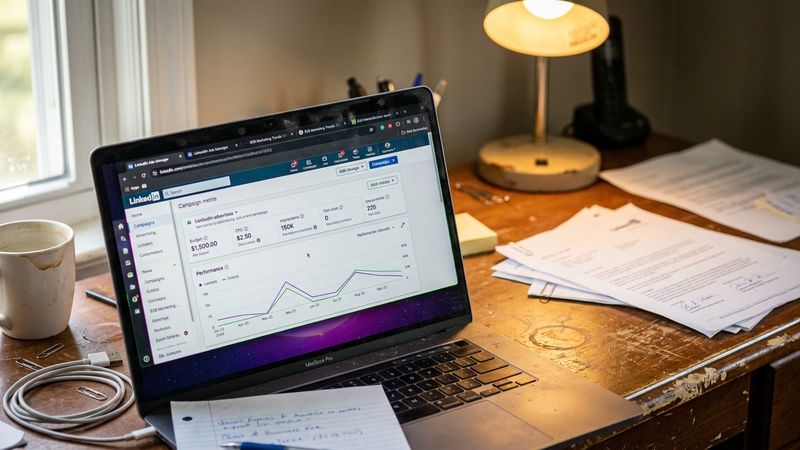
This distinction matters because LinkedIn's auction mechanics reward precision. Narrow targeting by job title and company size often lifts CTR by 20%, but it also raises CPC. The trade-off only works if your creative and landing pages convert at rates that justify the higher cost per click.
What the Benchmarks Actually Show
The 2026 data on LinkedIn performance is instructive. Average CTR for sponsored content runs 0.44% to 0.65%, with single-image ads at 0.56% outperforming video (0.44%) and carousel (0.40%). CPC ranges from $5.58 globally to $15+ for C-suite targeting.
Cost per lead varies dramatically by vertical and stage: HR Tech runs $60 to $300, Cybersecurity $80 to $400, Enterprise Software $100 to $500.
These numbers explain why B2B companies increased LinkedIn ad budgets by 31.7% between Q3 2024 and Q3 2025, while Google ad spending grew only 6%. The platform works for companies with the right economics. It just doesn't work for everyone.
The practical implication: if your LTV is under $5,000 or your sales cycle is under 30 days, LinkedIn's CPCs rarely drop below $12, and the 7-day default attribution window misses fast conversions. The math breaks when deal sizes drop below $5K or sales cycles compress under 30 days.
A Two-Week Pilot Design
For companies that meet the budget and market conditions, here's a pilot structure that generates signal without burning runway:
Start with a $15,000 to $25,000 budget over 6 to 8 weeks. Target a single ICP segment with tight job title and company size filters. Run two creative variants against a single offer, ideally something with a clear conversion event like a demo request or assessment.
Measure cost per qualified opportunity, not cost per lead. Set a kill threshold before you start: if CPO exceeds 40% of your target CAC by week 4, pause and diagnose before spending more.
The risk is that 6 to 8 weeks won't give you closed-won data for enterprise deals. The mitigation is to track leading indicators: demo show rate, opportunity creation rate, and sales feedback on lead quality. If those metrics are strong, you have enough signal to extend the test. If they're weak, you've learned something useful for $20,000 instead of $200,000.
The Unchanged Advice
For everyone who doesn't meet the two conditions, Kivilis's original guidance stands: put that money literally anywhere else. Founder-led sales, content that compounds, partnerships, events where your buyers actually show up.
LinkedIn ads aren't a bad channel. They're a channel with specific economics that reward scale and punish experimentation without sufficient budget.
The CFO-safe version: model your CAC payback at LinkedIn's actual CPCs before you spend a dollar. If the math doesn't work at $100 per click, no amount of creative optimization will save you.


