
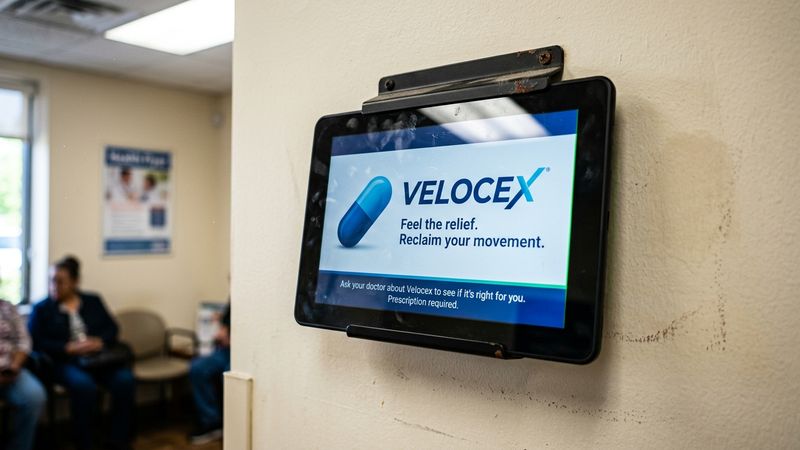
Pharma marketers spent $1.2 billion on point-of-care advertising in 2025, according to preliminary POCMA data reported by EMARKETER. That's a 171% increase since 2019. The waiting room where you fill out intake forms, the exam room where you wait for your physician, the check-in kiosk where you confirm your insurance: all of it is now media inventory.
For B2B marketers watching healthcare as a bellwether, this isn't just a pharma story. It's a case study in what happens when a channel combines captive attention, high trust, and measurable downstream action. The math is worth understanding, even if you never buy a single impression in a doctor's office.
The Economics of Captive Attention
Point-of-care advertising works because it reaches people at the exact moment health decisions crystallize. POCMA's industry report found that patients exposed to POC ads are more likely to refill prescriptions than those who saw the same message on television. One in three TV ads plays to an empty room. Nearly 40% of digital budgets miss their intended audience entirely. By contrast, a patient sitting in a cardiologist's waiting room is already thinking about their heart.
The trust differential is substantial. PatientPoint's 2025 Patient Confidence Index found that 45% of patients are more likely to trust a doctor's office that appears digitally advanced. That trust converts: 58% of patients who notice in-office ads are willing to ask their doctor about the advertised treatment, per M3 MI research cited in the same EMARKETER analysis.
This is the inverse of most digital advertising, where trust is the scarcest resource. Healthcare settings come pre-loaded with credibility. The white coat effect extends to the screens on the wall.
What the Spend Shift Reveals
The reallocation is telling. While POC spending grew 171% from 2019 to 2023, pharmaceutical advertising spend on HCP-targeted digital display and print ads dropped 22% over the same period, according to POCMA's analysis of M3 MI data. Direct-to-consumer advertising rose 26%, but the real growth story is the shift toward moments of decision rather than moments of awareness.
The channel mix logic is straightforward: why pay to reach someone scrolling through their phone at 10 PM when you can reach them in the exam room at 2 PM, right before they ask their doctor about treatment options? Fierce Pharma reported that 94% of pharma marketers now use point-of-care marketing, with 61% planning to increase spending in the next year.
The attribution story is unusually clean for healthcare. A Veeva Crossix case study cited by POCMA found that a specialty Rx brand attributed 35% of new patient starts to POC despite allocating only 14% of media spend to the channel. That's the kind of efficiency ratio that gets CFO attention.
The Infrastructure Behind the Screens
The healthcare digital signage market is projected to reach $1.1 billion by 2030, growing at 8% annually. Polaris Market Research estimates the broader healthcare digital signage ecosystem at $8.73 billion in 2026, with hospitals holding 41% of end-user share.
The screens themselves are just the visible layer. The real infrastructure is the content management systems, the programmatic buying platforms, and the measurement integrations that connect ad exposure to prescription fills. Vistar Media notes that healthcare DOOH campaigns now drive a 105% boost in purchase consideration while maintaining HIPAA compliance through one-to-many targeting that never touches protected health information.
This matters for B2B marketers because it demonstrates how a traditionally unmeasurable channel became measurable. The same pattern is playing out in retail media, connected TV, and other environments where physical presence creates targeting precision that cookies never could.
The Trust Arbitrage
Health Monitor Network's 2026 outlook frames POC as "where healthcare becomes real," the moment when questions surface and decisions crystallize. The channel works because it aligns with how clinicians practice and how patients experience care.
The behavioral data supports this framing. A POCMA and Ipsos study found that after engaging with point-of-care ads:
- 35% of patients started taking a new medication or supplement
- 26% talked to their doctor about a condition
- 23% began taking their medication as directed
These are downstream actions, not awareness metrics.
For B2B marketers in other industries, the lesson is about context matching. The doctor's office works as an ad channel because the message matches the mindset. Patients are already thinking about health. They're already in a decision-making frame. The advertising doesn't interrupt; it informs.
The Measurement Model Worth Stealing
Healthcare marketing attribution is notoriously difficult. Sales cycles run 6 to 18 months. Multiple stakeholders influence each decision. Offline conversions like phone calls and facility visits dominate the funnel. Improvado's 2026 healthcare attribution guide estimates typical attribution accuracy at 48 to 62% for patient acquisition, compared to 75 to 90% for e-commerce.
POC advertising cuts through this complexity by compressing the attribution window. The patient sees the ad, talks to the doctor, and either acts or doesn't, often within the same visit. The measurement isn't perfect, but it's far cleaner than tracking a patient who saw a TV ad six months ago and eventually asked about a treatment.
AdQuick's 2026 guide to doctor office advertising lists CPMs ranging from $15 to $65, with waiting room dwell times of 15 to 45 minutes. Compare that to digital display, where attention is measured in seconds and viewability is a constant battle.
What This Means for Your Media Mix
The doctor's office becoming an ad channel is part of a broader pattern: physical environments with captive attention and contextual relevance are being systematically monetized. Retail media networks, airport lounges, gym screens, gas station pumps. The common thread is that these environments offer something digital advertising increasingly cannot: guaranteed attention in a relevant context.
CrownTV's 2026 digital signage statistics show that 70% of US hospitals now run digital signage, with 92% of institutions reporting better communications. The infrastructure is in place. The measurement is improving. The spend is following.
For B2B marketers, the strategic question isn't whether to buy doctor's office inventory. It's whether your own channel mix includes environments where your buyers are already in a decision-making mindset. The conference floor. The industry publication. The peer community. The places where attention is earned by context, not purchased by interruption.
The doctor's office became an ad channel because someone recognized that captive attention plus high trust plus measurable action equals a media property worth building. That formula applies far beyond healthcare. The question is where you're applying it.


