
Google just handed us a year's worth of behavioral data, and it reads like a post-mortem for the keyword strategies most marketing teams finalized last summer.
According to Search Engine Journal's analysis of Google's May 2026 report "How People Are Using AI Mode in the U.S.," the average AI Mode query is now triple the length of a traditional search query. That single figure should make every CMO pause mid-sip of their morning coffee. A year ago, the working assumption for most keyword strategies was that users type three to four words, then scan results. Google's own data says that assumption now describes a minority of what AI Mode users are actually doing.
Here's the thing about digital marketing in 2026: it's a bit like being a DJ at a wedding where the guests suddenly started requesting full symphonies instead of three-minute pop songs. You've got to read the room, and the room has changed.
The User Moved. The Content Didn't.
The report covers AI Mode's first year in the U.S., from May 2025 through April 2026. The numbers paint a picture of a searcher who no longer exists in the persona most SEO teams built their strategies around.
Follow-up queries in AI Mode have grown more than 40% on average per month. Users aren't landing on one answer and leaving; they're staying in the conversation and going deeper. Multimodal interactions now account for more than one in six AI Mode searches, meaning voice, image, or video input rather than typed text. Image-input searches alone have increased more than 40% month over month since launch.
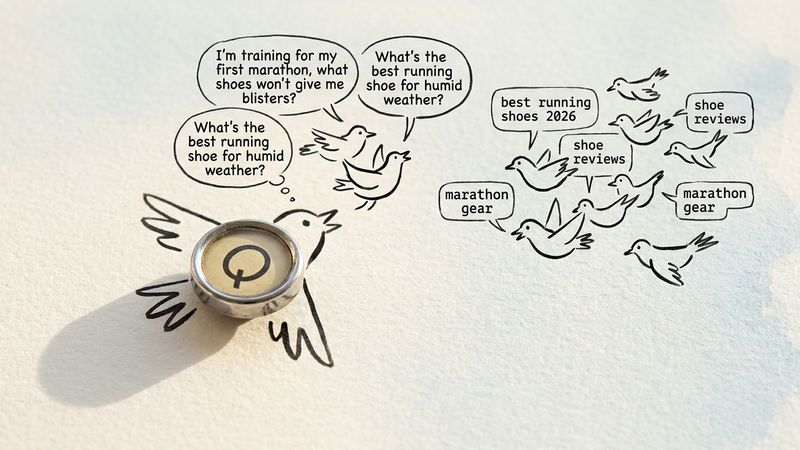
But here's the detail that should really make you rethink your content calendar: the top five opening words in AI Mode searches are "what," "how," "I," "is," and "can." Notice that third entry. "I." People are narrating personal context into the search bar. Not "running shoes for flat feet." Something closer to "I have flat feet and my knees hurt, can you help me find a running shoe that won't make it worse?"
That is not a keyword. That is a person talking to someone who might actually help them.
The Gap Between What Users Want and What Content Delivers
The report organizes AI Mode behavior into five categories: Explore, Decide, Learn, Create, and Do. Brainstorming-related queries have grown 30% faster than the overall pace of AI Mode queries. Planning queries have grown 80% faster. Queries beginning with "which" have grown 40% faster over the past six months, suggesting that AI Mode has become a genuine decision-support tool for everyday purchases.
This is the gap most content strategies have not addressed. Content built for a user who types "best running shoes 2025" and lands on a listicle does not serve a user asking, "I hate cardio. Give me a routine that avoids it but still works." That's an actual example from Google's Health and Wellness data in the report.
Google's I/O 2026 announcement confirmed the scale: AI Mode has surpassed one billion monthly users, with queries more than doubling every quarter since launch. AI Overviews now reach 2.5 billion monthly users. The company also introduced what it calls "the biggest upgrade to our Search box in over 25 years," a dynamically expanding interface designed for longer, more conversational queries.
What This Means for B2B Marketing Strategy
Let's not get seduced by the shiny object syndrome here. The underlying shift isn't about AI; it's about user behavior. AI is just the interface that finally lets people search the way they've always wanted to: by explaining their actual problem instead of guessing which three words might summon the right answer.
For B2B marketers, this creates both a challenge and an opportunity. Research from AI Growth Academy shows that 77% of B2B research now involves AI tools. Your target audience isn't just browsing Google anymore. They're having strategic conversations with AI about their procurement decisions, their vendor evaluations, their implementation challenges.
The opportunity? Data from Superlines indicates that AI traffic converts 4.4x better than traditional search traffic. When someone does click through from an AI citation, they're not browsing. They're ready to act. Lower volume, higher intent, better buyers.
The challenge? Around 93% of AI search sessions end without a website click, according to the same research. Your content needs to be good enough to be cited, not just ranked.
The New Playbook: From Keywords to Conversations
So what actually works now? Based on the data and what I'm seeing across our own campaigns, here's where the smart money is moving:
Structure for citation, not just ranking. QuickSEO's analysis of 60+ data points shows that content with statistics, citations, and quotations achieves 30-40% higher visibility in AI responses. Pages updated within two months earn 28% more citations than older content. The AI is looking for sources it can trust and quote. Give it something quotable.
Answer the question in the first 40 words. The "Golden Answer" format is becoming standard practice: a direct, concise answer immediately after your H2 heading, followed by supporting detail. AI systems are scanning for clear, authoritative statements they can synthesize into responses.
Build for follow-up questions. If your content only answers the initial query, you're missing the 40% month-over-month growth in follow-up queries. Think about the conversation your prospect is having with AI, not just the first question they ask.
Embrace multimodal inputs. With image-input searches growing 40% month over month, your visual content strategy matters more than ever. Product images, diagrams, infographics: these are now search inputs, not just page decoration.
The Metrics That Matter Now
Here's where most marketing dashboards are still stuck in 2024. We're measuring clicks and rankings when the game has shifted to citations and mentions.
Semrush's AI search trends analysis puts it bluntly: in AI-powered search, your goal is to be referenced. To have your content cited, quoted, or mentioned. Traditional metrics like ranking position and click-through rate are being supplemented (and in some cases replaced) by inclusion, visibility, and citation frequency within AI-generated summaries.
This doesn't mean traditional SEO is dead. Yellowhead's analysis of Google's May 2026 core update notes that Google explicitly confirmed SEO remains the foundation for AI search visibility. But the foundation now supports a different structure.
The Real Question for CMOs
Marketing is like dating: you don't propose on the first ad impression. But AI search is changing the courtship entirely. Your prospect might form their entire opinion of your brand through an AI conversation where your website never appears, only your content's reputation does.
The question isn't whether to adapt. The question is whether your content strategy reflects how people actually search now, or how they searched eighteen months ago.
Google's data tells us the user has moved. The content gap is real, measurable, and widening. The brands that close it first will own the AI-mediated discovery layer that's rapidly becoming the default way B2B buyers research their options.
Every CMO loves to talk ROI, but let's not forget there's also "Return on Imagination." The teams that reimagine their content for conversational, context-rich, citation-worthy discovery will find themselves in a very different competitive position than those still optimizing for three-word keyword strings.
The search box just got a lot bigger. Time to fill it with something worth citing.


