
Last week, a CMO friend showed me her company's shiny new synthetic audience tool. It could simulate 10,000 IT decision-makers in under an hour, complete with firmographics, job titles, and behavioral signals scraped from LinkedIn. She asked it how a fictional CTO named "David" would respond to a new cybersecurity pitch.
The AI delivered a perfectly reasonable answer. David would prioritize ROI, want a demo within two weeks, and need sign-off from his CFO.
"Great," I said. "But would David actually buy?"
She paused. The tool had no idea.
Here's the uncomfortable truth about synthetic audiences in 2026: they're getting remarkably good at describing buyers, and remarkably bad at predicting how those buyers actually make decisions. The gap isn't technical. It's psychological.
The Two-Thirds Problem
Scott Gillum's recent research on buyer personalities across 10,000 buyers and 15 industries uncovered something that should make every marketer rethink their synthetic persona strategy. Buyer personalities aren't randomly distributed. They cluster predictably by role and industry.
Gillum calls it the Two-Thirds Rule: within any given role and industry combination, two personality types account for at least two-thirds of the people holding that job. Data scientists in life sciences skew toward one profile. Operations leaders in airlines skew toward another. The patterns are consistent enough to be actionable.
Most synthetic personas miss this entirely. They're built from data that's easy to collect: firmographics, job history, public behavior, survey responses. That data tells you what category someone falls into. It says almost nothing about how they weigh risk, process information, or respond to your messaging.
Without personality as an input, your synthetic buyer is a cardboard cutout with a LinkedIn profile.
The Work Persona Problem
There's a second, subtler issue. When someone takes a job, they put on what Gillum calls a "work persona", a professional identity that may or may not reflect who they actually are. The CFO who's cautious and methodical in meetings might be impulsive and risk-tolerant in her actual decision-making. The VP of Engineering who seems analytical and reserved might make gut calls faster than anyone on the buying committee.
Synthetic personas trained on professional signals (LinkedIn activity, published content, meeting behavior) learn the mask, not the person underneath. They capture how buyers present themselves, not how they actually decide.
This matters because B2B purchases aren't rational spreadsheet exercises. They're emotional, political, and deeply personal. The buyer who looks like a textbook "Conscientious" type on paper might actually be a "Dominant" decision-maker who's learned to play the corporate game. Your AI doesn't know the difference.
When AI Plays a Personality, It Plays a Cartoon
Recent research comparing how LLMs simulate personality traits against actual human responses found something revealing. When researchers prompted models to "be" a high-Machiavellian, or a deep narcissist, or a profoundly humane person, the machines matched only the direction of the human pattern. Dark prompt, lower moral sensitivity. Light prompt, higher.
But they missed everything underneath. Their dark characters didn't just score low on moral norms. They scored close to zero, in a flat, absolute way that no actual human being does. The responses were rigid, extreme, and cartoonish.
Worse, the models couldn't tell dark traits apart. Machiavellianism, narcissism, psychopathy, and sadism are four distinct constructs with four distinct inner logics. The AI treated them as interchangeable.
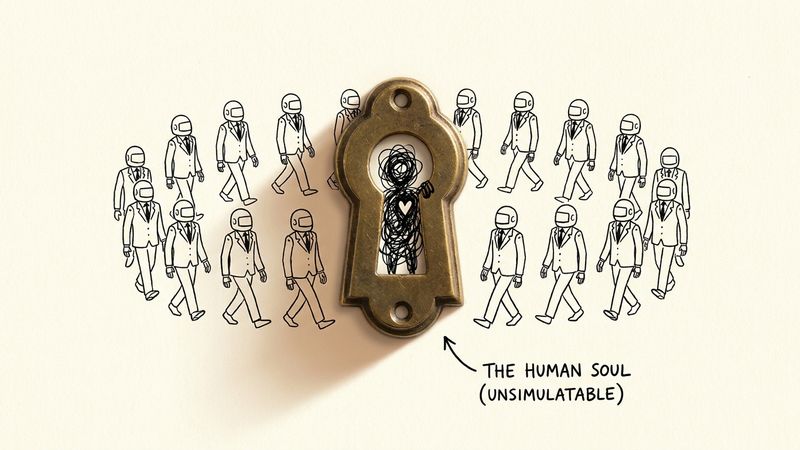
This is the synthetic audience problem in miniature. AI can simulate the surface of personality. It struggles with the texture, the contradictions, the messy humanity that actually drives buying behavior.
The DISC Gap in Your Martech Stack
If you've spent any time in B2B sales training, you've probably encountered DISC, the behavioral model that classifies people into four core styles: Dominant, Influential, Steady, and Conscientious. It's been around since the 1920s, and roughly 70% of Fortune 500 sales teams are trained on it.
The reason DISC persists isn't nostalgia. It's because buyers genuinely don't want to be sold to the same way. A Dominant CFO wants the number and the ask in 60 seconds. An Influential VP of Marketing wants a story and a relationship. A Steady operations leader wants risk reduction and a slow build. A Conscientious engineer wants a spec sheet and footnotes.
Run the same demo for all four, and you lose three of them.
Synthetic consumer platforms are getting better at demographic and behavioral simulation. Some now claim up to 90% alignment with human survey data on structured tasks like ranking and pricing. But they remain limited in modeling emotional nuance, cultural context, and the kind of personality-driven decision-making that actually closes deals.
The platforms that will win aren't the ones with the most data. They're the ones that figure out how to layer personality intelligence on top of firmographic and behavioral signals.
What Actually Works
So what do you do if you're a marketing leader trying to get value from synthetic audiences without falling into the personality trap?
First, treat synthetic audiences as hypothesis generators, not oracles. They're excellent for rapid concept testing, message iteration, and identifying directional preferences. They're terrible at predicting whether a specific buyer will actually sign the contract.
Second, layer personality data into your models. Gillum's Two-Thirds Rule gives you a starting point: if you know the role and industry, you can make educated guesses about the dominant personality types. Tools like Humantic AI and Crystal Knows are building DISC prediction into their buyer intelligence platforms, using text analysis to estimate personality before the first call.
Third, validate synthetic insights against real buyer behavior. The best synthetic audience tools are the ones that close the loop, comparing their predictions against actual conversion data and adjusting their models accordingly. If your platform can't tell you how accurate its predictions have been, you're flying blind.
Fourth, remember that personality isn't static. The same buyer might show up as a "Steady" type in a low-stakes evaluation and a "Dominant" type when the deal gets real. Context matters. Pressure changes people. Your synthetic persona doesn't know that the CFO just got chewed out by the board and is now in "prove something" mode.
The Human in the Loop
Here's my take, and I'll admit it's a bit old-school for a guy who spends half his life in martech dashboards: the best synthetic audience strategy still requires humans who actually understand buyers.
AI can simulate the what. It can tell you that IT decision-makers in mid-market manufacturing companies tend to prioritize integration over features. It can predict that your messaging will resonate better with risk-averse buyers than with early adopters.
But the why, the emotional logic that turns a qualified lead into a closed deal, still lives in the messy, contradictory, deeply human space that AI hasn't cracked yet.
The marketers who win in 2026 won't be the ones with the most sophisticated synthetic audience tools. They'll be the ones who use those tools to ask better questions, then bring human judgment to the answers.
Data tells you the what. Personality tells you the why. And right now, your AI only knows half the story.


