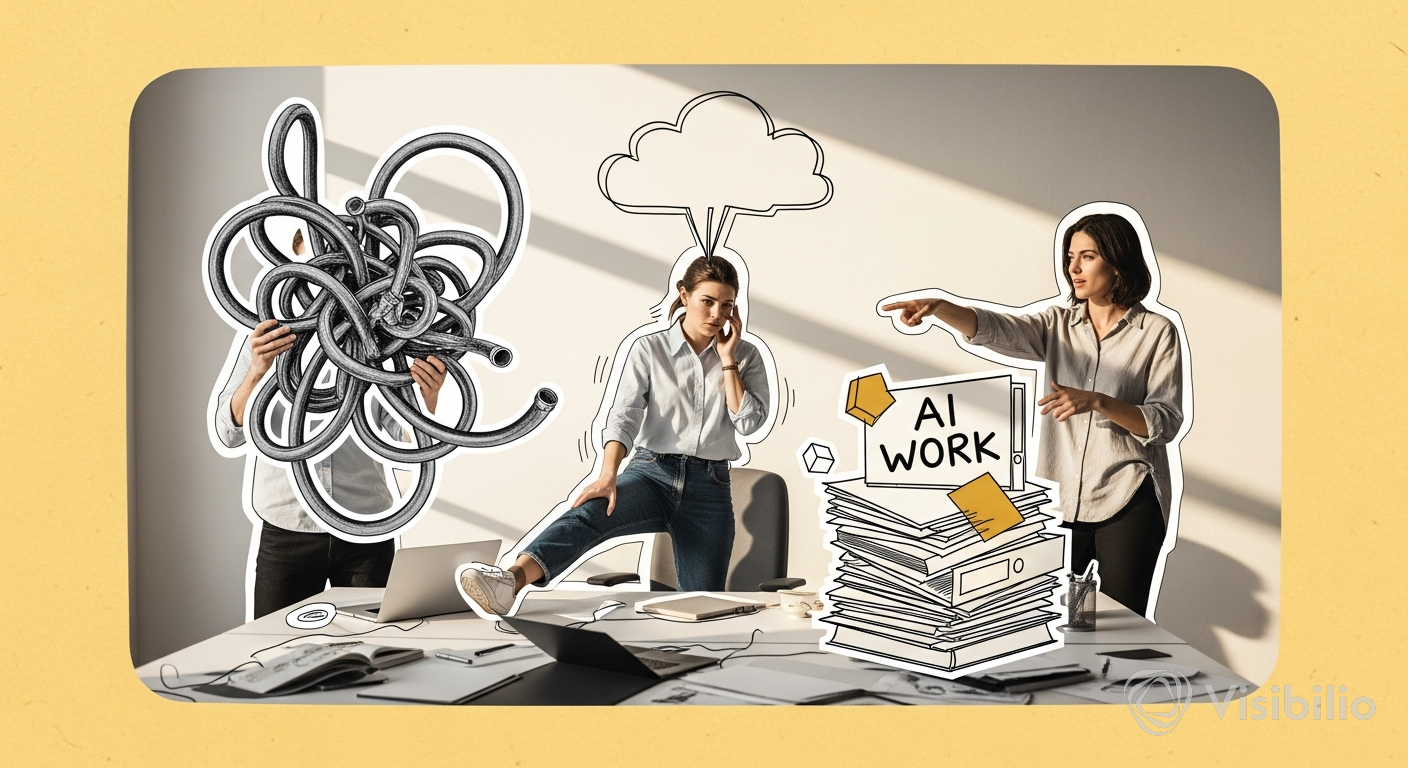
Forty percent of employees received AI-generated work in the past month that needed significant rework. Each instance cost about two hours to fix. At a 10,000-person company, BetterUp Labs and Stanford researchers estimate that cleanup bill at roughly $9 million a year. That's the cost of work that was supposed to save time.
The reflex most marketing teams reach for: better prompts. Prompt libraries. Brand voice guides. AI literacy training. Monthly office hours. Maybe the CMO writes a memo about "substance over volume." Melissa Reeve, writing in MarTech, described a mid-sized B2B SaaS marketing team that did all of this. The workslop kept coming anyway.
The individual-fix trap
Every popular recommendation right now puts the burden on the same unit: the individual. Model purposeful AI use. Develop a "pilot mindset." Set guardrails. Define handoff lines with IT and legal. None of this is wrong. All of it misses the structural failure underneath.
Only 19% of knowledge workers say they have clarity on what types of work AI should do in their role, according to Asana's State of AI at Work research. That number should stop you cold. Four out of five people on a marketing team are guessing at where AI fits into their job, and we're surprised the output is mediocre?
Expert guidance from Adobe and Skai converges on the same point: prompts work best when marketers write structured briefs (role, context, audience, channel, KPIs, constraints, success criteria) rather than generic commands. That's real. Structured prompting does improve first-draft quality. But here's the gap nobody's closing: each person on the team figures this out alone, in their own silo, on their own timeline.
Parallel R&D projects, zero knowledge transfer
Reeve nails the diagnosis. The content specialist learns in week one that the model needs a longer brief and a tighter persona. The designer learns in week two that the image tool wants brand colors in hex, not plain English. The email marketer learns in week three that subject lines come out generic unless you feed the last three that performed.
Each insight is earned. None of it travels.
The content specialist doesn't know what the designer figured out. The email marketer doesn't know what the content specialist learned. When someone leaves, the knowledge walks out with them. What looks like a prompting problem is actually a coordination-of-learning problem. And no prompt library fixes that, because a prompt library is a static artifact. Learning is a living system.
The real fix: infrastructure that carries learning between people
The shift happening in B2B AI right now is relevant. Andreessen Horowitz describes "Wave 2" AI apps that own the workflow by making AI native to the product experience rather than living in disconnected tools. Prismatic flags context management, multi-model orchestration, and token optimization as core requirements for reliable AI output. Monday's enterprise research shows governance and centralized data climbing the buying-criteria list.
All of this points the same direction for marketing ops: the system around the prompt matters more than the prompt itself. That means building connective tissue. Specifically:
- Shared learning logs, not just shared prompt libraries. A prompt library tells people what to type. A learning log tells them why it works, what failed before, and what changed. The difference is institutional memory vs. a recipe card.
- QA gates tied to pipeline outcomes. If AI-generated content goes live without a human review step that checks against audience-specific criteria, you're automating mediocrity. Define what gets automated, what requires review, and the failure mode for each.
- Context management as an ops function. Brand rules, audience definitions, messaging hierarchies, compliance constraints, and performance data need to feed into AI workflows systematically. Not pasted into a prompt by whoever remembers.
- Measurement that tracks rework, not just output volume. Time-to-usable-output is a better leading indicator than pieces-produced. If your team generates 40% more content but spends 30% more time fixing it, you've lost.
72% of marketers say AI can help them produce more personalized content. That's probably true. But personalization expectations make the context problem worse, not better. Every audience segment, every channel, every compliance constraint is another input the AI needs to get right. Without a system feeding those inputs consistently, you get personalized workslop instead of generic workslop. An upgrade nobody asked for.
When this framing is wrong
Small teams (under five people) with tight communication loops might genuinely have a prompting problem and not a systems problem. If everyone sits in the same Slack channel and shares learnings informally, the coordination issue is smaller. The systems argument scales with headcount and cross-functional complexity. For a three-person content team, a good prompt template might be the whole fix.
But most demand gen orgs reading this aren't three people. They're 10, 20, 50 people spread across content, paid, lifecycle, and RevOps, each running their own quiet experiments with AI and rarely comparing notes.
Reeve's B2B SaaS marketing leader did everything the current advice says to do. Built the library. Ran the training. Wrote the memo. The workslop persisted because the advice treats AI quality as an individual skill problem. It's a system design problem. The prompt is the last mile. The plumbing is everything before it.


