
The martech landscape hit 15,505 products in 2026, up just 0.79% from last year. After a 100x run since 2011, the number finally flatlined. Pundits are calling it "peak martech." They're missing the point.
That flat headline conceals a churn rate that should concern every CMO with a bloated stack. According to the State of Martech 2026 report, nearly 1,500 tools were added while more than 1,300 disappeared. Two-thirds of the tools that vanished came from the 2010-2020 vintage, not the flash-in-the-pan AI natives from the ChatGPT surge. The first big wave of martech is finally consolidating, and the implications for your stack architecture matter more than any AI feature announcement.
The Data Layer Ate the Stack
If AI weren't consuming every conference keynote, the most consequential shift in martech would be what's happening at the data layer. Cloud data warehouses and lakehouses from Databricks, Snowflake, and BigQuery have quietly become the gravitational center of enterprise marketing infrastructure.
Scott Brinker's research with Databricks describes this as a move from the traditional "stack" (that Tetris arrangement of platforms stitched together by integration plumbing) to a "composable canvas" where everything sits adjacent to a unified data foundation. The old architecture moved data between applications. The new architecture brings applications to where the data already lives.
This matters for CAC payback and operational velocity in ways that AI features alone cannot address. When your MAP, CRM, CDP, and web analytics speak different data languages, your AI models degrade fast. Outputs become unreliable. Prioritization breaks. False positives multiply. Stack fragmentation isn't just an IT headache; it's a pipeline performance risk.
Composable CDPs and the Death of the Black Box
The composable CDP revolution is the clearest signal of where martech architecture is heading. Traditional packaged CDPs promised a "single source of truth" but delivered what practitioners now call a "second source of truth," separate from core data strategy and incapable of supporting sophisticated predictive use cases.
The composable model flips this. Instead of ingesting data into a proprietary silo, composable CDPs activate data directly in the warehouse. Hightouch coined the term in 2022, and by 2026 nearly every vendor in the space has adopted some variation of "composable" and "zero-copy" capabilities. Databricks' launch of CustomerLake, an agentic CDP built natively on their lakehouse platform, signals that infrastructure companies are now competing directly with application-layer vendors.
For marketing leaders, this creates a strategic question that has nothing to do with AI features: where does your customer data actually live, and who controls the schema? If you're paying for the privilege of storing your own customer data in a SaaS silo when you have governed data in a cloud warehouse, you're paying twice for the same asset.
CFO Scrutiny Is Forcing the Consolidation Conversation
Heinz Marketing's analysis captures the economic pressure driving stack consolidation: "CFOs want ROI, not novelty. Teams are expected to move faster and deliver more, but without adding headcount or spend."
The growth era from 2020 through 2023 created stack sprawl because budgets were generous and GTM teams needed to move fast. Nobody stopped to ask whether the new tool overlapped with the old one. It was easier to buy than to build, easier to add than to integrate. The result for most companies today: overlapping tools, expensive tools going unused, disconnected data, and complicated workflows that only a few people closest to the tool understand.
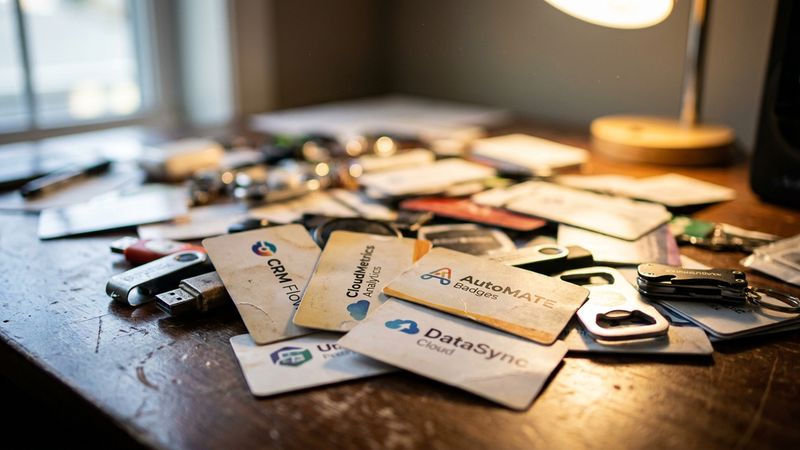
RevOps now owns more tech decisions than ever, and they're asking a reasonable question: if we're not growing headcount, why are our software costs going up? The answer usually involves a stack audit that reveals 30% of tools are redundant or underutilized.
SaaS Becomes Infrastructure, AI Becomes the Value Layer
Frans Riemersma's framing clarifies the structural shift: SaaS platforms are no longer the primary source of differentiation. They're becoming infrastructure, systems of record, workflow engines, and integration layers that provide stability and structure. The real value is moving on top of that foundation.
Where SaaS operates on rules and predefined logic, AI operates on language, context, and probability. It doesn't just execute workflows. It interprets, decides, and adapts. But here's what the AI hype cycle obscures: AI is only as good as the data foundation underneath it. If your data is fragmented across disconnected tools, your AI investments will underperform regardless of how sophisticated the models are.
This is why the data layer shift matters more than any individual AI feature. As Canto's CMO Erica Gunn noted, AI is being used not just to generate content but to solve the increasingly difficult challenges of organization, findability, and workflow acceleration. The unglamorous work of data unification enables the glamorous AI use cases.
What This Means for Your Stack Roadmap
The practical implications are straightforward. First, audit your stack for data gravity. Where does your customer data actually reside? How many copies exist across how many tools? What's the cost of keeping those copies synchronized?
Second, evaluate new tools by their data architecture, not their AI features. Ask whether the tool activates data in place or requires you to move data into another silo. Ask about zero-copy capabilities and native warehouse integrations.
Third, model the consolidation math. If you can eliminate three tools by consolidating to one platform with native warehouse connectivity, what's the impact on CAC payback? What's the reduction in integration maintenance? What's the improvement in data quality for downstream AI use cases?
The martech landscape isn't stagnating. It's being rewired around a different center of gravity. The companies that recognize this shift will build leaner stacks with better data foundations. The companies that chase AI features without fixing their data architecture will keep paying for tools that can't talk to each other.
Model or it didn't happen.


