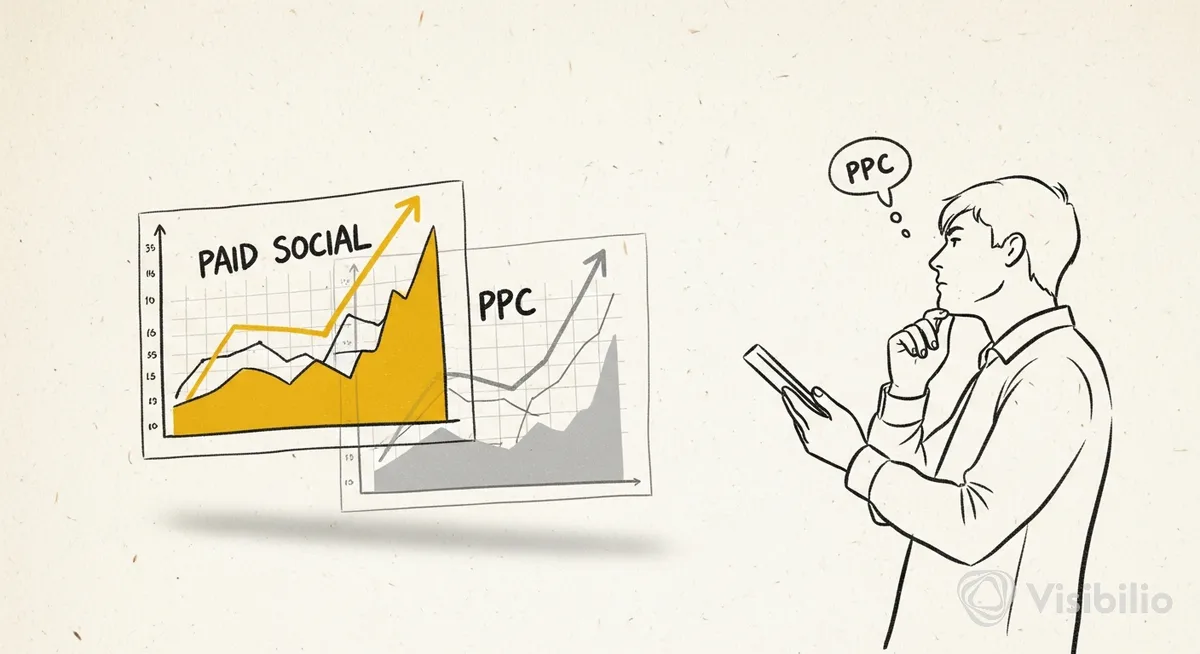
If paid social is absorbing budget while PPC still gets blamed for “high intent costs,” there’s one constraint that matters more than creative or bidding: attribution can’t prove incrementality anymore.
Apple’s iOS 14.5 opt-out tracking pushed a lot of cross-channel reporting into aggregated, modeled signals—useful for steering, weak for truth. Some teams saw CPMs triple from $6 to $18 in the post–iOS 14.5 era, a reminder that the economics moved even as the measurement got fuzzier. (Source: [1])
So the job isn’t to find a prettier multi-touch model. It’s to answer a narrower, board-safe question: did paid social create incremental lift in PPC outcomes that matter—branded demand, non-brand efficiency, and conversions—beyond what would’ve happened anyway?
The one move: run a geo split holdout to measure search lift
The cleanest way to measure paid social’s impact on PPC is a hypothesis-driven geographic split test. Increase paid social spend in test regions. Hold spend flat (or materially lower) in control regions. Then compare the change in PPC metrics between the two groups over the same window. (Source: [2])
That sounds simple. In practice, it’s one of the few methods that survives the “black box” dynamic of automated ad products and privacy-limited tracking because it doesn’t require user-level stitching to detect a signal. You’re reading the market’s behavior, not a platform’s story about the behavior. (Source: [1][6])
The hypothesis most teams are implicitly betting on is also testable: paid social exposure increases brand searches, improves non-brand CTRs, and lifts conversions in paid search campaigns. (Source: [2])
But the context matters. Social and search are now competing discovery engines. TikTok US iPhone searches increased 455% from Aug 2022 to Jan 2023, and 74% of users were cited as searching on-app in 2023 context. (Source: [3]) If social is where demand starts, PPC often becomes where demand gets harvested. The lift is real—or it isn’t. The geo test tells you which.
The hypothesis, metrics, and guardrails (make it falsifiable)
Hypothesis (falsifiable): If we increase paid social spend by X% in test geos while holding PPC settings constant, then branded search impressions/clicks and PPC conversion rate will increase in test vs control because paid social increases awareness and consideration that shows up as downstream search intent. (Source: [2])
Primary success metric: incremental lift in branded PPC demand (impressions and/or clicks) in test vs control. This is usually the first place the signal shows up when social is genuinely creating demand. (Source: [2])
Secondary metrics: change in non-brand PPC CTR and PPC conversion rate in test vs control. (Source: [2])
Guardrails: keep PPC spend, bids, match type mix, and budgets stable across geos during the test window; watch PPC CPA/ROAS so the test doesn’t blow up unit economics while you wait for lift to materialize. Directional, not definitive.
Stop-loss threshold: define one before launch. Example: if PPC CPA in test geos degrades materially versus control for a full week with no corresponding branded lift, pause the social increase and move to readout. The exact number should match your margin reality; the point is to pre-commit.
Run it this week: setup, launch, readout, next test
Here’s the 5-minute version you can run this week:
Setup (owners, tools, design)
Owner: Demand gen lead (design + readout). Support: PPC owner (freeze search variables), RevOps/analytics (geo mapping + reporting).
Tools: ad platforms (Meta/TikTok/LinkedIn as applicable), Google Ads, GA4, and first-party signal plumbing if available. Experts specifically recommend first-party integrations like Meta Conversions API tied into CRM and GA4 to improve measurement and algorithm learning under privacy constraints. (Source: [4])
Geo selection: pick geos that are large enough to show movement, and similar enough that you’re not just measuring regional quirks. One explicit callout from practitioners: account for factors like commuter patterns when designing geo tests. (Source: [2]) If your audience commutes across a city boundary, “geo” isn’t clean.
Baseline window: capture at least one to two weeks of pre-test PPC metrics by geo so you know what “normal” looks like before you touch spend.
Launch (what changes, what stays fixed)
Paid social: increase spend meaningfully in test geos; keep creative and targeting consistent across test/control so spend is the main difference. You’re measuring incrementality, not creative iteration.
PPC: hold budgets and bidding strategy steady across geos. No new brand campaign structure mid-test. No landing page overhaul. No sudden match type expansion. If search changes at the same time, the result becomes a story you can’t prove.
Messaging alignment: keep the promise consistent across channels. The research brief’s experts repeatedly emphasize full-funnel coordination: social creates awareness and demand; PPC captures high-intent; retargeting and consistent messaging connect the two. (Source: [1][2][3]) Consistency isn’t branding polish here. It’s measurement hygiene.
Readout (what to measure and what not to over-interpret)
What to measure: compare test vs control deltas for branded impressions/clicks, non-brand CTR, and PPC conversion rate. (Source: [2]) Also segment by device if possible—mobile drives over 50% of paid search clicks and has 24.6% higher CTR than desktop in 2023 context. (Source: [1]) Social exposure is often mobile-first, so the lift may show up there sooner.
What not to over-interpret: platform-reported assisted conversions as “proof.” Post-privacy, reporting accuracy is reduced and some formats operate like a black box. (Source: [1][6]) The geo delta is the anchor; attribution is supporting detail.
How long: long enough to dampen day-to-day noise but short enough to keep confounders out. Many teams start with 2–4 weeks depending on volume. If volume is low, the honest answer is: the test may be underpowered, and you’ll only get directional signal.
Next test (if you get lift, don’t waste it)
If branded lift shows up, the next move is to tighten the handoff: retarget paid social engagers with PPC-aligned offers and landing pages, then re-run a smaller geo iteration to see whether the lift translates into conversion rate, not just curiosity. There’s a directional example in the brief: retargeting from TikTok paid social to Google PPC with discounts yielded a 40% conversion increase. (Source: [2]) Treat that as a possibility, not a promise.
The trade-off (and when this is wrong)
The trade-off is speed. A geo holdout test will reduce short-term flexibility because it forces you to freeze variables and live with uncertainty for a few weeks. It can also reduce volume in control regions if you’re intentionally holding social back. That’s the price of a cleaner answer.
When this is wrong: if your spend is too small to move branded search, if your product has ultra-long cycles where demand doesn’t show up as search in-week, or if your market is so concentrated that geo splits can’t isolate exposure (commuter spillover, national buying committees). In those cases, a geo test may tell you “no signal” even when social is doing something real—you’re just not measuring at the right altitude.
Still, for 2026 measurement, this is the pragmatic line in the sand. Social ad spend keeps growing (US social network ad spend reached $82.88B in 2024, +13.5% YoY), and video is taking a bigger share, which makes top-of-funnel influence harder to see in last-click reports. (Source: [3]) The geo holdout brings the question back to something operational: did the market search more, click more, convert more—because social showed up first?


