Eric Siu shared a comparison worth sitting with: 731,000 views on one piece of content, zero leads. A different piece, 134,000 views, generated actual leads. The gap wasn't audience size. It was the absence of anything between the view and a next step. No capture offer, no CRM field write, no owner for what happens after someone watches.
That gap is the operating problem most social and webinar programs share. And it's the reason reach metrics keep climbing while pipeline contribution stays flat or unmeasurable.
Your Content Calendar Isn't a Conversion System
A publishing calendar tells you where and when an asset goes live. What it almost never specifies: what the viewer receives next, which record changes in the CRM, and who owns a qualified response. Teams optimize publishing throughput, then wonder why they can't trace a single webinar attendee to a held meeting.
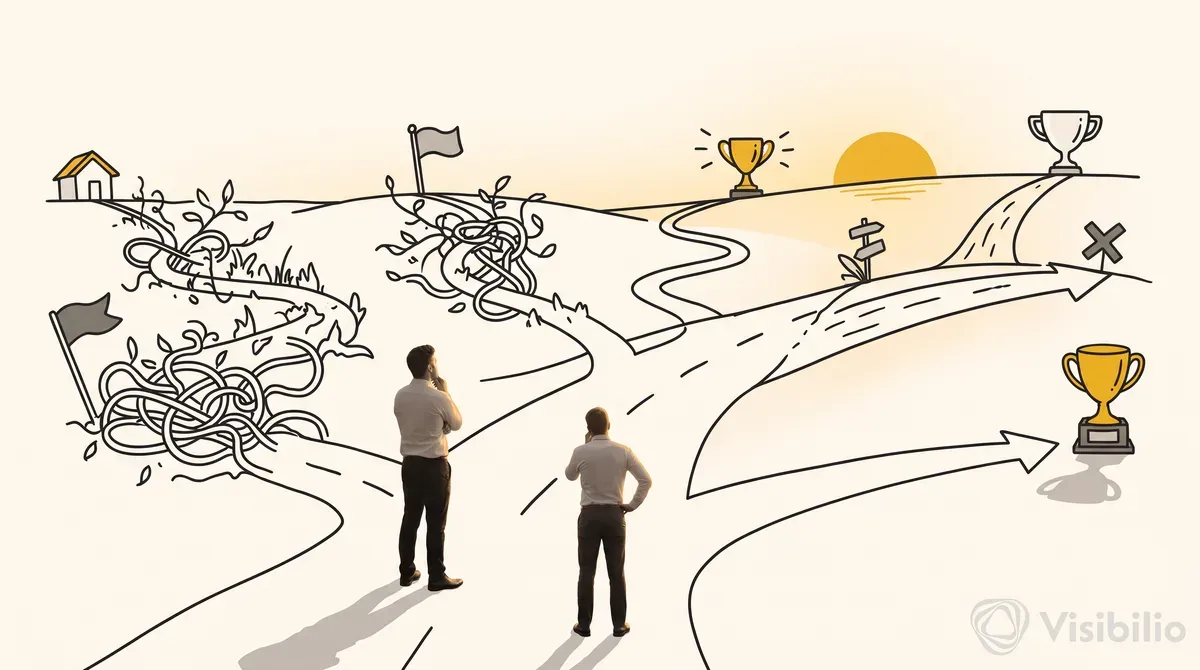
The fix isn't more content. It's designing the next step before you publish. Content and demand gen should map the path from awareness to qualified opportunity before anything goes live, so attention has a deliberate route to intent and sales conversations. In practice, most teams skip this because the calendar is full, the webinar is Thursday, and "we'll figure out follow-up after."
Separate Demand Creation from Demand Capture
Reach and impressions are leading indicators that content was seen. Pipeline is evidence that the right accounts progressed into qualified opportunities. Treating one as the other is the core mistake.
A strong program pairs demand creation (education, awareness, preference-building) with demand capture (high-intent next steps like comparisons, tools, or demos). Forcing every viewer into a sales form doesn't work. Chili Piper's own analysis found that "Book a Demo" CTAs ask for trust the buyer hasn't built yet, reducing conversion when intent isn't there. So the practical move: offer a useful subscription path before defaulting to a meeting request. An editable worksheet, a diagnostic template, a benchmark calculator. Something that earns permission and writes a CRM record with source context, without pretending every download is pipeline.
The Fields That Actually Matter
The webinar ends. Someone exports the attendee list. Marketing sends a generic follow-up. Sales gets a batch of "hot leads" with no distinction between someone who watched 40 minutes and asked an implementation question versus someone who registered and never showed.
The operator's job is to preserve three separate signals:
- Attendance describes engagement (live-only attendance runs about 33-45% of registrations, per ORRJO and Webtonic benchmarks, but vendors report this inconsistently, so track live and on-demand separately).
- Subscription captures permission and ongoing interest.
- A stated implementation question or help request creates a different next action entirely.
Combining these into one "hot lead" label destroys useful distinctions. Attach the webinar asset ID and campaign context at capture time. Record subscription status. Preserve the attendee's stated question. The revenue owner gets a meeting task only when buyer fit and expressed intent support it.
LinkedOtter's directional planning ranges: attendee-to-meeting-booked rates run roughly 1-3% for broad webinars, 3-7% for better-targeted ones, and 7-15%+ for highly targeted webinars with disciplined follow-up. Those aren't verified industry averages. They're planning assumptions. Your internal baseline matters more than any external benchmark.
Attribution Is an Ops Problem, Not a Model Debate
Social-first and content-led buyer journeys don't convert in the same session they're influenced. Click-based attribution misses the real path. Multiple sources in the 2026 attribution literature (The Starr Conspiracy, Factors.ai, ClickMinded) converge on the same recommendation: combine CRM and web analytics with self-reported attribution ("How did you hear about us?") and sales feedback. Operationalize the process rather than debating which model is theoretically superior.
The hypothesis, if you want to test this: If we add a self-reported attribution field to our post-webinar and post-demo forms, then our ability to connect social/webinar touches to opportunities will improve because click-based attribution currently misses multi-session journeys. Success = at least 60% field completion rate on the self-report. Guardrail = don't let the new field add more than 5 seconds to form completion. Stop-loss = if completion rate on the overall form drops more than 10%, remove the field and try a different placement.
Run It This Week
Pick one social asset and one webinar. For each, write down:
- The capture offer (what does the viewer get next?)
- The CRM fields written at capture (asset ID, campaign, subscription status, intent signal)
- The qualify rule (what combination of fit + intent earns a meeting task?)
- The owner (who handles the qualified handoff, and who owns exceptions?)
If you can't fill in all four columns, you don't have a conversion system. You have a publishing calendar with a hope attached.
Reuse that structure for every new asset. Keep the control layer the same. Count held meetings separately from booked meetings, and retain the originating capture record so you can actually learn which content drove pipeline and which just drove applause.
The 731,000-view piece wasn't a failure of content quality. It was a failure of architecture. The content worked exactly as designed: it got attention. Nobody designed what came after.