
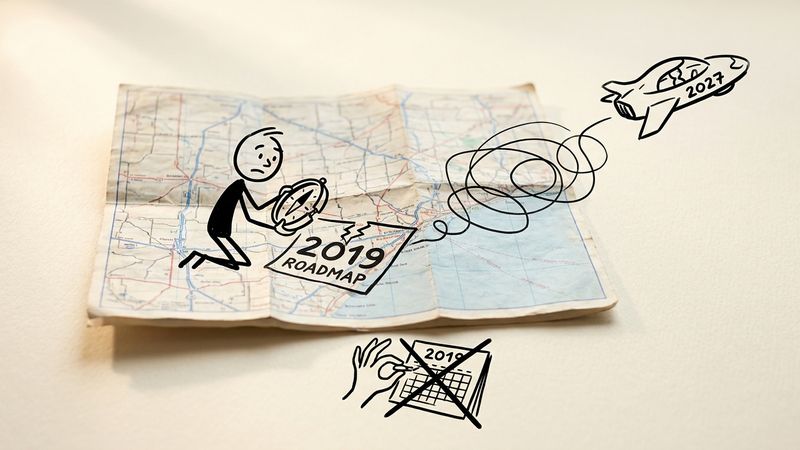
Here's a confession that might get my CMO card revoked: I've spent the last month staring at our 2027 planning framework and feeling like I'm trying to navigate with a map from 2019. The roads have moved. Some of them don't exist anymore. And yet, the planning template looks suspiciously familiar.
If you're a marketing leader right now, you're probably experiencing something similar. The good news, according to Forrester's 2027 Budget Planning Guides, is that 91% of marketers expect budget increases next year. Nearly a quarter anticipate growth of 10% or more. After a year of white-knuckle caution, the purse strings are loosening.
The bad news? More money flowing into a broken model just means you'll break it faster.
The Map and the Territory
Let me paint you a picture. For the past decade, B2B marketing operated on a set of assumptions that felt as solid as gravity. Buyers left digital breadcrumbs we could follow. Engagement signals told us who was interested. Channels were countable, manageable, optimizable. The buying journey was a thing we could observe, influence, and measure with reasonable confidence.
That world is dissolving. Mark Ogne at MarTech describes it well: buyers are harder to observe, AI is reshaping how they discover and evaluate solutions, traditional measurement signals are weakening, and buying committees keep expanding. Forrester called this shift the "B2B go-to-market singularity" at this year's B2B Summit, which sounds dramatic until you realize they're basically saying the old playbook is now kindling.
So what do most CMOs do when facing uncertainty? They do more. More AI pilots. More programs. More channels. More content. More campaigns. More activity. Each creates the appearance of progress. Each gives you something to point to in the board deck. And each can make the underlying problem harder to see.
The Optimization Trap
Here's where it gets uncomfortable. Most of us built our careers on optimization. We learned to squeeze conversion rates, improve campaign performance, maximize channel efficiency. We got really, really good at making the existing machine run faster.
The problem is that optimization assumes the system you're optimizing is the right system. When the market shifts underneath you, optimization becomes a way of preserving the wrong model with increasing precision. You're not adapting; you're just getting more efficient at yesterday.
I see this in my own organization. We have dashboards that would make a NASA engineer weep with joy. We can track micro-conversions across seventeen touchpoints. We can attribute revenue to specific campaigns with decimal-point accuracy. And yet, I'm increasingly suspicious that we're measuring the wrong things with exquisite precision.
Gartner's 2026 CMO Spend Survey found that 56% of marketing leaders say they don't have the budget to deliver their 2026 strategy. Marketing budgets are flat at 7.8% of company revenue, roughly where they've been for two years. At the same time, 15.3% of budgets now go to AI initiatives, and 70% of CMOs say becoming an AI leader is critical this year.
Where's that AI money coming from? Paid media is up to 31.4% of budgets. The cuts are hitting agency relationships and, more troublingly, loyalty and retention programs.
Read that again. We're cutting the work that compounds over three years to fund what shows up in this quarter's dashboard.
The Real Planning Question
The 2027 planning challenge isn't "how do I allocate budget across technology, talent, and programs?" That's the comfortable question, the one that fits neatly into a spreadsheet and a board presentation.
The real question is whether your marketing organization can adapt faster than the market changes. And that's a fundamentally different kind of problem.
Forrester's guidance points to some specific areas worth funding: building machine-readable information that enables AI agents to navigate your business context, and prioritizing answer engine optimization as AI-powered discovery increasingly influences buyer decisions. They also recommend cutting tech debt that slows AI and productivity, and consolidating AI pilots that aren't producing clear outcomes.
But here's what I think matters more than any specific budget line: the willingness to question whether your planning model itself needs to change.
Most planning processes are designed to allocate resources across a known set of activities. They assume you understand the playing field and just need to decide where to place your bets. When the playing field itself is shifting, that assumption becomes dangerous. You end up optimizing your way into irrelevance.
What Adaptation Actually Looks Like
I don't have a tidy framework for this. Anyone who claims they do is selling something. But I can tell you what I'm trying to do differently.
First, I'm building more slack into the system. Not slack as in waste, but slack as in capacity to respond. When every dollar and every hour is pre-allocated to known activities, you have no room to pivot when something unexpected emerges. And something unexpected will emerge.
Second, I'm getting more comfortable with shorter planning horizons for tactical execution while maintaining longer horizons for strategic direction. The annual plan as a detailed roadmap is dead. The annual plan as a set of strategic bets with quarterly recalibration? That might still work.
Third, I'm paying attention to what we're measuring and why. If our metrics are all optimized for a buying journey that no longer exists, we're flying blind while staring at instruments. The dashboard isn't the territory.
Fourth, and this is the hard one, I'm trying to protect the unglamorous work that compounds over time. Brand building. Customer relationships. Institutional knowledge. These are the first things to get cut when budgets tighten because they're the hardest to tie to this quarter's pipeline. They're also the things that create durable competitive advantage.
The Leadership Test
The CMOs who thrive in 2027 won't be the ones who got the biggest budget increases. They'll be the ones who recognized that more budget flowing into an outdated model just accelerates the problem.
Marketing is like dating, as I've said before. You don't propose on the first ad impression. But right now, a lot of us are still planning like the dating landscape of 2019, when the apps worked differently, the signals were clearer, and you could actually see who was swiping.
The market has changed. The question is whether we're willing to change with it, or whether we'll just optimize our way into a very expensive dead end.


