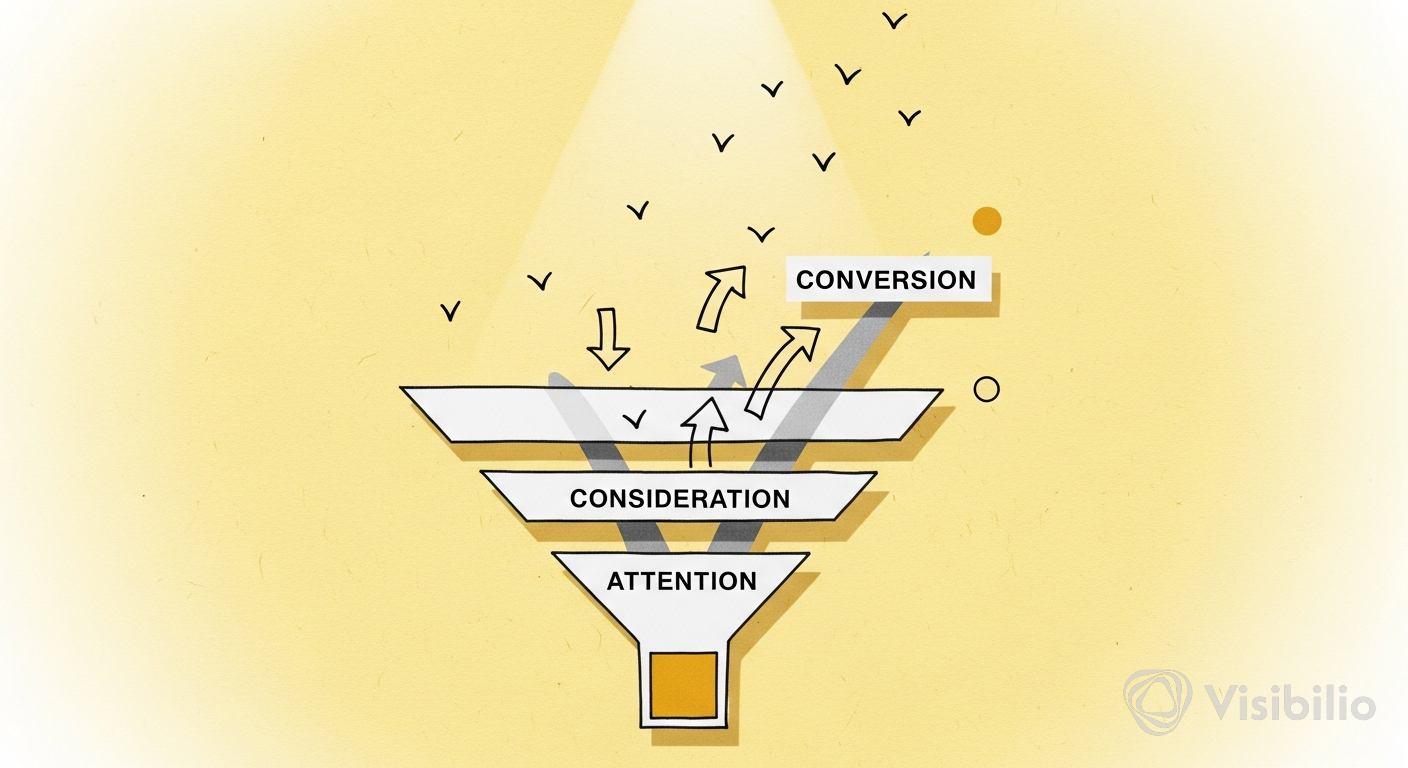
Median cost per lead on LinkedIn rose 73% over the past 24 months in B2B tech. Meanwhile, CPLs on Meta and Google climbed 40–90% thanks to iOS privacy changes and cookie deprecation. The reflex is to cut spend or throw more budget at BOFU campaigns. Both moves make things worse.
The teams still generating qualified pipeline on LinkedIn in 2026 aren't spending more. They're spending differently: a structured 3-stage funnel that earns attention before asking for a demo. The data supports the architecture. LinkedIn-influenced deals close at a 39% higher rate than non-influenced ones, and LinkedIn-sourced leads carry 2x larger average deal sizes compared to other channels. But those numbers only show up when the funnel is built correctly.
Why the Target → Ad → Demo Sequence Fails
Most LinkedIn campaigns still run the same play: pick an audience, show a product ad, ask for a demo. The problem isn't targeting. It's sequencing. Even with perfect ICP filters, the majority of that audience has never heard of you. Asking a stranger to book 30 minutes with your AE is a big ask. Conversion rates for cold-audience BOFU campaigns typically land between 1.5% and 4.0%, and the CPL math gets ugly fast when your ACV doesn't justify £80–£200 per lead.
The fix isn't broader targeting or higher budgets. It's a diagnostic question: which stage of the funnel is leaking?
Stage 1: Trust Through People (TOFU, 20–30% of Budget)
The strongest TOFU asset on LinkedIn isn't your company page. It's a person. Thought Leader Ads (promoting posts from personal profiles) run at 77% cheaper CPC than image ads. That's not a rounding error; it changes the unit economics of awareness entirely.
The goal here isn't leads. It's engagement signals. Short educational videos, practical text posts, and POV content from founders or subject matter experts create the initial touchpoint. Video views on LinkedIn grew 36% year-over-year, and 71% of B2B decision-makers are now Gen Z and Millennials who default to video-first consumption.
What to measure: video view rate, engagement rate, cost per engagement. What not to over-interpret: impressions alone. Guardrail: frequency cap of 3–4 impressions/day for Sponsored Content. Audience size sweet spot: 50K–500K. Top performers use 30% more audience filters than the median, but going below 50K creates artificial scarcity that spikes costs.
Stage 2: Transfer Trust to the Brand (MOFU, 40–50% of Budget)
Once someone engages with Stage 1 content, they're no longer cold. They've demonstrated signal. Now the objective shifts from awareness to education, and the content shifts from individual to brand.
This is where Document Ads ($38–$82 CPL), longer-form videos, ungated guides, and educational webinars do the work. Lead Gen Forms convert 3x better than landing page forms at this stage. Video ads generate 50% more engagement but cost about 20% more, so validate whether video improves downstream pipeline metrics rather than just CTR.
The trade-off is real: MOFU gets the largest budget share because it's the conversion layer most teams starve. Over-investing in BOFU while starving consideration is the single most common budget allocation mistake on LinkedIn.
Stage 3: Ask for the Next Step (BOFU, 20–30% of Budget)
By Stage 3, prospects have interacted with your content multiple times, associated the expertise with your brand, and developed enough confidence to consider a conversation. Now you've earned the ask: demo, consultation, product trial.
Conversation Ads at this stage hit 50% open rates and 12% click-through rates. But frequency matters: cap Message Ads at 1–2 per 30 days. More than that, and you're burning the trust you spent two stages building.
A healthy lead-to-opportunity conversion rate at this stage sits between 15% and 25%. Below 10% means something upstream is broken (targeting, content quality, or audience progression).
The Optimization Most Teams Miss: Audience Exclusions
Without proper exclusions, the same person sees all three stages simultaneously. Budgets bleed. Creative fatigue accelerates. The funnel collapses into a flat campaign with extra steps.
As prospects engage with Stage 1 content, exclude them from Stage 1 and move them into Stage 2 audiences. Same graduation from Stage 2 to Stage 3. LinkedIn's engagement retargeting (video viewers, post engagers, lead form openers, document ad interactions) makes this mechanically possible. The cleaner the progression, the more efficiently spend converts to pipeline.
Run It This Week
Setup: Audit your current LinkedIn campaigns. Map each campaign to a funnel stage (TOFU/MOFU/BOFU). If everything maps to BOFU, that's your problem.
Launch: Start with one Thought Leader Ad campaign promoting an SME's best-performing organic post. Budget: $3,000–$5,000/month. Audience: 50K–500K with layered filters by seniority tier (end user, manager, executive). Sustain for 6–8 weeks before drawing conclusions.
The hypothesis: If we shift 20–30% of LinkedIn budget to TOFU Thought Leader Ads and build engagement-based retargeting audiences for MOFU/BOFU, then lead-to-opportunity rate will increase above 15% because we're converting warmer audiences instead of cold-targeting demo requests.
Success: Lead-to-opportunity rate ≥15%. Guardrails: CPL stays within £80–£200; TOFU engagement rate above platform baseline. Stop-loss: If CPL exceeds £200 after 6 weeks with no improvement in lead-to-opportunity, pause and diagnose audience or creative.
The 73% CPL increase didn't happen because LinkedIn stopped working. It happened because most teams kept running the same flat campaign architecture while the platform evolved around them. The funnel isn't complicated. Three stages, proper exclusions, budget weighted toward the middle. The teams running this architecture aren't paying less per click. They're paying less per opportunity that actually closes.


