
Your cost-per-lead looks great. Your pipeline is full of names. And your sales team is quietly furious because half those leads never answer the phone, and the other half are students, competitors, or people who thought they were signing up for something else.
This is the vanity metric trap, and it's costing B2B marketers millions in wasted spend. The fix isn't another audience hack or creative refresh. It's teaching your ad platforms what a real customer looks like by syncing the conversion events that actually matter: qualified leads, opportunities, closed-won deals, and revenue.
The Algorithm Only Knows What You Tell It
When you optimize for "lead form submitted," you're training Meta and Google to find people who are excellent at filling out forms. That's it. The platform has no idea whether those leads ever became customers unless you close the loop. So it keeps finding more of the same: high-volume, low-intent form fillers who look efficient in Ads Manager and worthless in your CRM.
As one practitioner put it, "You didn't generate potential customers: you generated noise."
Down-funnel event sync changes the question the algorithm is trying to answer. Instead of "Who is likely to submit this form?" it becomes "Who is likely to become the type of lead the business can actually convert?" That shift requires feeding your CRM's lifecycle stage changes, opportunity creation events, and closed-won revenue back to the ad platforms that bought the top of funnel.
The Technical Pipeline: Three Stages
The mechanics are straightforward, even if the implementation requires coordination across marketing, RevOps, and sometimes engineering.
First, you capture the platform's click identifier at the moment of first touch. For Google, that's the GCLID appended to your landing page URL. For Meta, it's either the fbclid or, better, the Meta Lead ID if you're using Instant Forms. This identifier must be stored as a hidden field on every form and passed through to your CRM as a custom property. If you lose the click ID, you lose the ability to attribute downstream conversions.
Second, your CRM or data warehouse tags each conversion event with that original identifier. When a lead becomes an MQL, when an opportunity is created, when a deal closes, the system records the event alongside the click ID that started the journey.
Third, a connector sends those events to the platform's API. For Google, that's Enhanced Conversions for Leads, which uses hashed first-party data to match offline conversions back to the original ad click. For Meta, it's the Conversions API for CRM integration, which accepts lifecycle stage changes and attributes them to the campaign that generated the lead.
The clean version is server-side: it survives cookie loss, ad blockers, and iOS restrictions that have made browser-based pixels increasingly unreliable. One implementation guide notes that pixel-only setups now miss over half of actual conversions due to these privacy changes.
Which Events to Sync
Not every CRM stage belongs in your ad platform. The goal is to send events that are both meaningful to your business and frequent enough for the algorithm to learn from.
Pearmill's guidance offers a useful framework: pick an event that happens within one to three days of the click, correlates at least 0.6 with high-value customers, and fires at least 50 times per week. If your closed-won events are too sparse, optimize toward a mid-funnel stage like "demo completed" or "trial activated" while still syncing closed-won as a secondary conversion for reporting.
For most B2B companies, the hierarchy looks like this:
- Form submission at the top (low value, high volume)
- Demo booked or trial activated in the middle (medium value, stronger buying signal)
- Closed-won at the bottom (high value, the outcome you actually pay for)
- Expansion or renewal post-sale (highest value, true lifetime value)
The mistake is sending only the shallow event. As one technical guide warns, "Lead is too shallow. Use offline conversion import for downstream events and let Enhanced Conversions handle the in-page events."
The Math That Matters
Consider a campaign that generates 500 leads at $20 each. The dashboard looks efficient: $10,000 spent, 500 leads, $20 CPL. But the CRM tells a different story. Of those 500 leads, 140 were contacted, 65 became MQLs, 28 became SQLs, 12 became opportunities, and 4 became customers generating $48,000 in revenue.
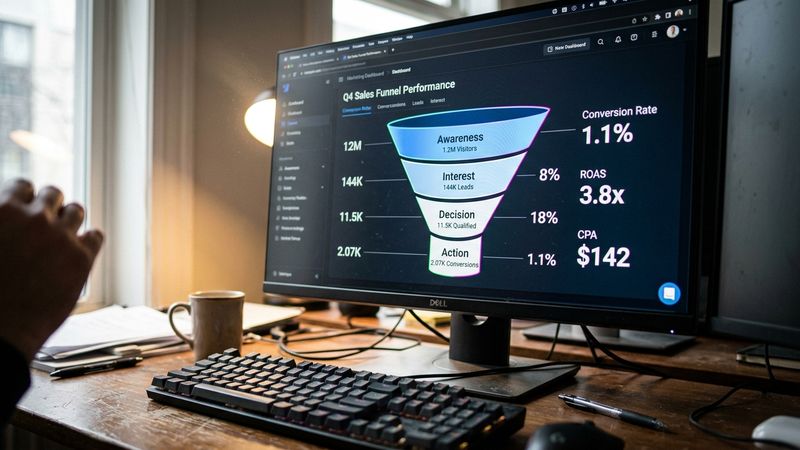
The real economics: $357 per SQL, $833 per opportunity, $2,500 customer acquisition cost, and a 4.8x revenue-to-ad-spend ratio. The $20 lead was never the business result. It was the first measurable action in a funnel where 99% of the value sits downstream.
If the ad platform only sees the form submission, it can't distinguish between the 472 leads that never converted and the 28 that did. It keeps finding more people who resemble cheap form submitters rather than profitable customers. B2B CAC has increased over 60% in the past five years, and this optimization mismatch is a significant contributor.
Implementation Realities
HubSpot's documentation shows how to create conversion events that sync lifecycle stage changes to Meta via the Conversions API. The setup requires a connected Meta pixel, a Business Manager account, and forms created in HubSpot. Only events that occur after creating the conversion event will be counted, so you're building forward, not backfilling.
For Google, the migration to Enhanced Conversions for Leads is now mandatory for new implementations. Starting , offline conversion imports will be blocked in the Google Ads API and migrated to the Data Manager API. If you're still using legacy GCLID-only imports, the upgrade path is clear: add hashed user data (email, phone) alongside the click identifier to improve match rates and unlock cross-device attribution.
Meta's qualified-leads performance goal now requires a Conversions API integration for new campaign creation. CRM feedback has moved from optional reporting enhancement to core infrastructure.
The Two-Week Pilot
Start with one campaign and one down-funnel event. Closed-won is ideal if you have enough volume; demo completed works if your sales cycle is long and closed-won events are sparse.
Week One
Audit your current tracking. Compare conversion numbers across your ad platform, analytics tool, and CRM. The discrepancy tells you exactly what you're losing. Implement GCLID or fbclid capture on all forms. Verify the identifier flows through to your CRM.
Week Two
Configure the server-side sync. For Google, set up Enhanced Conversions for Leads through Data Manager. For Meta, connect your CRM via the Conversions API. Send your first batch of historical conversions (within the 90-day attribution window) and monitor match quality.
The validation metric is simple: do the conversions you send appear in the platform's conversion report, attributed to the correct campaigns? If match quality is low, check your hashing implementation and ensure you're sending all available customer parameters.
Risks and Mitigations
Data latency is the primary risk. B2B sales cycles can stretch months, and ad platforms weight recent conversions more heavily in their bidding models. If your average time-to-close is 90 days, the algorithm may struggle to learn from events that happen long after the click. Mitigation: sync mid-funnel events (MQL, demo booked) that happen within the attribution window while still sending closed-won for reporting accuracy.
Match rate degradation is the second risk. If your forms collect only email and your CRM stores a different email format, matches will fail. Mitigation: normalize and hash consistently, send multiple customer parameters (email, phone, name), and audit match quality weekly.
The third risk is organizational: marketing owns the ad platform, sales owns the CRM, and RevOps owns the data pipeline. If these teams aren't aligned on which events matter and how they're defined, you'll sync garbage. Mitigation: document the event taxonomy, agree on definitions, and run a joint review before launch.
The CFO will ask whether this is worth the implementation cost. The answer is in the CAC payback math. If down-funnel sync improves lead quality by even 20%, the reduction in wasted sales capacity and the improvement in close rates will pay for the integration many times over. Model it before you pitch it.


