
Here's a fun exercise: walk into your next budget meeting and tell the CFO that your connected TV campaign delivered "really solid reach." Watch their face. That micro-expression, somewhere between confusion and disappointment, is the exact reason you need to start building your CTV measurement infrastructure today, not in Q4 when the 2027 planning cycle is already half-baked.
I've been in enough budget rooms to know that "we got impressions" doesn't cut it anymore. It barely cut it in 2019. And yet, as Ken Insana recently pointed out on LinkedIn, most brands are still running CTV campaigns where every single KPI is a delivery metric. Impressions. Reach. Video completion rate. All of which tell you the ad was served. None of which tell you the ad actually did anything.
That gap between "delivered" and "drove results" is where CTV budgets go to die.
The Measurement Vacuum Is Your Problem
Let me be clear: CTV works. The targeting capabilities, the non-skippable formats, the ability to reach cord-cutters who haven't seen a linear TV ad since the Obama administration. All of it is real. The problem isn't the channel. The problem is that most marketing teams have built zero infrastructure to prove it works.
And here's the timing issue nobody wants to talk about. Your 2027 budget isn't decided in January 2027. It's decided in September and October of 2026. Which means right now, this month, you're either walking into planning conversations with evidence or you're walking in with hope. Finance teams don't fund hope.
The 2026 Demand Generation Benchmark Survey captures something I've been seeing anecdotally: B2B marketing teams are under intense pressure to prove that every dollar drives pipeline. Leadership wants proof. The channels competing for that dollar have never been more crowded. ABM. Content. Intent data. AI platforms. CTV is fighting for the same finite spend, and it's losing when it can't show receipts.
What "Evidence" Actually Looks Like
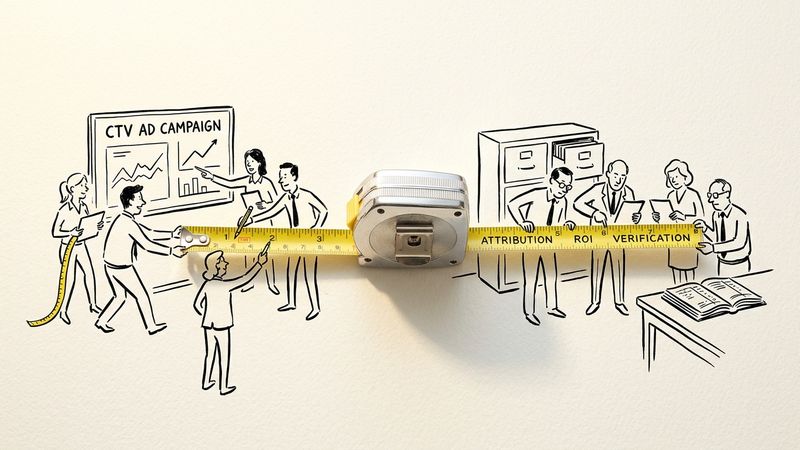
So what does CTV measurement look like when it's done right? It's not complicated, but it does require you to set it up before the campaign runs, not after.
Brand lift studies. These measure whether people who saw your ad have higher awareness, consideration, or intent than people who didn't. They're not free, but they're not expensive either, and they give you something to say beyond "we reached 2 million households."
Search acceleration. Did branded search queries increase during and after your CTV flight? This is one of the cleanest signals that your upper-funnel spend is actually moving people down the funnel. You can measure it with tools you probably already have.
Website visits with precise channel attribution. Not just "direct traffic went up." Actual attribution that connects CTV exposure to site visits. This requires some technical setup, but it's doable, and it transforms your reporting from "we think it worked" to "here's what happened."
Incrementality testing. The gold standard. Run your campaign in some markets, hold out others, and measure the difference in outcomes. It's the closest thing to a controlled experiment you can run in the wild, and it gives you the kind of evidence that makes CFOs nod instead of squint.
Frequency capping that actually works. This one's less about measurement and more about not wasting money. Insana's observation that most CTV campaigns have "shockingly low frequency" across the whole campaign is spot-on. You're either hitting the same people too many times or not enough times to matter. Neither is good.
The Creative Problem Nobody Wants to Discuss
Here's the other thing: most CTV creative is just a TV spot that got uploaded to a different platform. Same 30-second format. Same brand anthem energy. Same assumption that viewers will sit there passively like it's 1997.
CTV is not linear TV. The viewer is on a streaming platform, probably with a phone in their hand, definitely with the ability to switch to a different show in two seconds. Your creative needs to acknowledge that reality. It needs to be built for the environment, not repurposed from a different one.
I'm not saying you need to reinvent your entire creative process. I'm saying that if your CTV spot is identical to your linear spot, you're leaving performance on the table. And when you can't measure performance anyway, you'll never know how much you left.
The Budget Defense Playbook
Let's talk about what happens in October when you're sitting across from finance and they're asking why CTV should get more money next year.
If you've spent the last few months building measurement infrastructure, you can say: "Our Q3 CTV campaign drove a 12% lift in brand consideration among target accounts, a 23% increase in branded search, and we saw a measurable uptick in site visits from exposed households. Here's the incrementality data."
If you haven't, you can say: "We reached 1.8 million households with a 94% video completion rate."
One of those answers gets you budget. The other gets you a polite suggestion to reallocate to channels with clearer ROI.
The math here isn't subtle. Marketing leaders who can connect spend to outcomes get more spend. Marketing leaders who can't get less. CTV is particularly vulnerable because it sits in that awkward middle ground between brand and performance, and if you can't prove it does either, it's the first thing to get cut when budgets tighten.
Start Now, Not Later
The window for building your 2027 evidence base is closing. If you're running CTV campaigns in Q3 and Q4 of 2026, those campaigns need measurement baked in from the start. You can't retrofit a brand lift study after the campaign ends. You can't run an incrementality test retroactively.
Here's my recommendation: pick one campaign in the next 60 days and treat it as your measurement pilot. Set up brand lift. Track search acceleration. Implement proper attribution. Run a holdout test if you can. Document everything.
Then, when October rolls around and you're in the budget room, you'll have something better than reach numbers. You'll have evidence. And evidence, in my experience, is the only thing that survives contact with a skeptical CFO.
CTV isn't going away. The audience is there, the targeting is there, the format is there. What's missing, for most B2B marketers, is the proof. Build that proof now, or spend 2027 explaining why your budget got cut.


