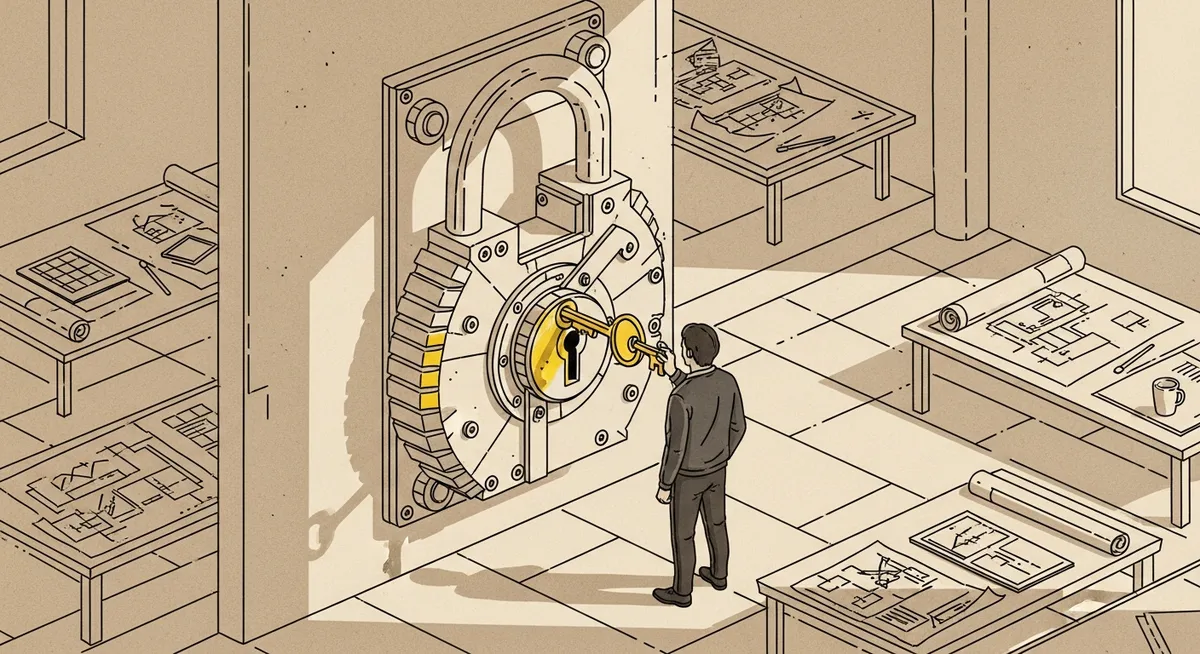
If your pipeline stalls after a strong demo and a clean ROI story, the constraint usually isn’t value—it’s blame. The deal doesn’t die because the buyer can’t see upside; it dies because they can’t survive the downside.
Here’s the pattern interrupt that explains a lot of “why did we lose?” post-mortems: in B2B software and technology evaluations, buyers rate security (60%) slightly above productivity (59%), with trustworthiness right behind (58%). That’s not a rounding error. It’s a priority stack. (Source: [1])
And it gets more intense as committees grow. The average buying group is now 7.4 people (up 6%), and 27% of buyers report more decision-makers due to the economic climate—often with more C-level scrutiny, including CFO involvement. (Sources: [1][2])
So the question isn’t “why didn’t they choose the better product?” The better question is: why would a committee choose something that’s hard to defend later?
The real optimization target: minimize regret, not maximize features
B2B buyers will describe their work as rational. Scorecards. Requirements. Total cost. ROI. That story is comforting—especially to vendors.
But the emotional math is different when the failure mode is public. Colin Gray of McCann Central has described how buyers often choose suppliers to avoid blame, not just disappointment, creating default effects where teams stick with familiar options (sometimes framed as a “Heathrow Option”). (Source: [1])
That framing lines up with what the data says buyers do. 81% prefer collectively familiar brands to mitigate personal risk. Not because familiar is always superior, but because familiar is easier to justify in an internal review when results lag. (Source: [1])
Committees make that bias stronger. When outcomes are uncertain, shared accountability becomes a feature. There’s a reason 40–60% of tenders can fail due to group disagreement—consensus is hard, and “safe” is often the only decision everyone can live with. (Source: [1])
The short version: a buyer champion doesn’t just need reasons to buy. They need cover.
Why “proof” beats persuasion in 2026 buying cycles
Persuasion-first marketing assumes comparison shopping: the buyer weighs your differentiators, sees the advantage, and moves forward.
But buyers are doing more self-serve research and trusting third parties more than vendor claims. 75% prefer independent information gathering, 54% consult peer reviews, and 76% trust online reviews. That’s not a content preference; it’s a risk strategy. (Sources: [2][6][1])
Then there’s the security layer—now basically unavoidable. 97% of buyers involve security stakeholders in purchases. When that person enters the room, the decision criteria shift toward threat models, compliance posture, data handling, and operational risk. (Sources: [1][2][4])
AI makes this sharper, not softer. Buyers may prefer AI features (62%) and overwhelmingly buy AI-enabled solutions (89%), but 41% worry about data security risks from AI adoption. (Sources: [2][4][1])
So yes, the buying cycle has shortened—10.1 months in 2025 vs. 11.3 in 2024. (Sources: [2][4])
But shorter doesn’t mean “less careful.” It often means the evaluation is front-loaded and outsourced to signals that feel safer: known brands, marketplaces, and credible third-party validation. Direct vendor purchases are down 9% as marketplaces/resellers rise—another way organizations standardize procurement and reduce perceived risk. (Source: [1])
Seen from the other side, this is why a beautiful product narrative can still lose: it’s answering the wrong internal question.
The one move: build a “Defensible Decision Pack” that committees can reuse
If you only change one thing, change this: stop shipping “why we’re better” assets as the default, and ship “why this is safe to approve” assets that map to the committee.
Call it a Defensible Decision Pack. The goal isn’t to add more content. It’s to reduce the cognitive load of internal alignment by giving each stakeholder the proof they need—without your champion rewriting your case from scratch.
Hypothesis (make it falsifiable): If we publish and route a Defensible Decision Pack to late-stage opportunities, then stage-to-stage conversion from evaluation → security/procurement → closed-won will improve because the buyer can reuse validated proof to build internal consensus and reduce perceived downside.
What goes in the pack (3 parts, because committees pattern-match):
- Security reassurance: a plain-English security overview plus the artifacts security teams actually request (and a clear path to deeper docs). This matters because security is a top stated priority (60%) and security stakeholders are involved in 97% of deals. (Sources: [1][2][4])
- ROI defensibility: a CFO-readable value narrative that makes assumptions explicit. TrustRadius notes that in uncertain markets, buyers need provable value/ROI to satisfy CFO scrutiny as self-serve research increases. (Source: [2])
- Third-party validation: curated peer review excerpts and references to external proof, aligned to the buyer’s use case. Buyers consult peer reviews (54%) and trust online reviews (76%). (Sources: [2][6][1])
One more detail that matters in 2026: include a short section on AI and data handling. Buyers are buying AI-enabled tools (89%) while worrying about AI data security (41%). If that tension isn’t addressed directly, it won’t be resolved—it’ll just delay the decision until the committee finds a safer default. (Sources: [2][4][1])
Trade-off (say it out loud): this will reduce early-stage volume if the team tries to force it into top-of-funnel nurture. That’s fine. This is a late-stage conversion tool, not a lead magnet.
Run it this week (operator-ready)
Setup (Day 1–2): Identify one segment where deals regularly stall in evaluation or security review (pick a single motion: mid-market or enterprise). Pull the last 10–20 closed-lost opportunities in that segment and tag the stated reason. Keep it simple: security, trust, procurement path, ROI scrutiny, committee misalignment.
Build (Day 2–4): Create a single doc or microsite with the three sections above. Owners: demand gen (pack assembly + distribution), product/security (security section), finance/RevOps (ROI assumptions + template), sales (where it’s used in-stage and in mutual action plans). Tools: whatever your team already uses for sales rooms or deal hubs; the workflow matters more than the platform.
Launch (Day 5): Route the pack only to late-stage opportunities (for example: post-demo, pre-security review) and require it to be attached in the deal room or sent as a single link. No scattershot enablement.
Readout (end of next week): In deal reviews, ask one question you can actually act on: which stakeholder blocked progress, and which section of the pack was missing or unconvincing? That becomes the next iteration.
What to measure (and what not to over-interpret):
- Primary metric: evaluation → next stage conversion rate (or time-in-stage reduction) for opportunities that received the pack vs. a baseline cohort (directional, not definitive).
- Secondary metrics: security review cycle time; number of stakeholders engaged in the deal room after sending.
- Guardrails: win rate shouldn’t drop while cycle time improves.
- Stop-loss threshold: if cycle time improves but win rate drops by a meaningful amount versus baseline, pause and audit whether the pack is attracting the wrong deals or surfacing disqualifying risk too late.
When this is wrong: in categories where downside risk is genuinely low (small contract values, low integration complexity, minimal data sensitivity), committees may still choose “better” on capability. But most B2B software doesn’t get that luxury anymore—security and trust are now table stakes, and the data shows buyers treat them that way. (Source: [1])
The kicker: “safe” is often the product in enterprise buying
The uncomfortable truth is that “safe” isn’t just a bias. It’s a requirement shaped by committee dynamics, security involvement, and economic scrutiny. The market is telling GTM teams this directly: security leads stated priorities (60%), trust is a primary concern for many buyers (73%), and nearly everyone pulls in security stakeholders (97%). (Sources: [1][3][1][2][4])
So the job isn’t to out-argue the safe decision. It’s to make the better decision feel safe enough to sign—and safe enough to defend months later, when someone asks what changed and why it was worth the risk.


