
A media-buying agent can stay perfectly within budget and still make a very expensive mistake. That sentence, buried in PropellerAds' recent piece on agentic guardrails, captures the governance gap most marketing teams haven't modeled yet.
The industry is moving fast. IAB's 2026 Outlook found that 96% of buyers are aware of agentic AI for ad buying, and 66% are already increasing their focus on it for campaign execution. IAB Europe's September report puts the number at 58% expecting agentic ad buying to reach operational scale within a year. The holdcos are building buyer agents. Publishers are building seller agents. The infrastructure is real.
What's lagging is the risk model. Most governance conversations center on spend limits, approval checkpoints, and audit trails. IAB's July 2026 Digital Video report found that 40% of digital video buyers want humans in the loop, 36% want explainability, and 31% want explicit limits on what agents can do. Those are sensible controls. They define the size of the playground. They don't address the quality of the ground the agent is standing on.
The Input Problem
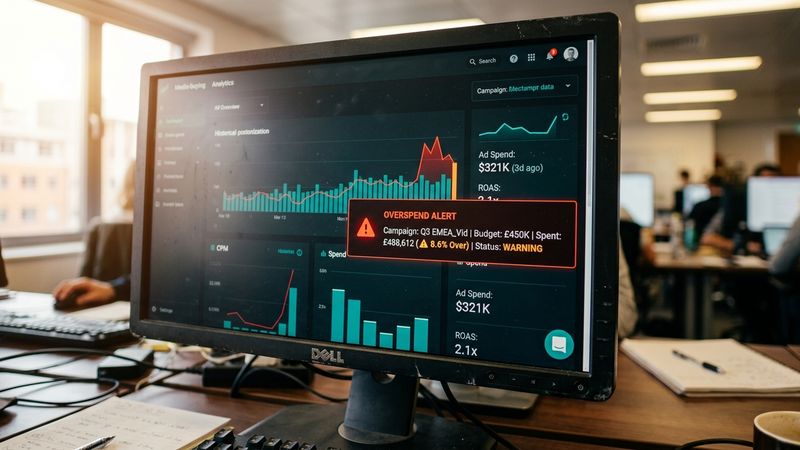
An autonomous buying agent optimizing toward CPA will do exactly what you tell it: find cheaper conversions. If a traffic source starts producing low-cost conversions, the agent will allocate more budget in that direction. The dashboard looks great. The CFO sees efficiency improving. The problem is that performance metrics and security signals can tell two completely different stories about the same traffic.
PropellerAds' Q2 2026 Ads Safety data illustrates the disconnect. Their moderation systems flagged cloaking violations in over 80% of confirmed suspensions, up from roughly 45% in 2022-2024. Cloaking is no longer a simple redirect; it's multi-layered infrastructure designed to defeat moderation. The violations getting through early-stage checks are the engineered ones. An agent optimizing on CPA alone won't see the warning lights until the damage is done.
The scale of the underlying problem is substantial. Improvado's 2026 ad fraud guide estimates global digital advertising fraud will exceed $100 billion this year. Pixalate's Q2 2026 benchmarks put the invalid traffic rate at 25% for desktop and mobile web in the US, 39% for mobile apps, and 25% for CTV. Clixtell's 2026 analysis notes that AI-driven automated traffic now grows roughly eight times faster than human traffic, and the signal margin between benign and malicious bots is under one percentage point.
When an agent can scale decisions automatically, those warning lights need to reach the driver before the system puts its foot down.
Two Data Streams, One Decision
The core issue is architectural. Performance data and security data typically live in different systems, owned by different teams, with different latency profiles. A buying agent pulling from the performance layer sees CPA, conversion volume, and pacing. It doesn't see the traffic-quality flags, the behavioral anomalies, or the redirect chains that a security layer might be tracking.
PropellerAds frames this as a question of what the agent is allowed to trust. A source can look efficient on CPA while collecting warning lights further down the road. A landing page can behave differently after launch. A redirect can introduce a questionable domain. The performance signal says "scale this." The security signal says "investigate this." If only one signal reaches the agent, the decision is already compromised.
This isn't a theoretical concern. IAB's July 2026 Digital Video report found that even for the most trusted CTV buying methods (direct I/O, programmatic guaranteed, self-serve), 43% of buyers expressed "somewhat to no confidence" in the quality of the inventory they're buying. That number rises to 55% for private marketplaces and 67% for open exchange. Buyer trust is being eroded on two fronts: bad actors introducing invalid inventory, and uncertainty around the origin and placement of otherwise legitimate inventory.
An agent operating in that environment without access to traffic-quality signals is optimizing blind.
What Governance Actually Requires
The standard governance checklist (spend caps, human checkpoints, audit trails) addresses one class of risk: the agent doing something you didn't authorize. It doesn't address the agent doing exactly what you authorized, based on inputs that were already corrupted.
Dataiku's recent piece on human-in-the-loop design patterns notes that only 5% of data leaders say AI output is traceable 100% of the time. That gap means most organizations can't produce the audit trail a regulator would require, let alone the diagnostic trail needed to understand why an agent made a particular allocation decision.
Z2A Digital's June 2026 analysis calls this the "trust trap": teams setting up programmatic AI agents with basic instructions and then letting them roam unsupervised. Agents don't possess the self-awareness to review their own actions, recognize errors, and correct themselves. Without human intervention, they'll keep carrying out their mistakes, and they execute those mistakes exponentially faster and at greater scale than humans.
The governance model needs to expand. Spend limits protect one side of the decision. Input validation protects the other.
The Practical Path Forward
PropellerAds' argument is that traffic-quality and security signals need to become part of the optimization logic, not a separate audit function that runs after the fact. The agent needs access to both performance data and risk data before it makes allocation decisions.
This means integrating traffic-quality APIs into the agent's decision loop. It means defining thresholds where anomalies trigger human review rather than automatic scaling. It means building the audit trail not just for what the agent did, but for what signals the agent saw when it made the decision.
IAB Tech Lab's 2026 roadmap is building toward this with its Agentic Advertising Management Protocols (AAMP), including reference implementations trained on existing industry standards that serve as guardrails for agent decisions. The infrastructure is coming. The question is whether individual teams will wait for industry standards or build the integration now.
For marketing leaders presenting to the board, the framing matters. Agentic media buying isn't just an efficiency play; it's a risk-transfer decision. You're moving decision authority from humans who can contextualize to systems that optimize on the signals they're given. If those signals are incomplete, the system will be extremely efficient at following the wrong trail.
The CFO will ask about spend controls. The right answer is that spend controls are necessary but not sufficient. The agent also needs to know what it's allowed to trust.


