
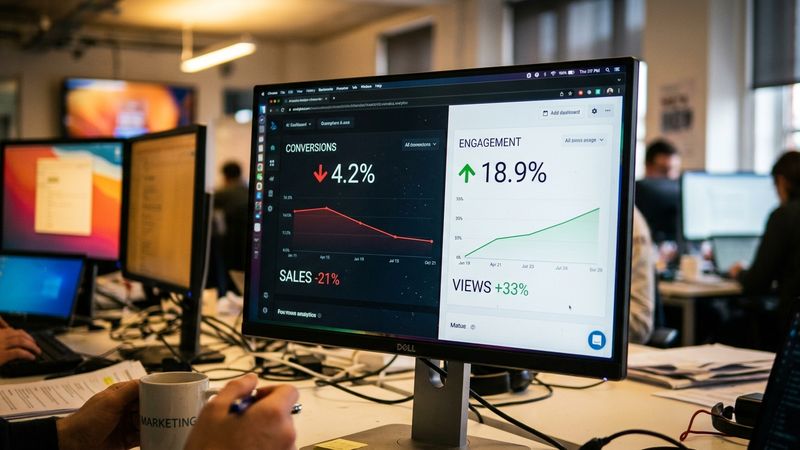
A CMO I advise showed me her Q3 dashboard last week. Google Ads reported a 3.2% conversion rate. Meta claimed 4.1%. Her CRM showed pipeline creation down 18% quarter over quarter. Three systems, three stories, zero alignment.
She asked the question every paid media leader is now asking: if the buying journey keeps moving into AI chats and surfaces I cannot track, how do I prove PPC value when the click is no longer the whole story?
The honest answer, as Navah Hopkins recently put it in Search Engine Journal, is that it is harder to measure and attribute in the blended SERP and AI experience world. There are fewer attributable signals through AI experiences. That is not a reason to abandon measurement. It is a reason to rebuild it around what you can actually verify.
The Click Was Always a Proxy
Clicks never captured intent. They captured a moment of curiosity strong enough to warrant a tap. In B2B, where cycles run six to eighteen months and buying committees involve five to eleven stakeholders, a single click rarely correlates with a closed deal.
What changed is that AI-powered experiences now let prospects compare options, refine questions through multi-turn conversations, and use citations only when visiting the source directly helps them. The click that used to signal "I'm interested" now competes with a conversation that never leaves the AI surface.
This matters for budget allocation. If your attribution model credits the last click before a demo request, you are systematically undervaluing every impression, every brand search, every AI-assisted research moment that preceded it. You are also overvaluing the channel that happened to catch the prospect at the moment they were ready to act.
Impressions as Directional Signal, Not Vanity Metric
Hopkins makes a useful distinction: whenever an ad serves, an impression happens, whether the placement appears on a traditional search results page, an AI surface, a display property, or another eligible environment. You cannot perfectly map impressions to individual AI exposure, but you can see that a given ad achieved impressions.
The operational move is to treat impression share and impression volume as influence signals, not success metrics. If your brand search volume rises while your paid impression share on non-brand terms holds steady, something is working upstream. If impression share drops while CPC rises, you are losing auction competitiveness and need to diagnose whether that is a bid issue, a quality score issue, or a targeting issue.
Supermetrics' PPC metrics guide frames this well: no single metric tells the whole story. CTR and impression share help explain visibility and response. Average CPC measures traffic cost. Conversion rate and cost per conversion explain how efficiently defined actions occur. The task is to select one primary outcome, then use the other metrics to explain its movement.
Platform Data Versus Your Source of Truth
Here is where most measurement stacks break. Google Ads, Meta, LinkedIn, and Microsoft each use different click, conversion, and attribution rules.
Adriaan Dekker's recent LinkedIn post surfaced a detail that surprised even experienced practitioners: on Meta, a "click" for attribution purposes is not limited to a website visit. It can include profile clicks, page visits, even in-feed engagements. So when you see "click-through" conversions in your reports, they might not come from people who ever clicked your link.
The implication is that platform-reported ROAS is not the same as true PPC ROI. Attribution App's breakdown makes the distinction clear: ROAS measures revenue efficiency within a platform, while ROI factors in all costs (software, agency fees, internal labor) to answer how much profit you earned for every dollar invested.
If your $20,000 in revenue came from $5,000 in ad spend plus $7,000 in other costs, your ROI is 17%, not the 400% ROAS the platform reports.
The fix is to validate platform data against your own sources of truth. That means CRM pipeline data, not just MQL counts. It means closed-won revenue tied back to first-touch and multi-touch attribution, not just last-click. It means passing as much signal back to platforms as you can (offline conversions, CRM events, revenue values) so their optimization algorithms have something closer to reality to work with.
Consent as Measurement Infrastructure
This is the part most teams skip. Privacy regulations and browser changes have made consent a prerequisite for capturing available click-based data. If your consent management is sloppy, you are losing signal before it ever reaches your attribution model. If your first-party data strategy is nonexistent, you are flying blind on the very users who matter most: the ones who have engaged with you before.
Hopkins frames consent as part of your measurement strategy, not a compliance checkbox. The teams that treat it as infrastructure, building consent flows that maximize opt-in rates while respecting user choice, end up with richer data sets and more accurate models.
A Practical Measurement Stack for 2026
Here is what I recommend to operators who need to prove PPC value when clicks are partial signals:
- First, define your primary outcome at the business level, not the platform level. Pipeline created, opportunities influenced, revenue closed. Pick one. Everything else is a diagnostic.
- Second, use impressions and impression share as leading indicators of reach and competitive position. Watch for divergence between impression trends and conversion trends; that divergence tells you where the funnel is leaking.
- Third, reconcile platform-reported conversions against CRM data weekly. If the gap widens, investigate whether it is an attribution window issue, a conversion definition issue, or a data pass-back issue.
- Fourth, calculate true PPC ROI quarterly, including all costs. Present that number alongside platform ROAS so your CFO sees both the efficiency metric and the profitability metric.
- Fifth, audit your consent flows and first-party data capture. Every percentage point of opt-in rate you gain is signal you would otherwise lose.
The click is not dead. It is just no longer the protagonist. The buying journey now includes research moments that never generate a trackable event, conversations with AI that never send traffic to your site, and brand impressions that shape decisions weeks before a form fill.
Your measurement stack needs to account for all of it, or you will keep optimizing for the metric that is easiest to count rather than the outcome that actually matters.


