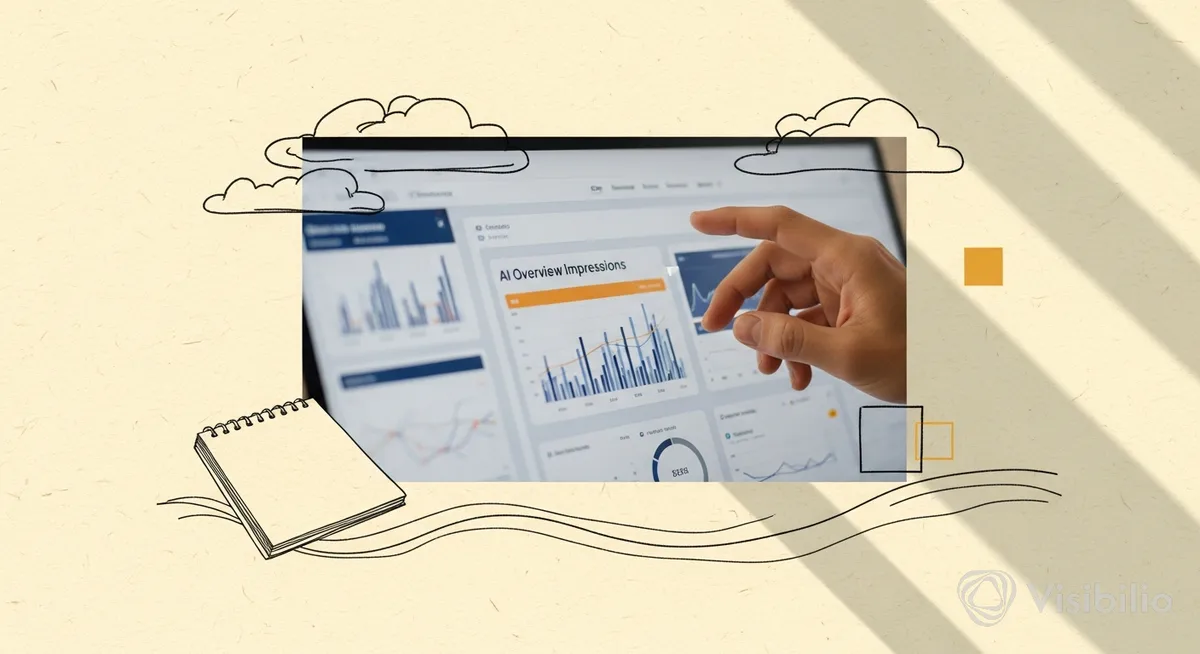
If SEO clicks are your pipeline plan, and AI Overviews start eating those clicks, the “traffic = impact” story breaks fast. Google’s new Search Console generative AI reporting in 2026 finally gives a clean cut of what used to be a foggy problem: which pages are showing up in AI Overviews, AI Mode, and generative features in Discover—and how often.
That’s the outcome. The constraint is annoying: the report is impressions-focused. No clicks. No CTR. No rankings. Still, for demand gen leaders, that’s enough to change how SEO gets measured and defended in 2026.
To understand why, it helps to remember the baseline. In 2023, Search Console didn’t provide dedicated AI Overview reporting; any AI-driven visibility was mixed into standard Web performance data and wasn’t separately filterable (Source: Query: Google Search Console AI Overview Reporting recent statistics 2023). So teams guessed. They inferred. They argued in Slack.
Now there’s a dedicated “Generative AI” performance view with breakdowns by page, country, device, and date (Source: Query: Google Search Console AI Overview Reporting recent statistics 2023). That single segmentation layer is the real shift: it turns AI visibility from vibes into a measurable surface area.
Why this matters now: visibility is rising while clicks may not
External estimates cited in industry coverage suggest AI Overviews appear on a meaningful share of searches—13% globally and 16% on U.S. desktop (Source: Query: Google Search Console AI Overview Reporting recent statistics 2023). Those are not Google metrics, and they shouldn’t be treated like gospel. But they do explain the anxiety: if a chunk of search sessions now resolves inside an AI answer, the old “rank → click → session” funnel thins out.
And the click impact can be brutal. Summaries of third-party analyses report organic CTR declines of 15% to 89% when an AI Overview is present, depending on query type (Source: Query: expert opinions on Google Search Console AI Overview Reporting impact on SEO). Again: not a GSC stat. Directional, not definitive. But it matches what many teams have felt—especially on informational, non-branded queries.
Here’s the tension that makes the new report useful: the same thing that can reduce clicks can also increase exposure. SEO experts have called dedicated reporting a breakthrough because it makes AI-driven visibility measurable, while warning that impressions don’t automatically translate into clicks (Source: Query: expert opinions on Google Search Console AI Overview Reporting impact on SEO).
So the question becomes operational, not philosophical: how does a team use AI impressions without letting them become a vanity metric?
The one move: build a “AI impressions → conversion” scoreboard
The practical tactic is simple: use the Generative AI report to find the pages Google’s AI systems cite often, then cross-reference those pages against standard Web performance and on-site conversion outcomes. The goal isn’t to “win AI.” The goal is to identify where AI visibility is happening and decide what to do with it.
Marie Haynes (Owner at Marie Haynes Consulting Inc.) described the core signal this way: a page with high AI impressions and high organic clicks is a clue for what “non-commodity” content looks like—content that still earns the click even when an AI answer is available (Source Content: Marie Haynes, June 2026).
That’s the thread worth pulling. If AI Overviews are answering the easy stuff, then the pages that still draw visits are telling you what the AI can’t fully replace: first-hand experience, original research, original images, deeper comparisons, sharper point-of-view. Not theory. Observed behavior.
But don’t stop at “it gets clicks.” Demand gen doesn’t get paid in clicks. The scoreboard has to include conversion, and it has to separate signal from noise.
Run it this week: a 7-day experiment with falsifiable readout
Setup (Day 1–2)
Owner: SEO lead + RevOps/analytics partner. One hour together, minimum.
Tools: Google Search Console. Web analytics (GA4 or equivalent). A spreadsheet is enough.
- Export your Generative AI report by page for the last 28 days (or the longest window available in your instance). Include device and country if those matter to your motion.
- Pull the same pages’ Web performance metrics from standard GSC (clicks, impressions) for the same date range.
- For those pages, pull on-site outcomes: primary conversion (demo request / trial start / contact), plus 1–2 micro conversions (newsletter signup, pricing page click, product page click).
Launch (Day 3)
Pick 10–25 pages with the highest AI impressions. Don’t cherry-pick. Use the list.
The hypothesis (make it falsifiable): If we prioritize pages with high AI impressions and improve their “post-click” conversion path, then conversion rate from organic sessions will increase, because these pages are already being selected as relevant in AI answers and can capture the residual click demand that still exists.
What to change (Day 3–4)
Make one conversion-focused adjustment on those pages. One. Examples that don’t require new net-new content:
- Clarify the next step above the fold (what the reader should do next, and why it’s worth it).
- Add a tighter internal path to BOFU pages (pricing, integrations, security, comparison) aligned to the page’s intent.
- Reduce distraction that doesn’t serve the handoff (especially if the page is informational but attracting evaluators).
Readout (Day 7)
Success = lift in primary conversion rate on the test pages vs their own baseline (directional).
Guardrails = organic sessions don’t fall more than expected week-over-week; micro conversion rate doesn’t crater.
Stop-loss = if primary conversion volume drops meaningfully for the week (pick a threshold your team will actually respect), roll back the changes and reassess intent mismatch.
Is seven days enough for statistical certainty? No. That’s not the point. The point is to create a measurement habit around the new AI segment and stop treating “AI visibility” as either a win or a disaster without a readout.
Trade-offs, and when this interpretation is wrong
The trade-off is obvious: emphasizing AI impressions can pull attention toward top-of-funnel pages that don’t monetize quickly. That can reduce short-term qualified pipeline if the team over-rotates on informational content and under-invests in commercial intent.
When this is wrong: if your motion relies on a small set of high-intent queries (branded, integration, pricing, competitor comparisons), AI Overviews may be less damaging—or even less present—than the broader discourse suggests. The research brief itself flags this nuance: CTR impact varies by query type and intent, and branded/action-oriented queries can be less negatively affected (Source: Query: expert opinions on Google Search Console AI Overview Reporting impact on SEO).
So don’t generalize from one cluster. Segment by intent. Treat the Generative AI report as a new dimension in your reporting model, not a replacement for it.
In 2023, teams were stuck debating what they couldn’t see. In 2026, Search Console is finally drawing a line around AI visibility. The pages that sit on both sides of that line—high AI impressions, and still earning meaningful clicks and conversions—aren’t just “good content.” They’re the blueprint for what remains defensible when answers get summarized by default.