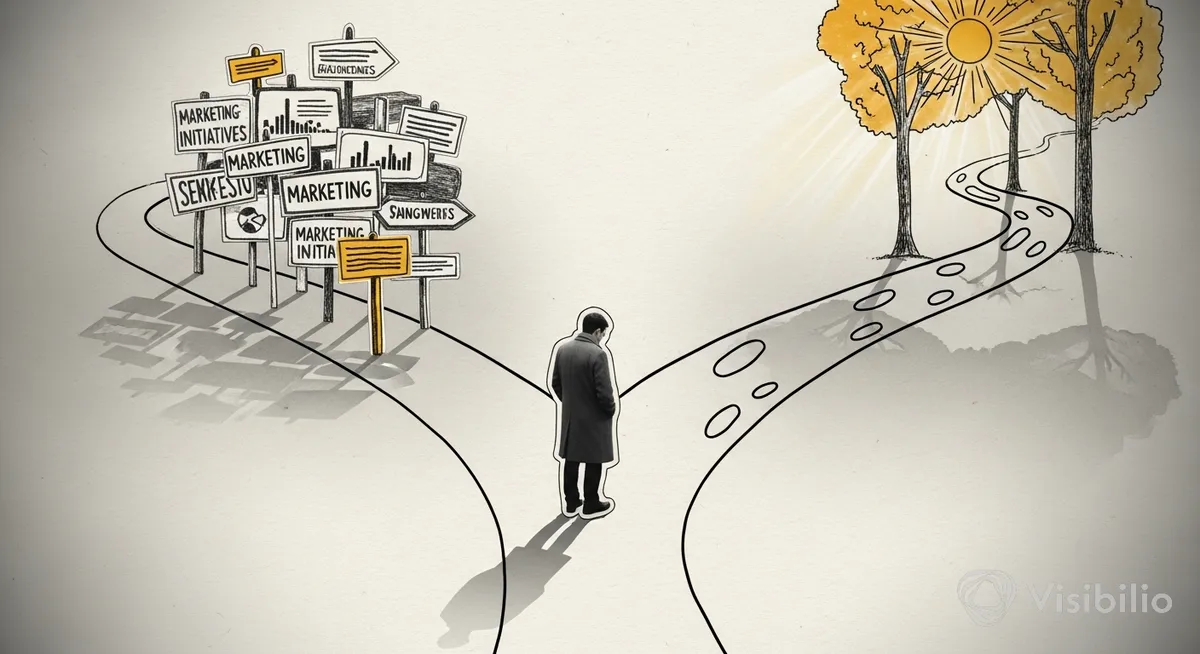
If your pipeline plan needs six channels to hit target and the handoffs are getting sloppy, you’re probably paying a hidden tax: marketing program proliferation. Not “we run multi-channel.” Actual proliferation—more initiatives, more overlapping plays, more one-off campaigns—until the buyer experience turns into noise.
Forrester’s 2026 report Marketing Program Proliferation Hurts Customer Experience And Limits Business Growth makes the core point plainly: unchecked program sprawl degrades customer experience (CX), and that drag shows up in growth. Not because channels are bad, but because disconnected execution creates fragmentation—different messages, different cadences, different definitions of “qualified,” different measurement habits.
And CX is the wrong place to get sloppy. CMSWire’s 2023 CX stats put a hard edge on it: 86% of consumers would leave a brand after just two poor experiences, and 49% have left a brand in the past year due to poor customer experience. B2B isn’t B2C, but the behavior rhyme is obvious: once trust erodes, the buyer stops taking meetings, renewals get harder, expansion takes longer, and referrals dry up.
If you only change one thing, change this: stop managing “programs by channel” and start managing one orchestrated workflow per audience segment.
Why this matters now: CX is becoming the growth constraint
The easy era—add a channel, add a tool, add a play—already feels over for most demand teams. Capacity is the limiter. In 2023, 60% of SaaS companies reported their biggest marketing problem is lack of time and resources (as summarized in the research brief). So when the org responds to performance pressure by launching yet another initiative, it’s not just inefficient. It’s self-sabotage.
The external pressure is rising too. Onramp.us cites a 2026 projection that 89% of businesses will compete primarily on customer experience. Treat that as directional, not definitive. Still, it matches what most operators see: when products converge and paid gets pricier, the experience becomes the differentiator buyers actually feel.
Here’s the tension: SaaS marketers are running multiple channels by default—email (84%), social ads (75%), content (69%) in 2023 (per the summarized channel usage stats). Multi-channel is normal. But multi-channel without orchestration is where the buyer gets whiplash.
The mechanism: how “more programs” turns into less qualified pipeline
Program proliferation doesn’t usually announce itself. It looks like “being busy.” A new webinar series. A partner co-marketing push. A field blitz. A quarterly product narrative refresh. Each one has a rational pitch deck.
Put together, they create three failure modes that show up downstream in pipeline and retention.
1) Message collisions. Different teams (brand, field, lifecycle, product marketing) ship messaging that’s individually fine, collectively incoherent. The buyer sees five angles, not one point of view. Confusion is a conversion killer. Short sentence. True.
2) Cadence pileups. Email, paid, SDR sequences, event invites all hit the same account with no shared frequency cap. It doesn’t feel “multi-touch.” It feels uncoordinated.
3) Measurement that rewards the wrong behavior. Forrester’s 2026 framing calls out an “environment of measuring marketing and sales for poor behaviors.” Translation for operators: channel dashboards reward local maxima—CTR, MQL volume, last-click conversions—while the business needs incrementality and lifecycle movement. Directional attribution is fine as a leading indicator. It’s not proof.
But the context gets even more operational. Hybrid staffing is common (56% in-house + outsourced, per the summarized staffing data). That setup can work, but it increases coordination overhead. Without a single orchestrated plan, external teams optimize for what they can see—channel metrics—because that’s what the contract tends to specify.
One primary tactic: run a “program portfolio reset” using orchestration workflows
Forrester’s answer to proliferation is marketing program orchestration: shifting from channel-specific execution to coordinated workflows, orchestrated audience segments, and metrics that reflect how revenue is created by meeting the buyer’s needs. Naomi Marr’s Forrester post also points to a practical artifact: a Marketing Program Orchestration Workflow Template that maps steps, inputs, outputs, roles, and KPIs so teams can build unified plans without subfunction overlap.
Here’s the 5-minute version you can run this week. Not a reorg. A reset.
Step 1: Pick one segment and one lifecycle outcome. Choose a segment where qualified pipeline is stalling or retention risk is rising. Then pick one outcome: new qualified pipeline, activation/adoption, renewal, or expansion. Forrester’s 2023 B2B predictions emphasized a shift toward retention and customer health (with customer health scores expected to triple on CMO dashboards in that cycle), which is a useful forcing function: stop adding acquisition programs when churn is the real leak.
Step 2: Collapse programs into a single workflow. Take every active initiative touching that segment and map it into one sequence: what happens first, what happens second, what triggers the next step. Owners and handoffs included. This is where “we’re multi-channel” becomes “we’re coherent.”
Step 3: Put one measurement spine under it. Success can’t be “each channel hit its KPI.” It has to be lifecycle movement tied to revenue outcomes. Clootrack’s 2023 stats summarize the upside: improving CX can increase sales revenues by 2–7% and profitability by 1–2%. Treat that as a business case for doing fewer things better, not as a promise you can claim from a dashboard screenshot.
Step 4: Cut overlap aggressively—and accept the trade-off. The trade-off is real: volume will often dip before quality improves. Some leads will disappear because the machine is no longer double-counting demand created by three overlapping programs. That’s not failure. That’s measurement getting closer to reality.
Run it this week: setup, hypothesis, metrics, guardrails
Setup: one segment (ICP slice + buying stage), one orchestrated workflow, one working session. Owners: Demand Gen + Marketing Ops + Lifecycle/CS (for retention workflows) + Sales/SDR lead for handoff alignment. Tools: whatever teams already use for campaign ops and reporting; the workflow is the point, not new software.
Timeline: 5 business days. Day 1 inventory programs. Day 2 map the orchestrated sequence and handoffs. Day 3 agree on measurement spine and cut list. Day 4 implement suppression/frequency caps and re-tag campaigns. Day 5 launch the consolidated workflow.
The hypothesis (make it falsifiable): If we consolidate overlapping channel programs into one orchestrated workflow per segment, then qualified pipeline conversion rate and customer health signals will improve, because buyers will experience fewer message collisions and fewer redundant touches.
Success = primary metric: stage-to-stage conversion for the segment’s core motion (for acquisition: lead to sales-accepted or opportunity; for retention: renewal rate or expansion attach). Secondary metrics = (1) contact-level frequency and unsubscribe/complaint rate, (2) sales cycle time or time-to-first-meeting for the segment. Stop-loss = if qualified pipeline volume drops more than a pre-agreed threshold (set one number internally) for two consecutive weeks without an offsetting lift in conversion quality, roll back the most aggressive cuts first.
What not to over-interpret: last-click shifts by channel. When programs get consolidated, attribution will move around even if incrementality improves. Use directional attribution as a diagnostic, then validate with holdouts where feasible.
Forrester’s 2026 claim that proliferation creates “noise” is easy to nod at and ignore. Don’t. The cost shows up as friction you can’t explain on a weekly pipeline call. The fix isn’t another program. It’s a smaller number of workflows that a buyer can actually experience as one journey.


