
Two-thirds of B2B decision-makers on TikTok say they use the platform to discover or learn about business products, software, and services. That discovery happens long before a website visit or a demo request. If your brand isn't there, you're invisible during the earliest, most formative stage of the buying journey.
The economics look compelling on paper. TikTok is 96% cheaper per view than LinkedIn, with an average engagement rate of 2.65% based on follower count. LinkedIn ads cost roughly $56 per 1,000 views; TikTok runs about $6.20. That's a 9x difference in cost per impression. And the audience has shifted: Millennials and Gen Z now make up 71% of B2B decision-makers, according to Forrester's Buyers' Journey Survey. These aren't junior researchers. LinkedIn's 2025 B2B Buyer Report found that millennials alone account for 44% of final purchasing decision-makers.
Yet most B2B accounts that rushed into TikTok came out empty-handed. The paradox is that the same metrics that made TikTok attractive also attracted a flood of generic content. Cheap views meant low barriers to entry, but they also meant audiences developed a high tolerance for ignoring what didn't grab them immediately.
The Shape That Survives
The accounts that consistently perform share a specific structure. They are founder-led or team-led. They show the product in context. They are specific to the point of being almost mundane.
Socialinsider's analysis of B2B TikTok content found that the most effective content leans into what practitioners call edutainment: quick tips, how-to's, industry insights, and behind-the-scenes looks. This is not a vague call for authenticity. It is a structural observation about what the platform rewards.
Consider the two most-cited success stories. Adobe has garnered nearly 3 million likes on TikTok by creating how-to videos that empower customers to maximize their tools. Adobe does not run polished brand ads on TikTok. It runs videos of people using Photoshop. Shopify's content focuses on entrepreneurship tips, small business success stories, and founder spotlights rather than product features. Shopify does not sell Shopify on TikTok. It sells the idea of running a business.
The pattern is consistent: show the work, not the brand. Show the person, not the logo. Show the problem being solved, not the feature list.
The Math Your CFO Needs
Before you pitch TikTok to your finance partner, model the economics honestly. Stackmatix's 2026 industry benchmarks show that SaaS and B2B Tech advertisers pay $12.50 CPM and $1.80 CPC, with cost per lead ranging from $45 to $120. Compare that to LinkedIn's $50 to $200 cost per lead and you see the opportunity, but also the constraint: TikTok's targeting is less precise for professional audiences.
Directive's 2026 analysis of TikTok vs. LinkedIn for B2B frames the trade-off clearly: LinkedIn earns its premium when professional targeting improves opportunity quality. TikTok can extend paid social reach beyond LinkedIn's finite professional audiences at a lower media cost. But CPL comparisons miss the downstream economics that determine which platform deserves more budget.
The question isn't which platform is cheaper. The question is which platform produces the strongest commercial return from additional investment at your current scale. If you've saturated LinkedIn's finite audience of security leaders or procurement managers, TikTok offers a way to reach the same people in a different context. If you're still building pipeline from LinkedIn's core targeting, TikTok may be a distraction.
A Pilot Design That Produces Signal
Run a 90-day pilot with these constraints:
Budget: $15,000 to $25,000 total. TikTok requires a $500 minimum per campaign and $50 daily at the campaign level. You need enough spend to generate statistically useful results, not just impressions.
Content: Produce 8 to 12 native videos. Do not repurpose LinkedIn posts or TV-style ads. The B2B Playbook's agency practice notes that most B2B teams repurpose LinkedIn posts or TV-style ads and wonder why they don't land. TikTok rewards native, education-first video that looks and feels like it belongs in the feed.
Talent: Use a founder, product manager, or customer success lead on camera. Not an actor. Not a voiceover. The person who actually knows the product and can speak to the problem without a script.
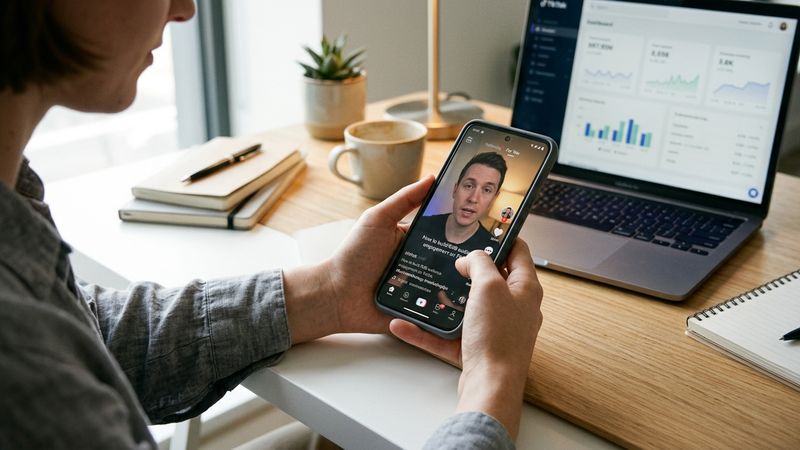
Measurement: Track three metrics that matter for B2B: engaged view-through rate (6+ seconds with focus), click-through rate to a landing page with a form, and downstream pipeline influence. TikTok's attribution window for engaged views captures conversions that last-click models miss entirely.
Holdout: If possible, run a geographic holdout to measure incrementality. Compare pipeline velocity in markets where TikTok is active versus markets where it isn't.
What Breaks and How to Mitigate
Three failure modes show up consistently:
Creative fatigue accelerates faster than on other platforms. TikTok's algorithm rewards novelty. A video that performs well in week one may crater by week three. Plan for a 2:1 ratio of creative production to active campaigns. If you're running 4 campaigns, you need 8 videos in rotation or in production.
Targeting precision is lower than LinkedIn. You cannot target by job title, company size, or industry with the same granularity. Compensate by using custom audiences from website traffic, customer lists, and engagement history. TikTok's machine learning improves with more data, so feed it signal from your CRM.
Attribution is harder to prove. TikTok influences early-stage awareness, which is difficult to connect to closed revenue in a 6-month sales cycle. Use self-reported attribution ("How did you hear about us?") on demo request forms. Track branded search volume as a leading indicator of awareness lift.
The Decision Framework
TikTok makes sense for B2B brands when three conditions are true:
First, your ICP includes buyers under 45 who consume short-form video daily. If your buyers are exclusively 55+ executives who don't use TikTok, the platform won't reach them regardless of cost efficiency.
Second, you have the creative capacity to produce native video at volume. One polished brand video per quarter won't work. You need 2 to 4 videos per month, shot on phones, featuring real employees, showing real product use.
Third, you've already saturated or are approaching diminishing returns on LinkedIn. Dreamdata found LinkedIn accounted for 41% of B2B advertising spend across its customer dataset in 2025, up from 39% the previous year. That concentration creates audience fatigue. TikTok offers a way to reach the same people in a different context, at a different moment in their day.
If those conditions aren't true, TikTok is a distraction. Invest in the channels that are already producing pipeline and revisit TikTok when your audience composition or creative capacity changes.
The brands that win on TikTok are not the ones with the biggest budgets or the slickest production values. They are the ones that understood something subtle about how TikTok works as a discovery engine rather than a broadcast channel. Show the work. Show the person. Show the problem being solved. The platform will do the rest.


