
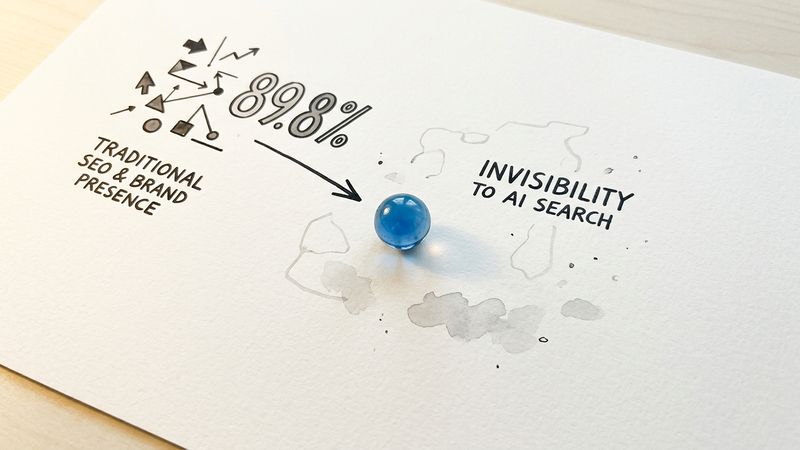
Here's a stat that should make every CMO's coffee go cold: 89.8% of 177 brands tested had zero AI mention rate across eight platforms in Q1 2026. Zero. Not "underperforming." Not "room for improvement." Invisible.
These aren't mom-and-pop shops. Many have strong traditional SEO, solid domain authority, and marketing teams who've been doing this for years. The problem isn't effort. It's that we've been optimizing for a game that's already changed while we were still celebrating our keyword rankings.
The Reading Comprehension Problem
I've got two kids, ages 12 and 9. Watching them learn to read taught me something that applies directly to what's happening in AI search right now.
My youngest could read words on a page pretty early. Phonics, check. Fluency, check. But ask her what she just read? Blank stare. Reading and comprehension are two different skills.
A recent audit of 50 major websites found exactly this pattern playing out in AI visibility. Most brands have made it easier for AI to find them. Almost none have made it possible for AI to truly understand them. And nearly two-thirds leave the question of which AI bots can access which content entirely to luck.
We've been teaching AI to read our content. We forgot to teach it what we actually mean.
Three Layers, Not One
The SEO industry has been treating AI visibility like traditional search with a fresh coat of paint. Get ranked, get found, get clicked. But that framework misses two critical layers.
Layer one is retrievability. Can AI fetch and parse your content without stumbling? This is the foundational layer most SEO teams already optimize for. Clean code, fast load times, proper indexing. If you've been doing SEO for more than six months, you're probably fine here.
Layer two is attribution and meaning. Can AI determine what your pages are about and who owns that expertise? This is where things get interesting, and where most brands are failing spectacularly.
Layer three is agency. What can AI actually do with your information once it understands it? Can it follow a recipe, so to speak? Can it connect your content to user intent in ways that generate citations?
Most marketing teams are stuck celebrating layer one while layers two and three remain completely unoptimized.
The Platform Fragmentation Nobody Talks About
Here's where it gets operationally messy. Each major AI search platform pulls from different data sources:
ChatGPT uses Bing's index. If Bing hasn't indexed your page, ChatGPT can't cite it. Perplexity runs its own crawler and indexes granular snippets rather than whole pages. Google's AI Overviews use a "query fan-out" technique, running multiple related searches simultaneously. Claude pulls from Brave Search, which has its own ranking logic entirely.
The practical implication? You may need to verify indexation across multiple search engines, not just Google. That Bing Search Console you've been ignoring? Time to log in.
The E-E-A-T Gap in AI Citations
Research shows that the average domain age of sources referenced by ChatGPT is 17 years. Seventeen. AI systems strongly favor established, consistently credible entities over newer or poorly structured sites.
This isn't about age discrimination. It's about trust signals that accumulate over time: named authors with credentials, organizational schema, external references, consistent publishing history. A page with no named author and no organizational affiliations looks indistinguishable from low-quality filler content to an AI model.
For B2B brands, this means your thought leadership strategy and your AI visibility strategy are now the same thing. Those bylined articles from your subject matter experts? They're not just brand building anymore. They're technical SEO.
The Semantic Shift
Searches containing five or more words grew 1.5 times faster than shorter queries in recent years. Users are asking questions, not typing keywords. And AI systems understand meaning, relationships between concepts, and intent.
Repeating a keyword phrase does not signal relevance to a large language model. Covering a topic comprehensively, with contextually connected content, does.
This is the death of keyword density as a primary optimization lever. For years, we've been reverse-engineering Google's black box. Now we need to reverse-engineer how language models understand expertise and authority.
The Measurement Crisis
Rankings don't equal revenue anymore. We've gone from focusing on single keywords to query fan-outs that provide a different result every time someone asks an LLM a question.
The foundational assumptions that built entire marketing departments around SEO are crumbling. Content is not just quantity and keywords. More pages does not mean more traffic. And traditional ranking reports tell you almost nothing about your AI visibility.
A study by Brightedge found that 52% of AI Overview citations came from URLs already ranking in top 10 organic positions. That's encouraging overlap, but it also means 48% came from somewhere else entirely. Half your AI visibility is being determined by signals you're probably not tracking.
What Actually Needs to Change
Stop treating AI search like a faster, smarter version of traditional SEO. It's a different discipline. The tactics that earn keyword rankings do not automatically earn AI citations.
Start with structured data that goes beyond basic schema. AI systems need to understand not just what your page is about, but who created it, what organization stands behind it, and how it connects to your broader expertise.
Verify indexation across Bing, Brave, and Google, not just your primary search engine. Each AI platform has its own data source, and if you're not indexed there, you don't exist there.
Build content around topics and user intent, not keyword lists. For each page, ask what question a user is trying to resolve, then answer it directly and completely.
And for the love of all things measurable, start tracking AI citations as a distinct metric. 37% of consumers now start their searches with AI tools instead of Google. That number has been rising for eighteen months straight. If you're not measuring your presence in those conversations, you're flying blind into a headwind.
The Real Opportunity
Here's the thing about that 89.8% invisibility rate: it means the bar is still low. Most of your competitors haven't figured this out either. The brands that move now, that treat AI visibility as a distinct technical discipline rather than an afterthought to traditional SEO, will own the citations while everyone else is still optimizing for rankings that matter less every quarter.
Marketing is like dating, remember? You don't propose on the first ad impression. But you do need to show up where the conversation is happening. Right now, that conversation is increasingly happening inside AI interfaces. And most brands aren't even in the room.


