If AI is so “critical,” why do so few people use it every day—and why does that gap keep showing up inside otherwise sophisticated organizations?
In 2026, the most revealing AI statistic isn’t about models, benchmarks, or spend. It’s the gap between belief and behavior.
On one side: 94% of global business leaders say AI is critical to success over the next five years (Query 1). On the other: only 28% of U.S. employees report using ChatGPT at work, and 22% say they use it daily (Query 1). Two facts can both be true. Together, they’re uncomfortable.
That discomfort matters because AI adoption has already moved past the “is anyone doing this?” phase. In 2025, roughly 75–78% of companies reported using AI in at least one business function (Query 3). The new dividing line is simpler: who turns scattered usage into repeatable operating advantage—and who just collects pilots.
The leadership–adoption gap is the story (not the hype)
AI has become mainstream at the company level, but shallow at the employee level. That’s not a contradiction; it’s a pattern. A business can claim AI “in one function” while most people still do work the old way, or use tools quietly, inconsistently, and without shared standards.
The context, however, is more complex. Leaders aren’t wrong to feel urgency. In 2025, spending on generative AI reached $37B, up from $11.5B in 2024 (Query 3). And 92% of organizations planned to increase AI investments over the next three years (Query 3). Money is flowing. Expectations are set.
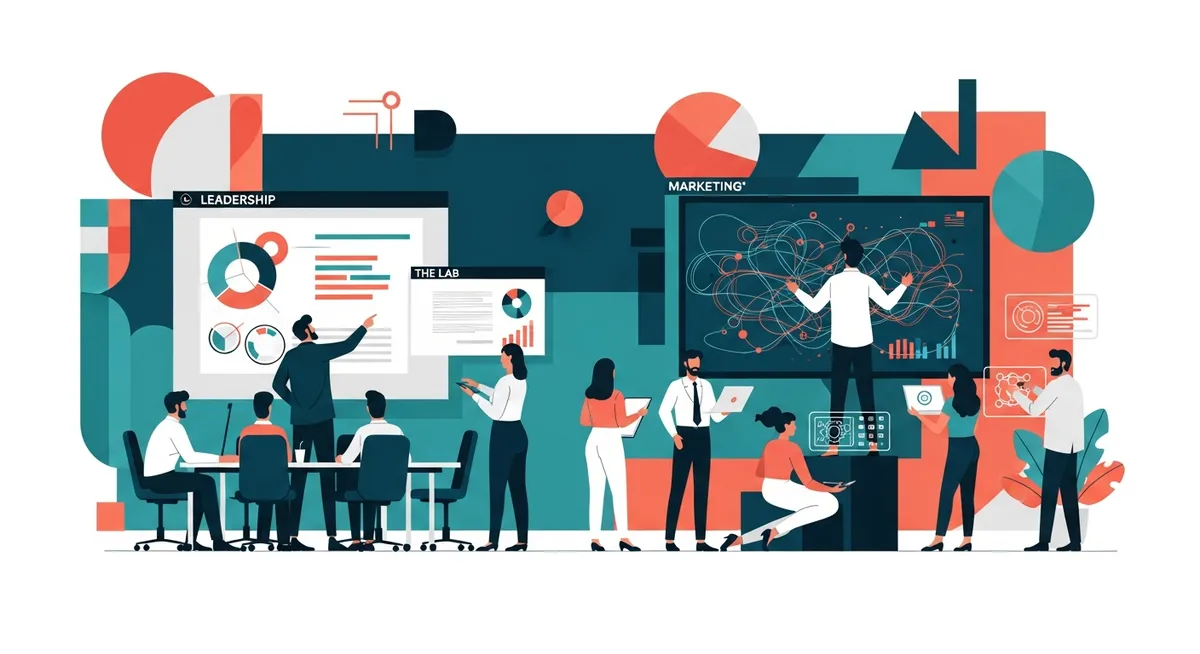
But expectations don’t redesign workflows. Decks don’t change incentives. And “AI access” doesn’t automatically become “AI habit.” This is where the Leadership–Lab–Crowd framing (popularized in the source content’s summary of Ethan Mollick’s argument) earns its keep: it’s not a slogan. It’s an operating model for learning fast without pretending certainty exists.
Leadership: role-modeling beats mandates
There’s a specific behavior difference between high-performing AI organizations and everyone else. High performers are 3x more likely to have senior leaders who actively champion and role-model AI use (Query 1). Not “support” it. Not “approve budget.” Use it, visibly, in the work.
That’s a pattern interrupt for a lot of executive teams. Many still treat AI as a technology program—something to delegate to IT, innovation, or a vendor. But the data says the performance edge shows up when leadership treats adoption as culture change and operating discipline.
Here’s the practical implication: leaders can’t only announce what’s allowed. They have to show what “good” looks like. What gets automated. What gets checked. What must never be pasted into a public tool. What quality looks like when a draft is AI-assisted. Short sentence. Employees copy what leaders do.
And governance doesn’t have to be the villain in this story. In fact, Responsible AI ownership is shifting toward first-line teams: 56% of executives say IT/engineering now lead Responsible AI efforts (Query 1). That shift reframes governance as quality enablement—clear standards, approved tools, and safe defaults—rather than a compliance gate that arrives after the work is done.
The Lab: stop treating pilots as outcomes
By 2026, the most common AI failure mode isn’t “we didn’t try.” It’s “we tried everywhere, but nothing stuck.” The reason is structural: pilots are easy to start and hard to integrate, especially when data access, procurement, and risk review all run on different clocks.
So the Lab’s job isn’t to produce demos. It’s to turn learning into infrastructure: reusable patterns, evaluation methods, and distribution. A centralized team—part technologists, part domain experts—can do three things that scattered experimentation can’t.
First, it can set benchmarks that are actually comparable across teams. Second, it can prototype quickly enough to answer, “Is this worth integrating?” before a quarter disappears. Third, it can standardize what “approved” means in a world where buying is now the default.
That last point has become unavoidable. In 2025, 76% of AI use cases were bought externally rather than built in-house, up from 53% in 2024 (Query 3). Buying speeds time-to-value. It also changes the risk profile—vendor dependency, data handling, and model behavior become procurement and architecture questions, not just product features.
Seen from the other side, the Lab is also how organizations cope with rising external pressure. In 2024, U.S. federal agencies issued 59 AI regulations—double the prior year—and global legislative mentions of AI rose 21.3% (Query 1). When the regulatory surface area expands, “everyone pick a tool” stops being a harmless phase.
The Crowd: adoption is discovered, not rolled out
Even in organizations with strong leadership intent and a competent Lab, the Crowd still determines whether AI becomes real. Why? Because employees find the use cases that no steering committee can predict: the tiny handoffs, the repetitive rewrites, the analysis steps that nobody enjoys but everyone needs.
This is where the leadership–adoption gap becomes actionable. If only 22% use ChatGPT daily at work (Query 1), the constraint isn’t awareness. It’s friction: uncertainty about what’s allowed, inconsistent quality standards, and a lack of workflow redesign.
Expert guidance for 2025 emphasized scaling beyond pilots through workflow redesign, AI agents/hyperautomation, and stronger infrastructure and operating models (Query 2). That matches what many enterprises are chasing: hyperautomation is a priority for 90% of large enterprises (Query 2). Over 50% of companies are using AI agents to reduce repetitive work by 30–50% (Query 2). Those numbers are the promise. The Crowd is how the promise becomes daily practice.
But there’s a catch. Crowd-led experimentation without shared guardrails creates hidden risk and uneven outcomes—especially when most organizations are increasing AI investments anyway. And while adoption is widespread at the company level, transformation expectations can still be muted: fewer organizations expect high transformation in 2025 (Query 3), suggesting ROI stays uneven when workflows remain unchanged.
The better approach—actually, the only approach that scales—is a feedback loop. Leadership sets direction and standards. The Lab makes safe, repeatable patterns. The Crowd discovers what works in real workflows, then feeds those wins back into the system.
Back to the opening gap: 94% conviction, 22% daily use. Closing it won’t come from another strategy cycle. It comes from making AI normal—visible in leadership behavior, supported by a Lab that builds guardrails as enablement, and powered by a Crowd that’s allowed to learn out loud. That’s how “AI is critical” stops being a belief and starts being a habit.


