
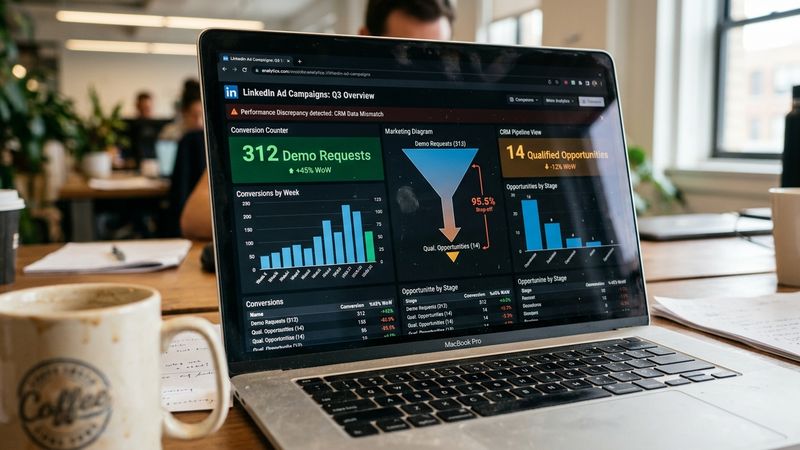
Your LinkedIn Campaign Manager shows 300 demo requests. Your CRM shows 14 new opportunities. The CFO asks which number is real, and you're stuck explaining why neither tells the whole story.
This is the B2B attribution gap in its purest form: the distance between what your ad platform reports and what actually moves through your pipeline. LinkedIn's native tracking tools have improved significantly, but the gap persists because the problem isn't technical. It's structural. B2B buying happens across months, involves multiple stakeholders, and rarely ends on a single converting click. No pixel can capture that.
The Insight Tag's Blind Spot
LinkedIn's Insight Tag is a lightweight JavaScript snippet that fires in the browser when a visitor converts. It works well when the browser cooperates. The problem is that browsers increasingly don't cooperate.
According to DataCops, 40 to 50 percent of B2B decision-makers block the Insight Tag before it fires. Ad blockers intercept the script from snap.licdn.com, a third-party domain sitting on every filter list. Apple's Intelligent Tracking Prevention caps first-party cookies at seven days on Safari. Privacy browsers like Brave and Firefox block third-party scripts by default.
The irony is painful: you're spending $10 to $15 per click to reach senior buyers, and those same buyers are technically sophisticated enough to disable your tracking. Your DevOps director with uBlock Origin, your CISO using Brave, your procurement VP on Firefox with enhanced tracking protection: all invisible to the Insight Tag the moment they land on your page.
Then there's the sales cycle problem. LinkedIn extended their attribution window to 365 days specifically because B2B deals take time. But if a buyer clicks your ad in January and closes in July, and ITP expired their cookie on day seven, LinkedIn never connects those dots. As Impactable notes, the Insight Tag alone was never built for this kind of attribution.
CAPI Closes Part of the Gap
LinkedIn's Conversions API (CAPI) addresses the browser problem by establishing a server-to-server connection between your systems and LinkedIn's ad platform. Instead of relying on a browser-based pixel, your server sends conversion data directly to LinkedIn.
According to LinkedIn's documentation, CAPI allows you to connect both online and offline data, measure performance across your entire customer journey, and strengthen performance with a reliable connection that doesn't rely on cookie-based tracking. When used alongside the Insight Tag, LinkedIn deduplicates events so conversions aren't counted twice.
LinkedIn's own beta data shows advertisers using CAPI saw a 31 percent increase in attributed conversions compared to traditional tracking methods and a 20 percent decrease in cost per action. Those using Qualified Lead Optimization saw a 39 percent decrease in cost per qualified lead.
The implementation path matters. LinkedIn offers two approaches: partner integrations for teams that want limited technical lift, or direct API integration for teams that want full control and have developer resources for ongoing maintenance. Direct integration typically takes two to four weeks.
The Deeper Problem: Signal Corruption
CAPI solves the pipe. It doesn't solve the water.
DataCops makes a critical distinction: the root problem in B2B conversion tracking is not signal loss. It's signal corruption. Signal loss is recoverable. Signal corruption compounds.
B2B lead generation on LinkedIn attracts form-fill bots and data scrapers alongside actual decision-makers. Your $10 clicks bring in automated traffic from lead intelligence tools, competitor reconnaissance scripts, and fraud bots submitting contact forms. When those bot-generated "leads" flow through a standard CAPI setup, they land in LinkedIn's optimization dataset as valid conversions. LinkedIn's algorithm learns to find more traffic that behaves like your bots. Your Lookalike Audiences degrade. Your CPL climbs. Your team runs another creative test when the problem is upstream.
Account-Level Attribution: Where B2B Actually Lives
ZenABM's benchmarks put the median deal open rate from ad-influenced accounts at 0.58 percent. That means for every 170 accounts influenced by your LinkedIn ads, roughly one opens a deal. This is the conversion metric that matters for B2B: not form fills or content downloads, but actual pipeline creation.
DemandSense frames the attribution question correctly: does your platform connect ad activity to what actually happens in your CRM, not just form fills and website visits? Does it track influence at the account level, since B2B deals are won by committees, not individual leads?
Most attribution models were built for shorter, single-buyer journeys. First-touch gives 100 percent credit to the first interaction and ignores the sales calls that actually closed the deal. Last-touch gives 100 percent credit to the final interaction and ignores everything that built the pipeline months earlier. Linear treats a passing ad view the same as a demo request. Time decay undervalues early-stage awareness work.
SegmentStream captures the timing problem precisely: leads are fast but noisy, revenue is true but slow. The channels that produce the cheapest leads are often the channels that produce the worst pipeline. Display and broad-match search generate high lead volume at low cost. Sales works those leads for months and closes almost none. Meanwhile, a niche LinkedIn campaign produces fewer leads at higher CPL, but those leads close at three times the rate with twice the deal size.
You cannot see this without connecting CRM data to attribution.
Building a Defensible Measurement Stack
Verto Digital's pipeline intelligence framework breaks the problem into three stages: capture (server-side tracking with event taxonomy mapped to your buyer journey), identify (first-party identity resolution with ICP scoring), and activate (deal-stage signals fed back to ad platforms live).
The goal at every stage is the same: get deal-stage signals from your CRM back to the ad platform algorithms. When LinkedIn's algorithm learns from Closed/Won data instead of form fills, it optimizes for the traffic that actually converts to revenue.
Improvado's 2026 guide recommends 7-day click attribution (not the 1-day default), CRM real-time sync for closed-loop tracking, and a minimum $6K monthly budget with 50K to 500K audience size. The math breaks when deal sizes drop below $5K or sales cycles compress under 30 days.
The Two-Week Pilot
Start with what you can measure today. Install CAPI alongside your existing Insight Tag. Map your CRM stages to LinkedIn conversion events: MQL, SQL, Opportunity Created, Closed/Won. Set attribution windows that match your actual sales cycle, not LinkedIn's defaults.
Then run the comparison. Pull 90 days of LinkedIn-reported conversions against CRM-verified pipeline. Calculate the delta. That number is your attribution gap, and it's the number your CFO actually needs to see.
The gap won't close completely. B2B buying is too complex for any single measurement system. But the goal isn't perfect attribution. It's defensible attribution: a model where the assumptions are explicit, the sensitivities are documented, and the forecast connects to something Finance can verify in the CRM.
Model or it didn't happen.


