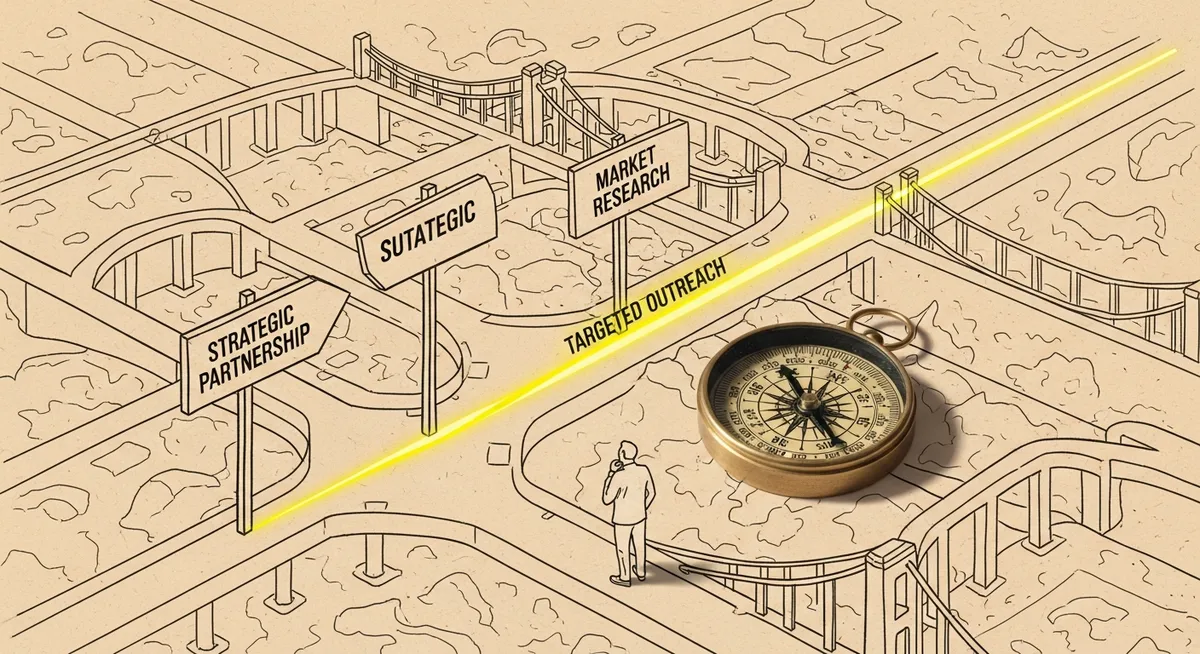
If outbound meetings are stuck and headcount is capped, the bottleneck usually isn’t “more activity.” It’s time. It’s targeting. It’s the invisible hours reps burn doing manual research, chasing bad titles, and working accounts that were never going to convert.
HockeyStack’s CRO, Emir Atlı, described that constraint bluntly in a write-up about an internal push called Project Nova: the revenue target demanded the output of a much larger SDR team, but hiring wasn’t on the table. The response wasn’t to squeeze more dials out of the same people. It was to rebuild how accounts get selected, researched, and routed into outreach.
The headline result: using HockeyStack’s Account Intelligence product plus Outreach and Nooks, the team reported going from 5 meetings per SDR per week to 15 per week in a quarter—with the same six SDRs.
That claim is a useful prompt for any demand gen leader in 2026. Not because “3x” is a universal expectation (it isn’t), but because it points at the right lever: an account-intelligence operating system that turns signals into prioritized work, fast enough that reps actually use it.
Why this matters in 2026: meetings aren’t scarce, rep time is
Outbound hasn’t died. But the economics have tightened. When close and win rates are under pressure (2023 context data cited 29% average close rate and 21% win rate in outbound performance discussions [3]), “more at-bats” isn’t automatically a good plan. You can scale meetings and still lose, just faster.
Meanwhile, multiple sources in the brief point to the same structural issue: reps spend a minority of their week actually selling. One stat used often in this conversation is that sellers spend only 28% of their time selling, with the rest going to admin and other work [4]. That’s the real villain. Not effort. Friction.
So the question isn’t “how do we book more meetings?” It’s “how do we convert rep-hours into better meetings—without adding headcount?” That’s where account intelligence earns its keep.
The one move: turn account intelligence into workflows, not tabs
If you only change one thing, change this: stop treating research as an artisanal craft done in browser tabs. Treat it as a repeatable system that produces a ranked list of accounts and contacts, with reasons attached, and pushes that work into the tools reps already live in.
Project Nova’s core idea was operational, not philosophical. Atlı lays out a progression: start with a pipeline target, translate it into opps needed, then translate opps into SDR capacity and activity. In the source, the model example is explicit: $1M in qualified pipeline at $50K ACV ⇒ 20 opps, then adjusting for stage conversion (70% S0 to S1 ⇒ 29 opps). The point isn’t that those exact ratios apply to every org. It’s that the math forces clarity about what must be true.
But math alone doesn’t create meetings. The next step is the operating system: lists, signals, enrichment, and routing—wired together.
In Nova, the requirements were practical: accurate phone numbers and emails for a defined ICP (B2B software in the US/Canada/UK, 300–10,000 employees), automated tracking of signals (site visits, third-party research, LinkedIn activity), scalable account research (competitor usage, hiring signals), and the basics of execution (sequencer + parallel dialer). Their stack: HockeyStack Account Intelligence for list building, signal tracking, and workflows; Outreach for sequencing; Nooks for dialing.
Here’s the pattern worth copying: workflows that produce work. Not dashboards that produce opinions.
How it works in practice: cold lists, then signal-based prioritization
Nova started with automating list building: create a view of accounts that match ICP, qualify them as B2B, find contacts that match buyer-persona criteria, sync to Salesforce, and then sequence into cold-call sequences. That’s the “cold” baseline.
Then the system got sharper by incorporating first-party and enriched signals. The source lists the exact signals they chose to operationalize, including:
- Pricing and Contact Sales pageviews
- Interactive demo views
- LinkedIn ad engagements/comments
- Template library pageviews
- SDR email opens
- Closed-lost accounts from the last 180 days (excluding bad fits) that returned to the website
That’s the shift that aligns with the broader expert perspective in the brief: SDRs increasingly function as an “intelligence hub” (connective tissue across marketing, sales, and ops), using account insights to prioritize and tailor messaging by persona priorities and awareness stage [1].
But the part most teams miss is speed. Incredible Health’s 2023 case study in the brief is a clean reference point: by replacing manual prospect research with Salesmotion to centralize account intelligence, they increased quarterly outbound meetings by 50% without adding SDR headcount [2]. Implementation took 3 days, and reps could access insights in 30 seconds [2].
That “30 seconds” detail matters more than it sounds. If insights take five minutes to find, they won’t be used consistently. If they’re one click away, they become habit.
What to measure (and what not to over-interpret)
Meeting count is a leading indicator. It’s also a trap.
Experts in the brief explicitly recommend moving SDR measurement away from lead volume and activity and toward account-centric outcomes: account engagement, coverage, meetings per account, pipeline influenced, and account progression over time [1]. That’s the right correction, especially when SDR outbound is often credited with 31–40% of pipeline in some orgs [3]. If that’s even directionally true in a given business, measurement sloppiness becomes expensive.
So the better scoreboard for this play is:
- Primary metric: meetings per SDR per week with an ICP-qualified rate attached (define your own qualification gate; don’t outsource it to last-click attribution).
- Secondary metrics: opportunities created per account worked; pipeline influenced per SDR (directional attribution is fine—just don’t claim incrementality from CRM sourcing alone).
- Guardrails: no increase in no-show rate; no increase in spam complaints/deliverability incidents; stable or improving stage conversion from first meeting to next step.
The trade-off: automation buys time, but it can also buy noise
Nova’s write-up is unusually honest about the cost: “It took a TON of work, and we made a lot of mistakes.” The mistakes are the real playbook.
Four are worth underlining:
- CRM gaps kill throughput. They found supplementing CRM records with net-new contacts was critical; the system surfaced missing contacts that matched buyer personas and sequenced them.
- Feedback loops must be near-real-time. They used a spreadsheet and Slack channel, with SDR feedback coming roughly every 30 minutes, and fixed bad titles/inaccurate data quickly.
- Start narrow. Broad titles and industries created lots of bad matches and wasted time. Expand incrementally.
- Own the workflows internally. Without an internal operator who understands the logic, execution slows down and agencies become a bottleneck.
That last point connects to a broader risk in AI-assisted outbound: quality can degrade into spam if personalization is shallow or data is wrong. The brief calls out that AI can handle repetitive tasks, but it still needs human oversight to avoid low-quality outreach [2][6]. In some commentary, oversight can be non-trivial (e.g., 15–20 hours weekly of coaching time cited) [2][6]. Time doesn’t disappear; it moves.
Run it this week: a practical setup, not a tool shopping list
Here’s the 5-minute version you can run this week—using whatever stack you already have, as long as it can (1) track signals, (2) enrich contacts, and (3) push prioritized work into sequencing and dialing.
Hypothesis (make it falsifiable): If we route SDR effort to accounts showing high-intent first-party signals (and restrict titles to a tight buyer-persona set), then meetings per SDR per week will increase within one sales cycle because reps will spend less time researching and more time in relevant conversations.
Setup: pick 200–500 ICP accounts; pick 3–5 titles max; define 5–7 intent signals you already capture (pricing/contact sales pageviews and demo interactions are the cleanest starting points if available); assign one operator owner (RevOps or SDR ops) and one SDR pilot.
Launch: build two queues for the pilot SDR: (1) cold ICP accounts, (2) signal-based accounts. Push both into the same cadence tool so the only variable is prioritization and research automation.
Readout (end of week 2): compare meetings booked per hour worked, not just total meetings. Add a simple quality check: % of meetings that reach a defined next step.
Stop-loss: if meeting volume rises but next-step rate drops meaningfully, pause expansion and tighten titles/industries before adding more volume. Meeting inflation is easy. Qualified pipeline is not.
Project Nova’s promise wasn’t “work harder.” It was “make the SDR team an intelligence system.” That’s the only version of outbound scale that still makes sense in 2026: less tab-hopping, fewer bad accounts, faster feedback, and measurement that punishes noise. The meeting number is the headline. The operating system is the story.


