
Here's the thing about search intent in 2026: everyone's been telling you it's dead. AI answers the question, the user moves on, game over. Except that's not what the data shows. Two major studies released this year tell a more interesting story, one where the four classical intent buckets (informational, navigational, commercial, transactional) are very much alive. They've just learned to speak a different language depending on which AI engine is listening.
Let me walk you through what actually happened to search intent, because the lazy "AI killed SEO" narrative is about as useful as a QR code on a billboard.
The Redistribution Nobody Predicted
Fractl and Search Engine Land analyzed over one million high-volume keywords across 379 brands in eight verticals. The headline number: 29% of search demand is in measurable decline. That's four percentage points above Gartner's original 25% forecast.
But here's where it gets interesting. The 285,489 declining keywords represent about 10.29 billion monthly searches. The 140,835 growing keywords? They account for 10.31 billion. Net change across the entire dataset: +16.8 million searches per month. Fewer keywords are growing, but each growing keyword carries more volume.
Search demand didn't evaporate. It relocated.
The pattern tracks with how information-heavy a category is. FinTech saw the steepest decline at 37.7%. Lifestyle had the smallest at 15.2%. Where a chatbot can provide a complete answer (drug interactions, deductible explanations, quick fund overviews), search volume drops. Categories that require comparison, purchase, or navigation to a specific site retain more demand.
Intent Didn't Flatten. It Fragmented.
The second study comes from BrightEdge's AI Hyper Cube research, which analyzed prompts across Google AI Overviews and ChatGPT. The prevailing assumption was that AI had flattened query intent into one mode: people ask, AI answers, done.
The data says otherwise. Informational intent still dominates, as it always has. But navigational, commercial, and transactional intent all appear in measurable share across both engines. More importantly, each of the four classical intent buckets has taken on a different shape depending on which AI engine the user is querying.
The same underlying user behavior produces fundamentally different query syntax, different content requirements, and different citation patterns across engines. A user researching running shoes on ChatGPT phrases the query differently than on Google AI Overviews, and the content that gets cited in each response follows different patterns.
This has direct implications for any brand thinking about where AI search fits in the consumer journey. AI is no longer just a research tool. It's encroaching on the entire funnel.
The Middle of the Funnel Is Collapsing Fastest
Here's the counterintuitive finding from the Fractl study: middle-of-funnel comparison queries are collapsing at 36%, not top-of-funnel informational queries as most marketers expected. The "best X vs Y" and "which product should I choose" queries are exactly the ones AI can synthesize from multiple sources and deliver without requiring a click.
McKinsey's research puts the commercial stakes in perspective: $750 billion in US revenue will funnel through AI-powered search by 2028. Half of consumers polled now intentionally seek out AI-powered search engines, with a majority saying it's the top digital source they use to make buying decisions.
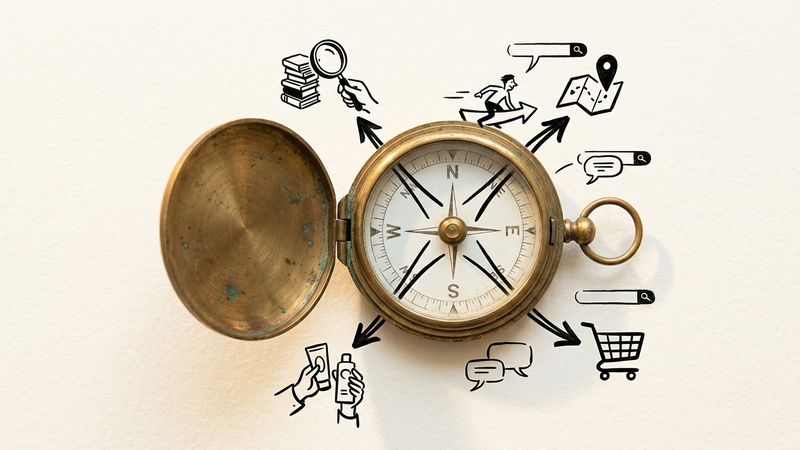
The decision-making is moving upstream. By the time a user clicks through to your site, they've already formed opinions based on what the AI told them. The remaining clicks from traditional search are more likely to come from informed consumers further along the purchase funnel.
Zero-Click Is Real, But Context Matters
Ahrefs found that AI Overviews now reduce clicks to top-ranking content by 58%, up from 34.5% in April 2025. The CTR suppression nearly doubled in eight months.
But here's what the zero-click panic misses: Fractl's consumer survey found that 70% of consumers say they use AI tools more than last year, while only 17% say they're using traditional search less. Most people aren't replacing one behavior with another. They're adding steps, skipping steps, and changing the order depending on the task.
The practical implication? Your keyword portfolio may be leaking demand on one side while a smaller set of higher-volume queries absorbs it on the other. The SEO audit question isn't "are rankings up or down?" It's "which side of the ledger are we sitting on for high-value queries?"
What This Means for Your Strategy
The data points to a few uncomfortable truths:
Non-branded queries are the vulnerable class. Across the Fractl dataset, 90% of all tracked search volume is non-branded. That number climbs to 99.6% in HealthTech and 98.5% in Wellness. When a query doesn't include a brand name, there's no specific site the user has to reach. AI answers the question, the session ends, and the user never visits a search result page.
Vertical-specific trends matter more than aggregate numbers. HealthTech had a 0.4x growth-to-decline ratio, while Lifestyle and SaaS were at 2.6x and 2.5x. The strategy shouldn't be "optimize everything for AI." It should be: identify the non-branded informational queries AI can fully satisfy, separate them from queries that still trigger comparison or purchase behavior, and find the growing keyword clusters where demand is concentrating.
Citation is the new ranking. BrightEdge research shows that AI engines frequently rely on a concentrated set of sources when generating recommendations. In some industries, the top five publishers and platforms account for a quarter of all citations in AI-generated recommendations. Being mentioned in the answer matters more than ranking in the results.
The Uncomfortable Question
Eighteen percent of consumers in the Fractl study have made a purchase based on an AI recommendation without verifying through search. Gen Z and millennials are 2.5x more likely to do this than baby boomers. That's an emerging "zero-search" purchase path that most brands aren't even measuring, let alone optimizing for.
Marketing is like dating, remember? You don't propose on the first ad impression. But AI is changing the courtship. The first impression might now be an AI-generated summary that names your competitor and not you. By the time the user gets to your site, they're not discovering you. They're validating a decision they already made.
The four intent buckets aren't dead. They've just moved into a house with multiple entrances, and most brands are still standing at the front door wondering why nobody's knocking.


