
Three years of flying blind on Business Profile posts just ended. Google quietly restored view counts this month, and if you're running local or regional campaigns in Europe, you now have two data shifts to model into your attribution stack before Q4 planning locks.
Let me walk through what changed, what it means for your forecast, and where the math gets tricky.
The EEA Layout Shift: Your Rank Tracking Just Got Noisier
Google Search Central documented on September 8 that commercial queries in the European Economic Area now render differently. Aggregators get a dedicated unit with the top-ranked provider expanded by default; direct suppliers get their own unit, but only when an aggregator unit is also present. Google also published a hub covering seven regional features across the EEA, Türkiye, and South Africa.
The operational implication is straightforward: if your Search Console data from Germany, France, or the Netherlands shows a position drop this month, you may be looking at a layout change rather than a ranking change. The query still returns your page. It just renders in a different container, and your rank tracker may not parse that container the same way it parsed the old SERP.
For CMOs with European revenue targets, this creates a measurement contamination problem. Your SEO team reports a decline. Your paid team sees stable CPCs. Finance asks why organic pipeline softened while paid held. The answer might be "nothing changed except the UI," but proving that requires isolating EEA traffic, comparing click-through rates pre- and post-September 8, and checking whether the queries triggering the new units overlap with your high-intent keywords.
If you don't have that segmentation in place, you're guessing. And guessing in a board review is expensive.
Post Views Return After a 42-Month Gap
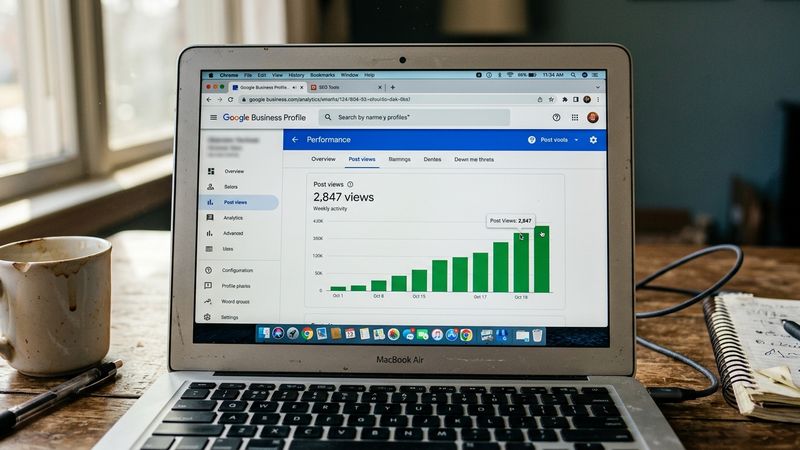
The second shift is more useful, though it comes with its own caveats. Google's September Small Business Bulletin confirmed that view counts are rolling out globally on Business Profile posts. The metric covers posts from the past 18 months, combines views from Search and Maps, and appears directly on each post card in the dashboard.
This matters because post performance has been a blind spot since February 2023, when Google retired the previous metrics with no replacement. If you've been publishing offers, updates, or event posts to your Business Profile, you've had no signal on whether anyone saw them. Now you do.
The catch: Google restored views, not clicks. The old metric showed both. The new one shows only impressions. You know a post was seen; you don't know if it drove action. That's a meaningful gap if you're trying to tie local content to pipeline.
For multi-location brands, the math gets interesting. You can now compare view counts across locations, normalize by market size, and identify which post types (offers vs. updates vs. events) generate the most visibility. That's a content-mix optimization problem you couldn't solve before. But you still can't close the loop to conversions without layering in your own tracking: UTM parameters on post links, call tracking on the phone number, or foot traffic attribution if you're running that stack.
The data isn't in the API yet, per Google's announcement. So if you're pulling Business Profile metrics into a BI tool or a multi-location dashboard, you're stuck with manual pulls until Google ships the endpoint. Plan accordingly.
ChatGPT Shopping and the Feed-Integration Signal
The third development is less immediately actionable but worth watching. Data from Profound indicates that ChatGPT Shopping's product recommendations shifted dramatically toward feed-integrated sources in July, jumping from 8.26% to 61.54% of recommendations on July 10 across nearly 1.8 million tracked prompt runs.
If you're in e-commerce or have a product catalog, this is a signal that structured feeds may start mattering for AI-driven discovery the way they've mattered for Google Shopping. The sample is one month, the methodology is third-party, and the effect may not hold. But if your product data isn't in a clean, feed-ready format, you're potentially invisible to a growing discovery channel.
For B2B, the direct relevance is limited unless you're selling physical products. The indirect relevance is strategic: AI shopping interfaces are pulling from structured data, not just crawled pages. If that pattern extends to B2B discovery (and there's no reason it won't), your content strategy needs to account for structured data as a first-class input, not an afterthought.
What to Model Before Q4 Lock
Here's the pilot checklist I'd run before finalizing Q4 plans:
First, segment your Search Console data by EEA vs. non-EEA and compare click-through rates for commercial queries before and after September 8. If CTR dropped in EEA but held elsewhere, you're seeing a layout effect, not a ranking effect. Document that for your CFO before someone asks why organic pipeline softened.
Second, pull your Business Profile post views for the past 18 months and build a baseline. Compare view counts by post type, by location, and by day of week. You now have enough data to run a content-mix test: publish offers in half your locations and updates in the other half, measure view differential, and decide whether the lift justifies the creative cost.
Third, audit your product feed hygiene. If you're running any e-commerce or marketplace motion, check whether your feed is structured, current, and syndicated to the platforms that matter. The ChatGPT Shopping shift may be a leading indicator; you don't want to be six months behind when the channel scales.
The Forecast Implication
None of these changes are catastrophic. They're calibration problems. Your EEA traffic didn't collapse; it's rendering differently. Your Business Profile posts didn't stop working; you just couldn't see them. Your product catalog didn't become irrelevant; it may need to be structured for new surfaces.
The risk is misattribution. If you don't adjust your models for the EEA layout change, you'll over-correct on SEO spend. If you don't use the new post views to optimize content mix, you'll keep publishing blind. If you don't watch the feed-integration trend, you'll miss a channel shift.
Model the changes. Update your assumptions. Show the math. That's how you keep marketing a revenue-predictable engine instead of a cost center that surprises Finance every quarter.


