
Sixty percent of YouTube sales contribution comes from ad creative. When that creative is optimized for local markets, brands can more than double ROI. Those numbers, drawn from Google's Ekimetrics meta-analysis spanning 44 models and 2,096 campaigns, explain why the new AI video dubbing capability in Asset Studio deserves a seat in your next pipeline review.
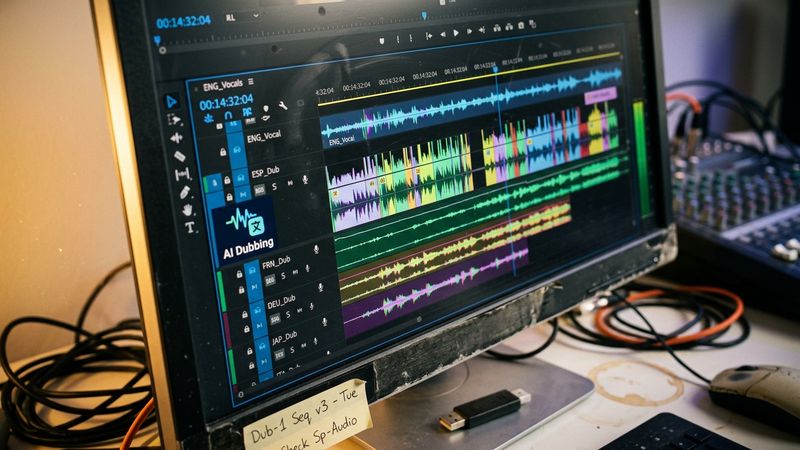
Google has rolled out an AI-powered Video Ads Dubbing tool within Asset Studio, its centralized creative hub inside Google Ads. The feature generates what Google describes as accurate, natural-sounding, and hyper-realistic audio dubs from existing video assets, according to Think with Google's localization guidance. For B2B marketers running international campaigns, this shifts the economics of video localization from a production line item to a platform feature.
The Unit Economics Shift
Traditional video dubbing runs $50 to $150 per finished minute for professional voiceover, plus studio time, talent coordination, and post-production. A 30-second spot localized into five languages could easily consume $2,000 to $5,000 in production costs before media spend begins. The timeline? Two to four weeks if your agency is responsive.
Asset Studio collapses that workflow into the same interface where you're already building campaigns. Upload your source video, select target languages, and the AI generates dubbed versions you can deploy directly to YouTube campaigns. The marginal cost of adding a sixth or seventh language approaches zero once the source asset exists.
This matters for CAC payback calculations. If your current model assumes video creative is a fixed cost amortized across English-speaking markets only, the dubbing tool changes the denominator. The same creative investment can now reach German, Spanish, French, and Japanese audiences without proportional production increases.
Where This Fits in the Asset Studio Stack
Asset Studio has evolved into Google's answer to the creative fragmentation problem. The platform now includes the Nano Banana Pro image generation model, multimodal video creation powered by Gemini and Veo, and a unified prompt interface that generates images, text, and video from a single brief. Video dubbing slots into this ecosystem as the localization layer.
The workflow integration is the real value. Rather than exporting assets to a third-party dubbing service, waiting for delivery, then re-uploading to Google Ads, the entire process stays within the platform. This reduces handoff errors, version control issues, and the inevitable which file is the final file conversations that plague international campaigns.
Google's Campaign Translator tool already covers text ads across Search, App, and Performance Max campaigns with over 200 language pairings. Video dubbing extends that same logic to the format that drives the majority of YouTube's sales contribution.
The 82% Problem
CSA Research data shows 82% of shoppers are more likely to buy a product if an ad is in their own language. For B2B marketers, the implication is clear: that enterprise prospect in Munich watching your product demo in English is statistically less likely to convert than one watching the same demo in German.
The barrier has always been production economics. A mid-market B2B company running YouTube campaigns in three languages already faces meaningful creative overhead. Expanding to seven or ten languages meant either accepting lower production quality or accepting that certain markets would remain English-only.
AI dubbing removes that constraint. The question shifts from can we afford to localize? to which markets justify the media spend? That's a healthier strategic conversation.
Risks and Mitigations
AI-generated audio carries quality variance. The hyper-realistic claim in Google's documentation will need validation against your specific use cases. Technical product demos with specialized terminology may require human review of translations before dubbing. Brand voice consistency across languages remains a governance challenge regardless of the production method.
Run a controlled test before scaling. Take one high-performing English video, generate dubs in two or three target languages, and deploy to a holdout audience segment. Measure completion rates, click-through, and downstream conversion against your English baseline. If the AI-dubbed versions underperform by more than 10-15%, you've identified a quality gap worth addressing before broader rollout.
The SynthID watermarking built into Asset Studio means AI-generated content is identifiable. For regulated industries or markets with emerging AI disclosure requirements, this provides an audit trail. Check with your legal team on disclosure obligations in target markets before deployment.
The Pilot Framework
Week one: Identify your top three performing YouTube video assets by conversion rate. Select two target languages where you have existing pipeline but limited localized creative.
Week two: Generate AI-dubbed versions in Asset Studio. Have a native speaker on your team or a translation partner review the output for accuracy and brand voice alignment. Flag any terminology issues for correction.
Week three: Deploy dubbed versions to existing campaigns targeting those language markets. Set up A/B tests comparing dubbed creative against English-only or subtitle-only variants. Establish baseline metrics for completion rate, CTR, and cost per qualified lead.
Week four: Review performance data. Calculate the incremental cost per lead in localized markets versus your English baseline. If the economics work, expand to additional languages. If they don't, document the quality gaps and determine whether human post-editing of AI dubs would close the performance gap.
The Board Conversation
When your CFO asks about the AI video dubbing investment, the answer is straightforward: there is no incremental investment. The capability is embedded in Asset Studio, which is embedded in Google Ads, which you're already paying for through media spend.
The real question is opportunity cost. Every month you run English-only video creative in multilingual markets, you're leaving conversion rate on the table. The 82% preference for native-language advertising isn't a soft metric; it's a direct input to your CAC model.
Model the impact. If localized video creative improves conversion rates by even 15% in non-English markets, what does that do to your blended CAC payback? What does it do to your pipeline coverage in EMEA or APAC? Those are the numbers that belong in your next forecast review.
The dubbing tool doesn't change your strategy. It changes the cost structure of executing a strategy you probably already know is right.


