
Three months ago, your AI referral traffic was a rounding error buried in Direct. Now it has its own row in the Default Channel Group report. The question is whether that row belongs in your board deck, or whether it's a floor you need to build on before anyone signs off on an AI content strategy.
On May 13, 2026, Google Analytics 4 shipped a native AI Assistant channel that automatically classifies sessions from ChatGPT, Gemini, Claude, Copilot, Deepseek, and Grok. No regex, no custom channel groups, no editor-level access required. For teams that spent the past year wiring up workarounds, that's a genuine convenience. For teams that haven't touched AI attribution at all, it's a baseline that didn't exist 90 days ago.
The update matters because it closes a specific gap: the inability to compare AI assistant traffic against organic search, paid, and email in the same acquisition report. Before May, AI referrals either landed in Referral (if the referrer header survived) or collapsed into Direct (if it didn't). Neither bucket told you anything useful about whether AI discovery was contributing to pipeline. Now you can at least see the sessions that GA4 can identify, filter them by source, and join them to conversion events.
The 70% Problem
The channel is a floor, not a ceiling. Analysis of over 446,000 visits found that 70.6% of AI-driven traffic arrives with no referrer header at all. Those sessions land in Direct, indistinguishable from someone who typed your URL from memory. The AI Assistant channel captures only the 29.4% of AI visits where the referrer survives the journey from chat interface to your site.
Mobile apps are the primary culprit. When a user taps a link inside the ChatGPT iOS app or Claude's Android client, the in-app browser frequently strips the referrer before the request leaves the device. One team's server-log analysis found that where GA4 recorded 5 Gemini referrals, their server logs showed 56 actual visits from the same source in the same window. That's a 9:1 gap, and Gemini is the most detectable mobile AI surface because it identifies itself in the User-Agent string. Every other major app leaves less of a fingerprint.
This means the number in your AI Assistant channel is a lower bound. If you're reporting it to a CFO or board, frame it that way: "We can confirm at least X sessions from AI assistants. Actual AI-influenced traffic is likely 2–3x higher, but we can't attribute the remainder without server-log correlation."
What the Channel Includes (and What It Doesn't)
Google's launch post named three platforms: ChatGPT, Gemini, and Claude. The live Default Channel Group documentation now lists five: ChatGPT, Gemini, Deepseek, Copilot, and Grok. Perplexity, one of the highest-intent AI traffic sources, is absent from the official definition and still lands in Referral. If you're running a custom channel group that includes Perplexity, keep it running in parallel.
Google's own AI Overviews and AI Mode clicks are counted as Organic Search, not AI Assistant. The official Organic Search definition now explicitly includes them. That's a defensible taxonomy choice (AI Overviews are still Google Search), but it means your AI Assistant channel understates total AI-influenced discovery. If a user reads your brand in an AI Overview and clicks through, that session is organic. If the same user asks ChatGPT the same question and clicks through, that session is AI Assistant. Same behavior, different bucket.
Conversion Quality: The Number Worth Watching
Traffic volume is interesting. Conversion quality is what earns budget. The same 446,000-visit analysis found that "dark AI" traffic (AI-influenced sessions that land in Direct) converts at 10.21% transactional rate versus 2.46% for non-AI traffic. That's a 4.1x conversion advantage, buried in a bucket where it gets averaged with genuine direct visits.
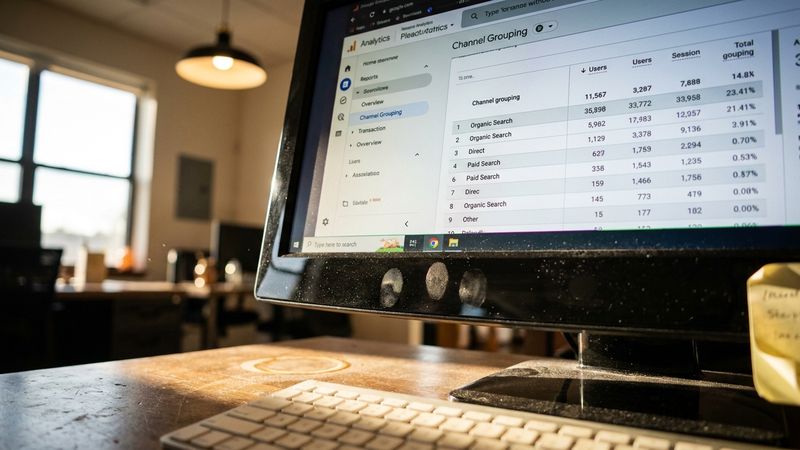
The visible AI Assistant channel likely shows similar quality signals, but you'll need to validate against your own data. Pull the AI Assistant segment, compare engagement rate and key event completion against Organic Search and Referral, and see whether the pattern holds. If AI-referred sessions convert at 2–3x the rate of organic, that's a signal worth surfacing in your next pipeline review. If they don't, you've learned something equally useful about your content's fit for AI discovery.
Cross-industry benchmarks from Conductor show AI referrals averaging 1.08% of total website traffic, with Information Technology reaching 2.80%. That's small in absolute terms, but the conversion quality data suggests the sessions that do arrive are disproportionately valuable. The question is whether you can grow the numerator.
A 90-Day Baseline Before Strategic Conclusions
The channel launched in mid-May. Broad availability across properties reached early June. That means you have roughly 90 days of data as of mid-August. Enough to establish a baseline, not enough to draw strategic conclusions about trend direction.
Before your next board meeting, annotate the launch date in your reports so anyone reading the dashboard understands why AI Assistant traffic appears to spike from zero. Run a parallel custom channel group that includes Perplexity and any other AI sources you care about, so you can compare the native channel against a broader definition. Pull session source/medium alongside the channel to see which AI platforms are actually sending traffic, not just which ones Google recognizes.
If you're building a case for AI content optimization investment, the AI Assistant channel gives you a denominator you didn't have before. But the numerator (actual AI-influenced sessions) is still undercounted, and the conversion-to-revenue connection still requires the same CRM joins and attribution modeling you'd apply to any other channel. The measurement gap is closing. It's not closed.
What This Means for Your Next Forecast
The AI Assistant channel doesn't change your CAC payback math today. It gives you a cleaner input for the model you'll need to build over the next two quarters. If AI-referred sessions convert at 2–3x organic and you can grow that traffic through content discoverability work, the ROI case writes itself. If the traffic stays flat or the conversion advantage doesn't hold in your vertical, you've avoided a misallocation.
Model or it didn't happen. The channel gives you something to model. Now run the experiment.


