
From Content Factory to Media Operation: A Maturity Model for 2026
Here's a confession that might get my CMO card revoked: the content team I inherited three years ago was producing 47 assets per month. Impressive, right? Except nobody could tell me which ones actually moved pipeline. We were a content factory running at full capacity, manufacturing widgets nobody ordered.
That's the dirty secret of most B2B marketing organizations in 2026. We've gotten really, really good at making stuff. We've gotten terrible at asking whether we should.
The Alignment Problem Nobody Wants to Admit
A recent case study from Content Marketing Institute nailed this perfectly. A multi-brand healthcare technology company was losing ground to smaller competitors. The obvious diagnosis? Not enough content. The actual diagnosis? Three of their brands were telling the same story to the same buyer on the same channels. They called these collision zones, which is a polite way of saying their brands were in a knife fight for the same eyeballs while the competition walked away with the deal.
The content function operated as a centralized team of five doing 95% reactive work. The loudest brand got the most attention. Quieter brands went silent for months. Sound familiar?
This wasn't a content problem. It was an alignment problem dressed up in a content costume.
The Four-Rung Ladder Most Teams Can't Climb
Here's the maturity model that's been rattling around my head since I saw it articulated clearly: most marketing organizations are stuck on the second rung of a four-rung ladder.
Rung One: Chaos. Content happens when someone screams loud enough. No process, no strategy, just survival.
Rung Two: The Content Factory. You've got a team, a calendar, maybe even a DAM system you actually use. You're producing at scale. You measure output. You feel productive. This is where 70% of B2B marketing teams live, and it's a trap.
Rung Three: Integrated Operations. Content connects to campaigns, campaigns connect to revenue, and someone can actually trace the line from blog post to closed deal without a Ouija board.
Rung Four: Media Operation. You're not just making content; you're building an audience asset. You think like a publisher, not a factory. Your content has a point of view that compounds over time.
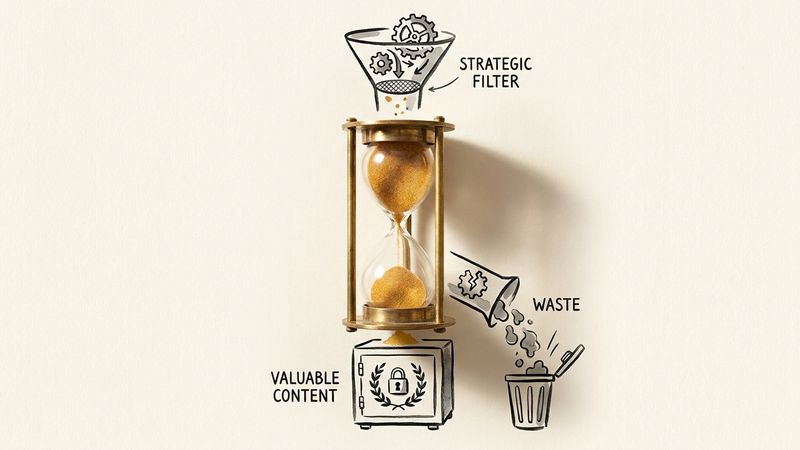
The jump from Rung Two to Rung Three is where careers go to die. It requires something most content teams don't have: the authority to say no.
Why AI Made This Worse Before It Made It Better
According to recent marketing operations research, 91% of marketers now actively use AI in their workflows, up from 63% last year. But only 12% of organizations operate at high marketing operations maturity.
Read that again. We've got AI everywhere and maturity almost nowhere.
Dotfusion's enterprise content operations guide found that 77% of workers report AI has increased their workload rather than decreased it. We're producing chaos at higher velocity. The content factory got faster, but nobody upgraded the factory's purpose.
The average B2B marketing technology stack now comprises 12 to 20 tools. Despite deliberate consolidation efforts, 62% of companies report increased tool adoption compared to two years ago. More tools, same alignment problems, faster production of content nobody asked for.
The Real Maturity Question
VKTR's content operations maturity model asks the uncomfortable question every executive with a GenAI budget should answer: Who's going to maintain the content your AI depends on?
Not who built it. Not who launched it. Who keeps it accurate, current, and trustworthy six months from now?
If you don't have a clear answer, you don't have a scalable AI initiative. You have a static pilot project waiting to decay.
Content operations maturity, not model sophistication, determines long-term success. Organizations obsess over which LLM to use while ignoring the operational reality that content goes stale, metadata drifts, and data quality erodes the moment you stop actively managing it.
The Six-Dimensional Reality Check
Digital Applied's maturity assessment makes a point that should be tattooed on every CMO's forearm: a single maturity score hides the truth. Profile shape matters more than magnitude.
Their framework scores Strategy, Data, Channel Execution, Technology, Content, and Operations separately. Teams regularly regress in one dimension while advancing in another, usually because the same headcount budget funded one and starved the other.
The cheapest maturity gains come from closing your largest dimension gap, not raising your strongest dimension further. A Content score of 3 will cap your Channel Execution ROI no matter how sophisticated your paid media team is.
Fix the floor first.
What Media Operations Actually Looks Like
PwC's 2026 Digital Trends survey found that 85% of operations leaders say they're ahead of most competitors in digital transformation, yet 89% say their tech investments haven't fully delivered expected results.
That's not confidence. That's delusion with a dashboard.
The organizations making the jump from content factory to media operation share three characteristics:
Editorial authority. Someone can kill a campaign that doesn't serve the audience, even if the sales team really wants it. This requires executive air cover and a willingness to have uncomfortable conversations.
Audience-first metrics. They measure engagement depth, not just reach. They track content's contribution to pipeline velocity, not just MQL volume. They know which pieces actually influence deals versus which ones just generate vanity metrics.
Compounding assets. They build content that gets more valuable over time, not less. Thought leadership that establishes a point of view. Research that becomes the industry benchmark. Frameworks that competitors have to reference.
The Uncomfortable Math
Boston Consulting Group reports that average marketing maturity declined by 8% between 2021 and 2024. This isn't regression; it's recalibration. The bar moved faster than organizations adapted.
Capabilities once viewed as differentiators now count as table stakes. Basic user identification, integrated planning, and exploratory AI use no longer qualify as advanced.
An organization rated advanced in 2022 may now rank as emerging if it hasn't operationalized GenAI into actual workflows that drive measurable outcomes.
The content factory was a 2019 achievement. In 2026, it's a participation trophy.
The Path Forward
Stop measuring output. Start measuring alignment. Ask your team three questions this week:
What content did we produce last quarter that we can directly connect to closed revenue? If the answer is we're not sure, you have an attribution problem masquerading as a content strategy.
Which of our brands or product lines are competing for the same audience on the same channels? If the answer is more than one, you have collision zones eating your budget.
Who has the authority to say no to a content request that doesn't serve our audience strategy? If the answer is nobody, you have a content factory, not a media operation.
The jump from factory to media operation isn't about more people, more tools, or more AI. It's about giving your content function the authority to make decisions that affect the whole organization.
That's not a content problem. That's a leadership problem. And in 2026, it's the only maturity question that actually matters.


