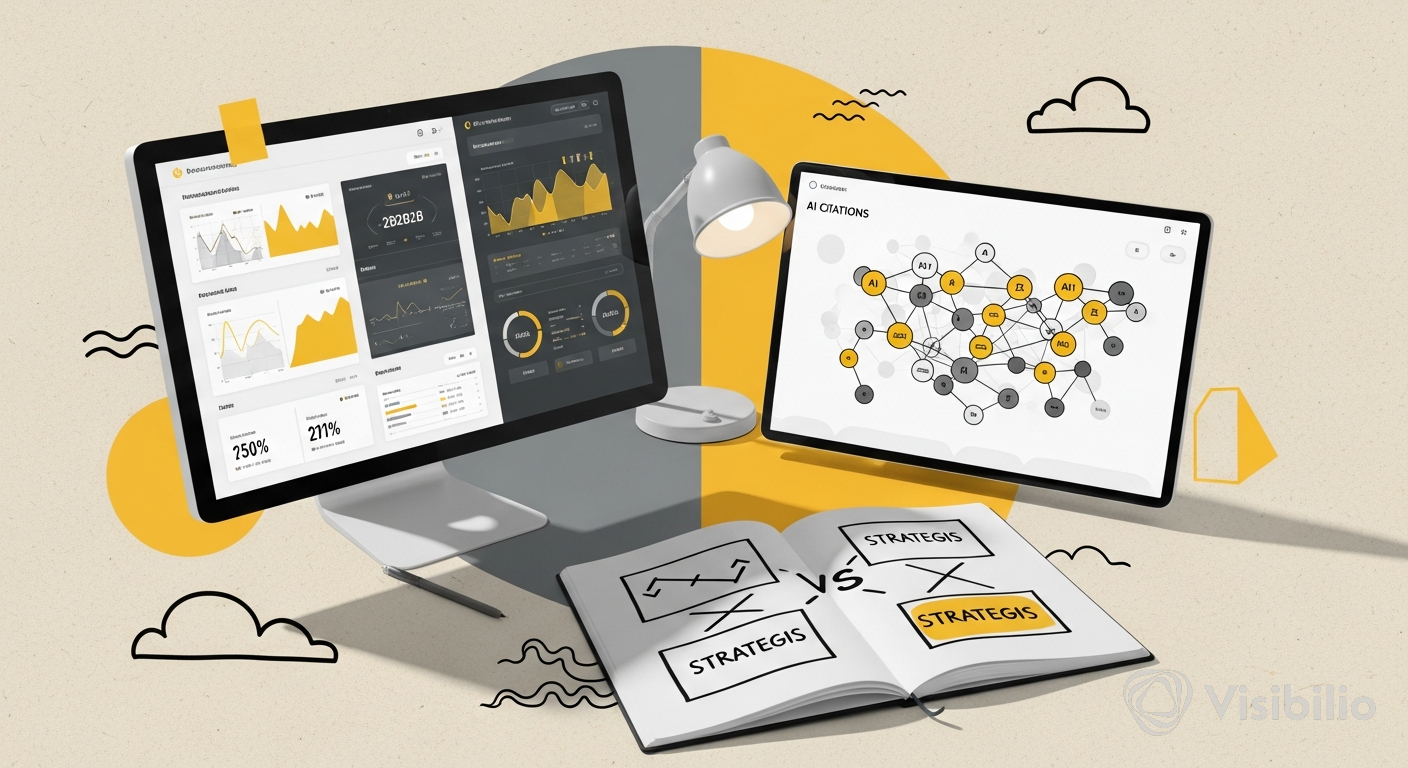
Bing Webmaster Tools now ships two separate performance reports. One tracks clicks, impressions, CTR, and average position. The other tracks AI citations, grounding queries, and something called Citation Share. Two dashboards. Two definitions of success. Microsoft didn't bury this in a blog post; they built it into the product.
That distinction matters more than the ~5% global search share Bing holds (about 14% on US desktop). Because Bing powers ChatGPT Search. And LLM-powered search referrals, while still small at roughly 0.9% of all referral visits as of March 2026, are growing at 5x year over year.
The Gap Between Ranking and Citation
The traditional Search Performance report measures what we've measured for twenty years: did a human see your link, and did they click it? The AI Performance report, launched in public preview in February 2026, measures something else entirely. It tracks how often AI systems cite your content as evidence when answering queries across Copilot, Bing AI summaries, and partner AI experiences.
On June 16, 2026, Microsoft expanded that report with Intents, Topics, Citation Share, and Compare features. Citation Share shows how often your pages get cited relative to competitors for the same grounding queries. Intents and Topics cluster the queries where your content appears, giving you a map of what AI systems think your site is about.
Microsoft is careful to position these as observational metrics, not a ranking system. That's worth noting. You can't "optimize to Citation Share" the way you optimize to position 1. But you can watch the delta between your traditional rank and your citation frequency. When those two numbers diverge, your content is being perceived differently by humans and machines.
Web IQ and Passage-Level Evidence
Underneath the reporting sits Web IQ, a suite of grounding APIs built on the Bing index. It doesn't return ranked documents. It returns passage-level evidence objects, scored by a metric Microsoft calls GDSAT (Grounding Satisfaction). GDSAT evaluates three dimensions: completeness (does the passage contain enough to support a claim on its own?), freshness (is the information current?), and authority (is the source credible enough for an AI to use it responsibly?).
This is the part that should change how content teams think about page architecture. A 3,000-word pillar page that buries the answer in paragraph fourteen doesn't score well on completeness. A case study from 2022 doesn't score well on freshness. A page with no clear authorship or sourcing doesn't score well on authority.
The implication: content needs to be structured in self-contained passages. Each section should answer a question without depending on surrounding context. That's a real structural shift from the "long-form SEO" playbook that treats word count as a proxy for depth.
What This Means for Demand Gen Teams
Three things to actually do with this information.
First, instrument the tracking now. LLM referral traffic is small in absolute terms. But 5x YoY growth means the window for baselining is closing. Get Bing Webmaster Tools verified, enable the AI Performance report, and start logging Citation Share and grounding queries alongside your existing GA4 or Amplitude data. You can't measure lift later if you don't have a baseline today.
Second, audit your content for passage independence. Pull your top 20 pages by organic traffic. For each one, ask: can a single section of this page answer a query without the reader (or an AI) needing the rest of the page? If the answer is no, restructure. Add clear subheadings, front-load the answer in each section, and make sure key claims include their supporting data within the same paragraph block.
Third, treat Microsoft Advertising as a diversification play, not a replacement. Bing's ad ecosystem (which extends to Yahoo, AOL, DuckDuckGo, and Ecosia) generated $13.9 billion in revenue in FY2025, up 21% YoY. You can import Google campaigns directly. The CPCs tend to run lower. If your Google Ads CAC is creeping up and you haven't tested Microsoft Advertising, you're leaving a cheaper distribution channel on the table.
The Caveat Worth Stating
Google still holds roughly 90% of global search share. Over-rotating to Bing and AI citation work at the expense of core Google SEO and SEM would be a mistake. This is incremental. It's diversification. Microsoft even tested a Windows 11 toggle that lets users disable Bing results entirely in system search, which tells you something about how even Microsoft views Bing's role in its own OS.
The honest framing: Bing's AI reporting tools are the best instrumentation available right now for understanding how LLMs use your content. That doesn't mean Bing is suddenly a primary channel. It means Microsoft built the measurement layer before anyone else did, and the data flowing through it connects to the AI surfaces that are growing fastest.
Two scoreboards. Two definitions of what "visible" means. The teams that instrument both now will have six months of baseline data by the time LLM referral traffic hits a number that gets boardroom attention. The ones that wait will be building dashboards while their competitors are reading them.


