Everyone Claims AI. Almost No One Proves It.
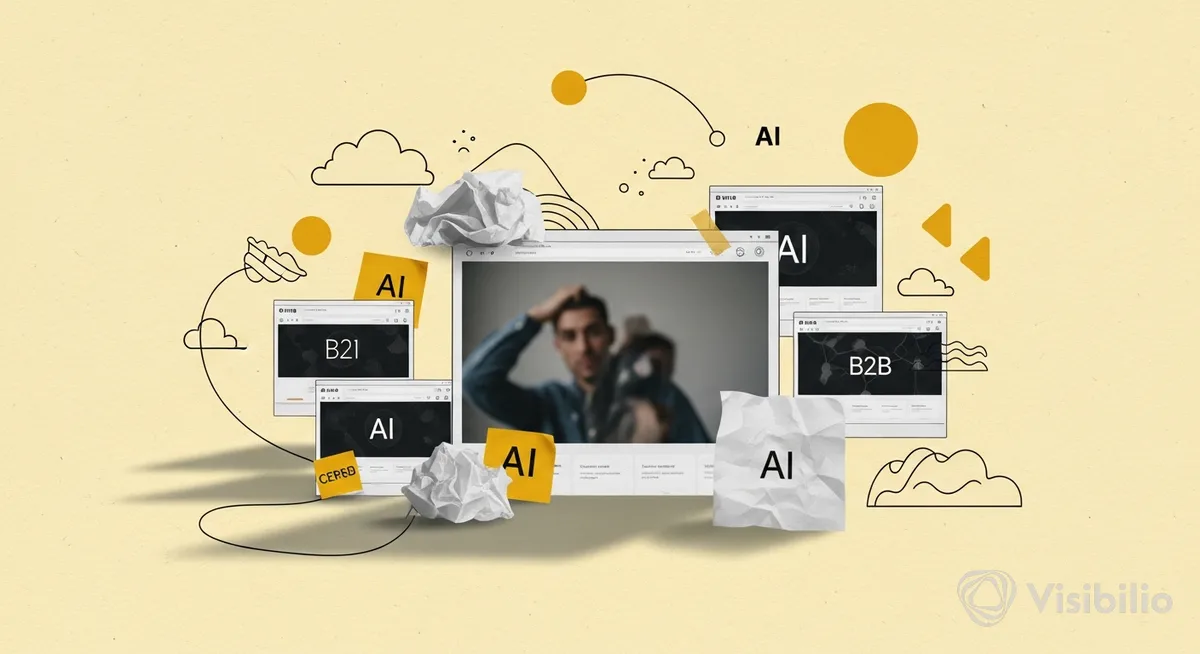
92% of the homepages in Kramer's analysis mention "AI." 66% say "platform." 75% say "agent" or "agentic." These numbers are striking. When nearly every company uses the same three words in the hero, differentiation diminishes. As Elaine Zelby of Tofu noted in the LinkedIn comments: "Even AllBirds is an AI company now."
The operational question for demand gen leaders isn't whether to mention AI on the homepage. If it's true, you should mention it. The real question is whether your above-the-fold treatment drives pipeline or merely follows a visual trend.
Robert Lennox framed it sharply: "When everyone uses the same word in the hero, naming what you actually do becomes the differentiator by default."
Sales-Led Sites Are Designed for Sellers, Not Buyers
Here's a number that should concern RevOps and marketing ops teams: only 22% of sales-led companies show a product screenshot on the homepage, compared to 57% of self-serve companies. And 0% of sales-led companies display pricing on their pricing page. Zero.
Anna Furmanov commented: "That is a new LOW can't get any lower." Lennox added, calling it "a tell that the buyer journey is designed around the seller's comfort instead of the buyer's decision."
This matters for pipeline quality. Buyers increasingly use AI tools to research vendors before engaging with sales. If your site lacks screenshots, pricing signals, and structured data, you're invisible during the crucial evaluation phase. The broader trend in B2B SaaS confirms this: teams are shifting focus from lead volume to lead quality, pipeline contribution, and revenue accountability. Hiding information filters you out of consideration.
The AEO Gap Nobody's Talking About
41% of the 100 sites have an FAQ section, but only two have FAQ schema marked up for LLMs to parse. Two out of a hundred.
Alexander Staveley called this "the sleeper insight" in the thread, and he's right. Teams are spending budget to "be found" in AI-driven search but haven't done the structural work to make their site legible to machines. It's like running paid search without conversion tracking — spending to show up while making it impossible to measure outcomes.
For marketing ops, this is a concrete gap with a straightforward fix: implement FAQ schema, structure content for machine readability, and measure whether AI-assisted discovery channels influence the pipeline. The measurement framework from the B2B SaaS video world applies here too — completion rates, CTA clicks tied to named accounts, assisted conversions, demo requests, pipeline influenced, deal velocity. Not views. Not impressions.
Hero Treatments Are Experiments, Not Aesthetic Choices
The examples from Kramer's post represent distinct hypotheses about what converts above the fold. Legora's full-bleed video bets on emotional engagement and brand recall. Owner's "type your restaurant name" prompt focuses on instant personalization and data capture. Navan's MCQ emphasizes segmentation and qualification before scrolling.
Each has trade-offs. Video can slow page load and distract from the primary CTA; without pipeline-linked measurement, it risks becoming a vanity asset. 82% of marketers report good ROI from video, and 41% of B2B video marketers say short-form social videos generate the highest ROI — but those benchmarks don't automatically apply to a hero section in a long-cycle enterprise motion without retargeting and attribution discipline.
Interactive prompts can reduce friction for motivated buyers but may add friction for casual browsers, potentially lowering total conversion volume while improving lead quality. That's a trade-off worth making deliberately.
The MCQ approach is the most explicit qualification mechanic, routing visitors into segments from the first interaction. But it only works if data flows cleanly into your CRM, lifecycle stages are standardized, and segmentation is utilized downstream.
None of these options are right or wrong in isolation. They're experiments. The measurement plan matters more than the creative.
The Conformity Tax
Kramer's data reveals a B2B SaaS landscape where 92% of companies use the same language, most sales-led sites hide essential information, and few have done the structural work to be discoverable by AI tools. Dark-mode heroes and prompt boxes appear ubiquitous, but they're concentrated in AI, engineering, and design companies — 62% of those companies have dark heroes, while only 9 out of 100 have a prompt-style input.
The conformity isn't just aesthetic; it's a pipeline issue. When your hero looks, reads, and functions like everyone else's, you're paying the same acquisition costs for an undifferentiated first impression. The companies that succeed won't be those with the best-looking hero section but those who treat it as an experiment with a falsifiable hypothesis, a measurement plan tied to pipeline, and the willingness to show buyers what they need to see.
In that analysis of 100 homepages, there's a company that put Jude Law in the hero and another that asked you to type your name. The interesting question isn't which one looks cooler; it's which one moved a deal.


