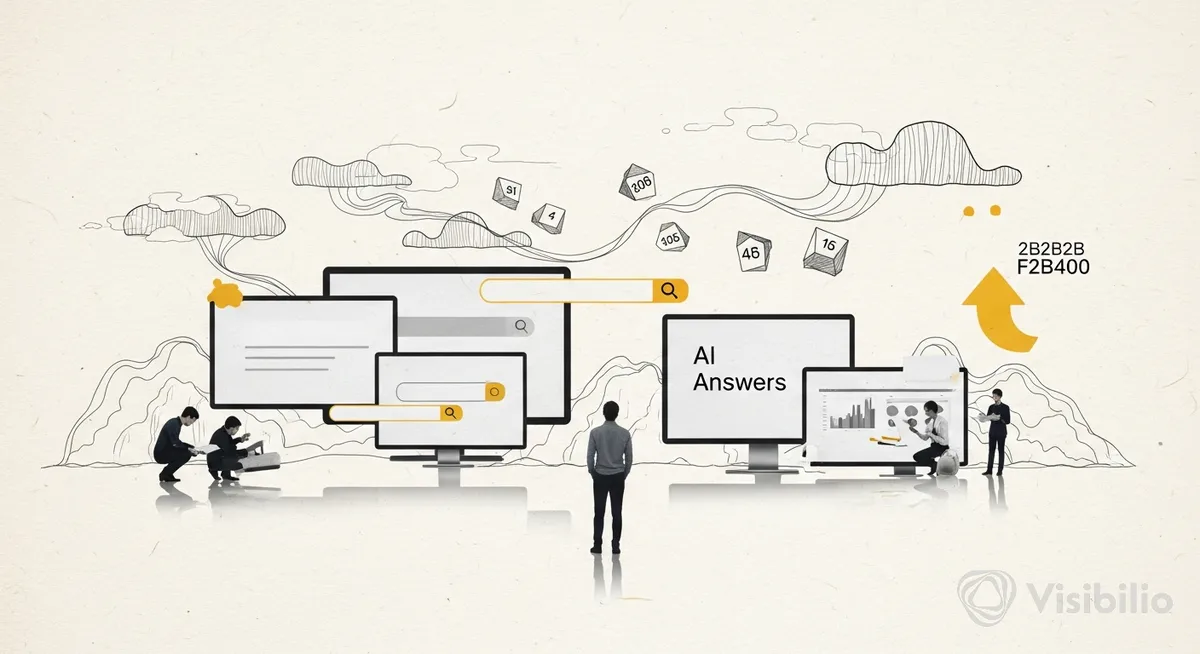
If organic sessions are down and leadership is asking what broke, here’s the uncomfortable constraint: Google can now answer the question without sending the click.
In one 2026 synthesis, AI Overviews show up in roughly 30–40% of queries, and organic CTR drops about 61% when they appear. Pair that with a cited U.S. zero-click rate of 58.5%, and the old scoreboard—sessions, CTR, rank—stops telling the truth. Not even close. (Sources: [1][4])
Yet teams are also seeing AI-referred sessions up 527% YoY in the same summary set, and multiple practitioners describe those visits as lower volume but higher intent. That’s the gap: classic SEO reporting is about reach; AI search visibility is increasingly about being the answer. (Sources: [1][2])
The SEO–GEO gap is a measurement bug, not a keyword problem
Call it the SEO–GEO gap: visibility is shifting toward AI-mediated answers (GEO), but most teams still operate like it’s 2019 SEO—rank, clicks, sessions, done. The operational mismatch is the story. (Sources: [1][5][7])
That mismatch matters right now because the SERP is changing faster than most dashboards. When AI Overviews compress the page into an on-SERP answer, a brand can influence the buyer without getting a visit. Your pipeline can stay flat or rise while your organic traffic chart looks like a slow leak.
And there’s a second tension that makes this harder to explain upstairs: ranking well doesn’t reliably translate into being cited by AI systems. One summarized study in the brief says overlap between top organic links and AI-cited sources fell from about 70% to under 20%. So “we’re #1” and “we’re not mentioned” can both be true at the same time. (Source: [1])
The context, however, is more complex. Another stat from the same research set says 76.1% of URLs cited in AI Overviews already rank in the top 10. So SEO fundamentals still feed GEO—just not in a clean, one-to-one way. (Source: [1])
What’s actually different about AI search traffic (and why sessions mislead)
Classic organic traffic is a volume engine. It’s built for discovery at scale: broad queries, informational pages, long-tail capture, lots of “good enough” visits that may or may not convert this quarter.
AI search traffic behaves differently in the practitioner summaries: less volume, but higher intent and higher conversion efficiency. One 2026 GEO report synthesis claims AI search visitors convert 4–5x better than traditional organic. Another claim in that same summary set attributes a 23x conversion rate versus standard organic to ZipTie. Directionally, the point is the same even if the magnitude varies: don’t judge this channel by sessions. (Source: [1])
So when a Marketing Ops lead gets asked, “Why is organic down?” the honest answer is: because the click is no longer the unit of influence. The buyer still searched. They may have read an AI Overview. They may have seen (or not seen) your brand cited. Then they moved on.
Seen from the other side, this is also an attribution problem. If AI Overviews increase zero-click behavior, last-click organic will undercount search’s contribution. That doesn’t mean search stopped working. It means the measurement model is stale. (Sources: [1][2][3])
One move: add an “AI visibility layer” to your search reporting
If you only change one thing, change this: stop forcing AI search into an SEO dashboard. Add a second layer that reports AI visibility alongside classic organic performance.
Search Engine Land’s GEO measurement guidance (as summarized in the brief) points to the right signals: AI citation frequency, share of voice, citation sentiment, and AI-referred traffic. None of those show up in the default SEO tool stack. (Source: [5])
The hypothesis (make it falsifiable): If we add GEO visibility metrics (citations + AI share of voice + AI referrals) to our search reporting, then we’ll reduce “organic panic” during AI Overview spikes because the team will be able to show stable or improving search influence even when clicks fall.
What to measure (and what not to over-interpret): Start with directional instrumentation. AI-referred sessions are imperfect (referrers vary by product), but they’re still a real leading indicator. Pair them with citation tracking so you can separate “we got fewer clicks” from “we disappeared from the answer.”
- Primary metric: AI citation frequency (brand/domain mentions in AI answers for your tracked query set)
- Secondary metrics: AI share of voice (your citations vs competitors), AI-referred sessions (where detectable)
- Guardrail: Organic non-brand clicks and top-10 rankings for priority pages (because 76.1% of AI Overview citations still come from top-10 URLs)
- Stop-loss threshold: If priority-page top-10 coverage drops materially while AI citations don’t rise, pause GEO-only experiments and fix the SEO baseline first
Trade-off: This will reduce the emotional clarity of a single KPI. Leadership loves one number. You’re going to replace it with a small set of signals that require interpretation. That’s the cost of accuracy.
Run it this week (operator-ready)
Setup: Pick 30–50 queries that map to real pipeline stages (problem-aware, solution-aware, category, competitor comparisons). Keep it tight. Assign an owner in Marketing Ops for instrumentation and an owner in Content/SEO for query mapping.
Tools: Use your existing analytics for sessions plus whatever citation monitoring workflow you already trust (the brief doesn’t mandate a vendor). The key is consistency: same query set, same cadence, same definitions.
Launch: Build a weekly report with two panels: (1) classic SEO (rank, non-brand clicks, CTR where meaningful) and (2) GEO visibility (citation frequency, AI SOV, sentiment if you can classify it reliably). Publish it in the same place leadership already looks.
Readout (two weeks): Compare weeks where AI Overviews are prevalent (the brief’s estimate is ~30–40% of queries) against weeks where they’re less visible. Watch whether organic CTR swings while citations hold steady—or vice versa. (Source: [1])
Next test: For pages that rank top-10 but aren’t getting cited, run a content audit focused on original, expert, first-party value. The May 2026 core update commentary in the brief suggests thin/scaled/intermediary content is under pressure, while original expertise appears more resilient. (Sources: [4][1][2][3])
The May 2026 update is a reminder: “thin” is a measurement risk too
Google’s May 2026 core update reportedly rolled out over about two weeks. Early commentary in the brief echoes what many SaaS teams are feeling: scaled, templated, intermediary content is more exposed; original, expert, first-party work holds up better. (Source: [4])
That connects back to the SEO–GEO gap in a non-obvious way. If AI systems are choosing what to cite—and the overlap between blue-link winners and AI citations is getting weaker—then “publish more pages” becomes the wrong reflex. The work shifts toward fewer assets with clearer authorship, sharper claims, and real first-party value. Not because it’s nicer writing. Because it’s easier to cite.
In other words: sessions might be dropping for reasons that have nothing to do with your technical SEO hygiene. The SERP is rerouting attention. The only way to keep search reporting honest in 2026 is to track both outputs: clicks and citations.
That’s the circle to close. When AI answers steal the click, they don’t necessarily steal the buyer. They steal the metric.


