
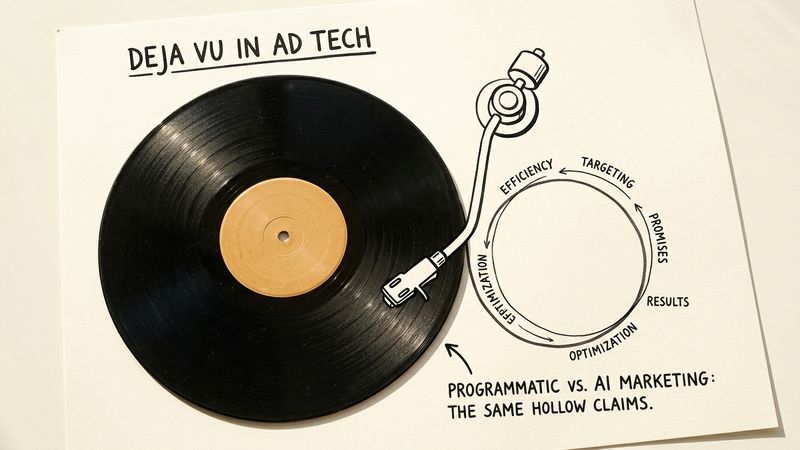
Here's a confession that might get my CMO card revoked: I've been watching the AI efficiency narrative unfold with a creeping sense of déjà vu that's less "interesting pattern recognition" and more "oh no, not this again."
Because I've seen this movie before. We all have. It was called programmatic advertising, and the ending wasn't great.
The Pitch That Sounds Familiar
The promise goes something like this: deploy AI tools across your marketing stack, automate the tedious stuff, and watch your team suddenly have time for "strategic thinking" while the machines handle execution. Efficiency at scale. Measurable results. Data-driven everything.
Sound familiar? It should. Greg Jarboe at Search Engine Journal recently pointed out that he taught a course called "Programmatic Buying Foundations" eight years ago with essentially the same pitch. The workflow was elegant: organize audience insights, design creative, execute with integrated technology, reach audiences across screens, measure impact. Each step came wrapped in case studies from brands like Mondelez and Ford India showing the system paying off.
Here's the part that gets conveniently edited out of the nostalgia reel: that same course included full sections on ad fraud, brand safety, and GDPR compliance. The tool that was supposed to make measurement more reliable came bundled with an entire unit on why measurement was getting less reliable. The efficiency promise arrived with its own asterisks.
The Numbers That Should Make You Nervous
Let me share a stat that's been keeping me up at night. According to research from METR, they put 16 experienced developers to work on 246 real-world tasks, some with AI assistance and some without. The developers expected AI would speed them up by roughly 25%. Instead, they finished about 20% slower. And here's the kicker: they still believed afterward that it had sped them up.
Read that again. They were slower, but they felt faster.
Marketing has its own version of this perception gap. We're so enamored with the idea of AI efficiency that we're not actually measuring whether we're efficient. We're measuring whether we feel efficient, which is a very different thing.
Epsilon's research found that 93% of marketers are planning to allocate at least 5% of their budget to AI initiatives. But according to an IBM study they cite, only 25% of AI initiatives have delivered expected ROI. That's a 75% disappointment rate, and we're still pouring money in.
Where the Hours Actually Go
The efficiency argument cracks when you start tracking what I call "shadow work", the hours that don't show up on project timelines but absolutely show up in your team's exhaustion.
With programmatic, the shadow work was fraud monitoring, brand safety reviews, reconciling discrepancies between platform dashboards and actual results, and endless vendor management calls. The automation didn't eliminate work; it relocated it to less visible corners of the operation.
AI marketing tools are following the same pattern. Your team isn't spending less time on content; they're spending time prompting, reviewing AI output, fixing hallucinations, maintaining brand voice consistency across AI-generated variations, and debugging workflows when the automation breaks. The work moved. It didn't disappear.
Jarboe calls this "the hidden rework and maintenance hours" that get buried inside AI marketing workflows. I call it the tax we pay for pretending automation is the same thing as elimination.
The Transparency Problem (Again)
One of the top concerns in programmatic's heyday was "lack of transparency." Advertisers couldn't see where their ads actually ran, couldn't verify the quality of inventory, couldn't trust that the metrics they were shown reflected reality.
AI marketing tools have their own transparency problem. Epsilon's survey shows 49% of respondents are concerned that model accuracy is affecting efficacy. Nearly half of marketers using AI tools suspect the AI isn't actually learning from the right data. That's not a minor concern. That's a foundational crack in the efficiency argument.
The issue, as Epsilon points out, is that predictive AI needs massive amounts of quality data to make accurate predictions. But most marketing AI is training on incomplete datasets, siloed information, and data that doesn't reflect the full customer journey. The AI can only learn from what it can observe, and most marketing stacks are designed to prevent comprehensive observation.
What Actually Drives Efficiency
Here's where I'm supposed to tell you AI is worthless and we should all go back to buying media over three-martini lunches. I'm not going to do that, because it's not true.
AI can deliver efficiency. But only when we stop treating it as a magic efficiency machine and start treating it as a tool that requires investment, maintenance, and honest measurement.
That means tracking the actual hours your team spends on AI-related tasks, not just the hours the AI supposedly saves. It means measuring output quality, not just output volume. It means acknowledging that a tool which generates 50 mediocre content variations isn't more efficient than a human who creates 5 good ones.
It also means learning from programmatic's mistakes. The brands that actually got value from programmatic were the ones who invested in transparency, built internal expertise, and didn't outsource their judgment to the algorithm. The same will be true for AI.
The Question Nobody Wants to Ask
Every CMO I know is under pressure to show AI ROI. The board wants to hear about efficiency gains. The CEO read an article about how AI is transforming marketing. The CFO wants to know why headcount isn't dropping if the robots are doing the work.
But the question we should be asking isn't "how do we prove AI is making us efficient?" It's "are we actually measuring efficiency, or are we measuring the feeling of efficiency?"
Because if we're just measuring feelings, we're going to end up exactly where programmatic did: a decade of investment, a lot of vendor enrichment, and a quiet admission that the promise was always more compelling than the reality.
Data tells you the what, but honest measurement tells you whether the what is actually happening. Right now, for most marketing AI deployments, we're not doing the honest measurement part.
And that's a movie I've definitely seen before. The sequel isn't any better.


