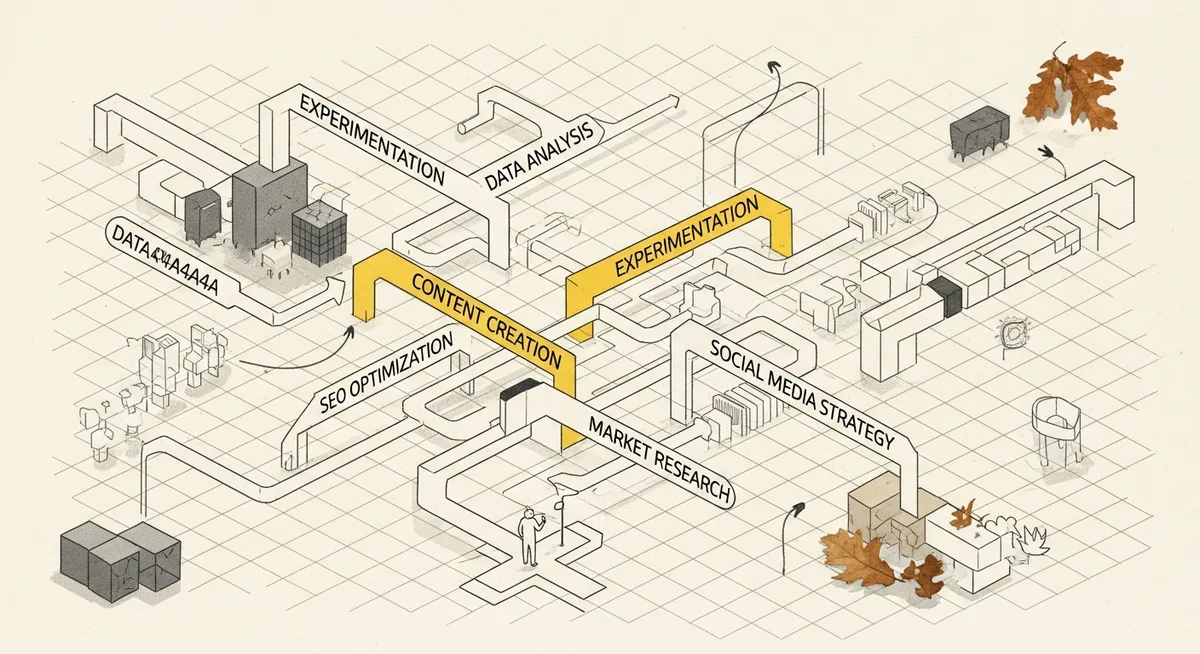
If your pipeline targets haven’t moved but “AI adoption” is everywhere, the constraint isn’t ideas—it’s cycle time with quality control. AI agents can shrink the time between hypothesis → launch → readout, but only if they’re boxed into measurable, auditable work.
Here’s the tension: marketing orgs are already stuffing agents into the stack—90.3% are incorporating AI agents somewhere in martech (Source: [4]). Yet only about one-third of B2B orgs have implemented agentic AI at scale (Source: [2]). Lots of tools. Not many operating-model changes. That gap is where teams bleed budget.
If you only change one thing, change this: use agentic AI to run one closed-loop experiment system end-to-end, not seven disconnected automations.
Why this matters now: buyers are outsourcing evaluation to machines
It’s not just that teams are using AI internally. Buyers are, too. Two-thirds of B2B buyers say they’re using AI agents/chatbots as much as or more than Google for vendor evaluation (Source: [1]). In tech/software, that figure is 80% (Source: [1]). And 94% of B2B buyers report using LLMs during their buying journey (Source: [4]).
So the “interface” between your marketing and the market is changing. But the stakes aren’t abstract. When AI systems mediate discovery, the penalty for inconsistency goes up: mismatched positioning across your site, ads, and sales collateral doesn’t just confuse humans—it trains the machines on noise.
And the work isn’t getting simpler. The average B2B buyer still has about 16 vendor interactions (Source: [4]). AI augments that journey; it doesn’t erase it. The job is to show up coherently across those touches, then learn faster than competitors.
The primary tactic: build an “agent-run experiment loop” for one channel
Agentic AI is often pitched as autonomy. The practical version is narrower: agents take responsibility for multi-step workflows without waiting for manual intervention (a framing Saul Marquez, CEO of Outcomes Rocket, has argued for—paraphrased in Source: [3]).
But autonomy without measurement is just faster randomness. The better pattern is: give the agent a bounded workflow that produces artifacts humans can review, and that ties back to a small set of metrics. Then let it run on a schedule.
Pick one channel where creative fatigue is already visible (paid social, paid search, lifecycle email). Keep the blast radius small. Exactly.
Step 1: Define the loop (inputs → outputs → checks)
Inputs: ICP/account list, current messaging, last 90 days of performance exports (platform + CRM where possible), and a baseline offer/page. No inputs, no signal.
Outputs: a weekly batch of variants (copy + creative angles + landing-page sections), a launch plan, and a readout template that compares to baseline. Not a brainstorm doc.
Checks: human review for brand/claims, and a QA checklist for tracking + routing. This is where most “we tried AI” efforts quietly die.
Step 2: Put the agent on a schedule, not a mood
AI’s widely framed as an efficiency and personalization amplifier—not a replacement for strategy—and it still needs oversight to avoid losing nuance and differentiation (Sources: [1], [2]). That’s not a philosophical point. It’s an ops requirement.
So the agent runs weekly. Same day, same time. It pulls the latest performance, proposes variants, and prepares a launch packet. Humans approve and ship. Then the agent monitors and flags anomalies.
There’s a reason to obsess over cadence: marketers report AI reduces campaign launch times by 75% (Source: [6]) and reduces manual work in campaign optimization by 60% (Source: [5]). If those numbers are even directionally true for your team, the win isn’t “better copy.” It’s more reps per quarter.
Step 3: Tie the loop to incrementality (directional) and a stop-loss
This is where teams get sloppy. Dashboards tempt last-click certainty. Don’t take the bait.
Primary metric: qualified pipeline created per dollar (or per 1,000 impressions) for the experiment cell versus baseline. Directional attribution is fine, but be explicit about it.
Secondary metrics: CTR (creative signal) and lead-to-meeting rate (handoff signal). AI-driven workflows have been associated with a 47% increase in CTRs (Source: [6])—use that as a leading indicator, not a victory lap.
Guardrails: spam/complaint rate (email), wasted spend (paid), and sales rejection reasons (handoff). Growth Syndicate data shows execution lags perceived benefits—execution 6.4/10 vs perceived benefits 8.8/10—and trust sits at 5.8/10 (Source: [5]). That gap is what guardrails are for.
Stop-loss threshold: if cost per qualified lead worsens by 20% versus baseline for 7 consecutive days (or one full buying cycle for low-volume), pause and revert. The agent doesn’t get to “learn” with your quarter.
Run it this week: one-loop setup (owners, tools, timeline)
Here’s the 5-minute version you can run this week:
- Audience: one segment only (e.g., a single vertical, or a 6sense/Demandbase intent cluster if available). Avoid “all non-customers.”
- Budget range: set a fixed test cell you can afford to lose. In practice, enough to get directional signal without rerouting the whole month. Keep it constant.
- Timeline: 7 days to set up; 14 days to first readout; then weekly cycles.
- Owners: Demand Gen owns the loop; RevOps owns tracking/routing QA; Sales owns rejection reason taxonomy (system problem, shared fix).
- Tools: use what you already run. If workflows matter, n8n-style automation is a practical backbone (as reflected in CXL’s program outline in the provided source content). CRM-native suites can reduce sprawl, but the constraint is governance, not features (Sources: [1], [3]).
The hypothesis (make it falsifiable): If we use an AI agent to generate and launch a weekly batch of ICP-scored creative variants and to produce a standardized readout, then qualified pipeline per dollar will increase versus baseline because we’ll run more controlled iterations while holding measurement and routing constant.
Trade-off (say it out loud): this will reduce volume before it improves quality. The first week is mostly plumbing: QA, taxonomy, and approvals. That’s the price of not letting the agent spray nonsense into-market.
When this is wrong: if your CRM data hygiene is weak, routing rules are inconsistent, or your ICP definition is political instead of operational, the agent will amplify the mess. Predictive scoring and orchestration only work as well as the data and program structure underneath (Source: [2]). Fix the baseline first.
The real payoff: speed without sameness
There’s a second tension worth naming. Growth Syndicate found 63% worry AI reduces differentiation (Source: [5]). That fear is reasonable. Most AI output looks the same because most teams give it the same inputs and accept the first draft.
Jamie Pagan, Director of Brand & Content, compared AI to “protein powder”—a supplement that scales what already works but won’t fix bad marketing (paraphrased in Source: [1]). That metaphor lands because it’s operationally true: agents amplify the system. They don’t create one.
The teams that get value won’t be the ones with the most prompts. They’ll be the ones with the tightest loop: clear hypothesis, bounded autonomy, human review, and a readout that can survive a skeptical RevOps leader. Faster cycles. Same standards.
That’s the circle to close: adoption is already high (Source: [4]). The advantage in 2026 isn’t “using agents.” It’s using them to run more disciplined experiments than everyone else—without letting your brand dissolve into the average of the internet.


