Your content team can write quotable, structured answers. Your devs can implement schema markup and achieve sub-three-second page loads. Your SEO lead has likely read every guide on answer engine optimization published this year. Yet, when you test buyer-intent prompts across ChatGPT, Google AI Mode, Claude, and Perplexity, your brand doesn't appear.
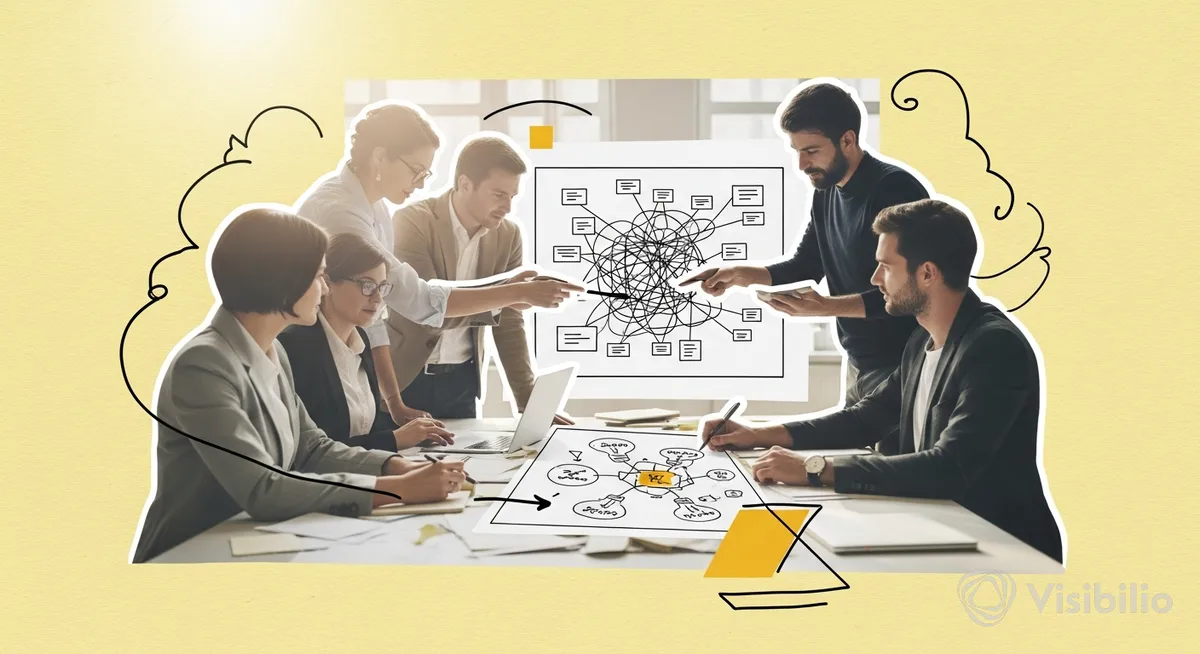
The issue isn't knowledge; it's how your teams coordinate that knowledge. AEO is a cross-functional program involving product marketing, content, SEO, PR, review generation, and technical markup. When any of these functions operates in isolation, the entire process falters.
Why Content Alone Can't Win Citations
Nikhil Lai, Principal Analyst at Forrester, states that copywriters can create distinctive, quotable content, but if customers criticize the brand on Reddit and the site promotes products rather than answering FAQs, that content won't be cited by AI assistants. Conversely, perfect technical implementation on pages with thin, unstructured content won't surface in AI Mode's answers either.
This is a critical point most teams underestimate. AEO authority isn't a single score controlled by one team; it's an aggregate signal from on-site content, off-site mentions, review sentiment, community threads, editorial coverage, and structured data. One inconsistent messaging gap can lead an AI model to pull from a third-party source instead of yours, sometimes generating inaccurate summaries of your product.
That citation accuracy issue is a process problem, not a content problem.
The Operating Loop That Actually Moves the Needle
Expert guidance converges on a repeatable four-step cycle: audit, rewrite, measure, refresh. This is not a one-off project or a quarterly content sprint; it's a continuous loop with clear owners and timelines.
Start with pages that already carry authority and revenue impact. Product pages, pricing pages, comparison pages, integration docs, and top-performing blog posts are quicker to optimize for citations than new content. The hypothesis is straightforward: restructuring an existing high-authority page with direct answers, question-based headings, and evidence blocks (named customers, quantified outcomes, proprietary data) will increase citation rates for buyer-intent prompts mentioning your category, as AI models prioritize extractability and trust signals.
The measurement aspect is where most teams stall. Traditional SEO KPIs don't capture AEO performance. You need AI-native metrics: citation rate across engines, share of AI answers in your category, AI-referred sessions, and conversion rates from those sessions. Without this instrumentation, AEO becomes unreportable, and unreportable programs lack resources.
Freshness is also crucial. Implementing a refresh cadence (approximately every 90 days or triggered by declining citation performance) keeps pages eligible for inclusion. Stale content drops out quietly, and the impact may not be noticed until pipeline dips.
The Cross-Functional Coordination Nobody Wants to Own
AEO requires coordinating content, IT, social, PR, paid media, brand, infosec, and legal. This list is accurate. Buyer journeys are shifting into AI assistants earlier in 2025, with shortlists created inside ChatGPT, Perplexity, and Gemini before prospects contact sales. If your off-site signals (reviews on G2, Reddit threads, comparison site mentions) contradict your on-site messaging, the AI model must choose a version. It won't always select yours.
The solution isn't another Slack channel; it's governance. A single-source-of-truth messaging framework, structured content templates that enforce direct answers, proof blocks, and schema into every high-value page, and a prompt-testing protocol where team members regularly run buyer-intent queries across multiple AI engines and track citations. When citations are absent, the specific page or passage that failed gets flagged and enters the rewrite queue.
This is operational work, not glamorous. Yet, it distinguishes teams that discuss AEO from those that achieve citations.
Where This Breaks Down
Two honest caveats: First, attribution remains complex. AI mentions can influence deals without generating click-through traffic, so over-relying on last-click or session data will undercount AEO's impact. Plan for this ambiguity in your reporting. Second, traditional SEO still matters. AEO doesn't replace crawlability and ranking work; AI search is absorbing more top-of-funnel queries, but both disciplines must coexist.
The trade-off when investing in AEO processes is that results may take longer to materialize than a paid campaign, and the measurement stack is still developing. However, the alternative is allowing AI assistants to build your buyers' shortlists without your input.
Teams treating AEO as a content project will continue publishing pages that no AI quotes. In contrast, teams viewing it as an operating system, with audit loops, refresh cadences, cross-functional governance, and prompt-testing protocols, will be the ones cited by algorithms. The bottleneck was never the writing; it was always the workflow surrounding it.


