
Here's a stat that should make every CMO pause mid-sip on their morning coffee: according to McKinsey's 2025 State of AI survey, 88% of organizations now use AI in at least one business function. Sounds like we've crossed the finish line, right? Except we haven't. Nearly two-thirds of those companies are still stuck in pilot mode, and only 39% report any EBIT impact at the enterprise level.
Let me translate that into marketing terms: almost everyone bought the gym membership, but barely anyone is showing up to actually work out.
The Tool Trap
The distinction between using AI as a tool versus building it into a system isn't semantic. It's the difference between having a hammer and building a house.
Most organizations treat AI like a shiny new app. Someone in marketing fires up ChatGPT to draft email copy. The sales team experiments with an AI assistant for lead scoring. Legal uses it to summarize contracts. Each department operates in its own sandbox, celebrating small wins that never compound into anything larger.
BCG's 2025 AI Radar found that only 5% of companies have created substantial value from AI at scale. The rest? They're spreading their bets across too many pilots, averaging 6.1 use cases compared to 3.5 for the leaders. More experiments, less depth, weaker results.
This is the classic "shiny object syndrome" I warn clients about constantly. We get seduced by the demo, not the discipline.
What the 12% Actually Do
The companies pulling ahead aren't using better models. They're running fundamentally different operations.
McKinsey's research identifies a cohort of "AI high performers" who share specific behaviors. They're 3.6 times more likely to pursue transformative change rather than incremental improvements. They spend more than 20% of their digital budgets on AI, making them five times more likely to make big bets than their peers. And here's the kicker: they redesign workflows before deploying AI, not after.
That last point deserves a moment. Most companies bolt AI onto existing processes like adding a spoiler to a minivan. It looks different, but it doesn't actually go faster. The winners tear up the playbook and rebuild around what AI makes possible.
Consider Klarna. The Swedish fintech didn't just add AI to customer service; they restructured the entire operation. According to Klarna's Q1 2025 report, 96% of employees now use AI daily, driving a 152% increase in revenue per employee since 2023. Their AI assistant handles two-thirds of customer service interactions, cutting average resolution time from 11 minutes to under two. That's not a tool. That's a system.
The Abandonment Epidemic
Here's where it gets uncomfortable. S&P Global Market Intelligence found that 42% of companies abandoned most of their AI initiatives in 2025, up from just 17% the year before. The average organization scrapped 46% of AI proof-of-concepts before they reached production.
Why the carnage? The usual suspects: cost overruns, data privacy concerns, security risks. But dig deeper and you find something more fundamental. These projects failed because they were never connected to actual business outcomes. The technology worked fine in controlled settings. The demos impressed leadership. Then reality hit: the workflow it was supposed to improve was already broken, nobody with budget authority owned the initiative, and the data foundation was a mess.
Research from RAND Corporation confirms that AI projects fail at roughly twice the rate of other IT projects. Not because the models are worse, but because AI requires a deeper level of organizational readiness that most companies haven't built.
The Marketing Angle
For those of us in marketing, this gap presents both a warning and an opportunity.
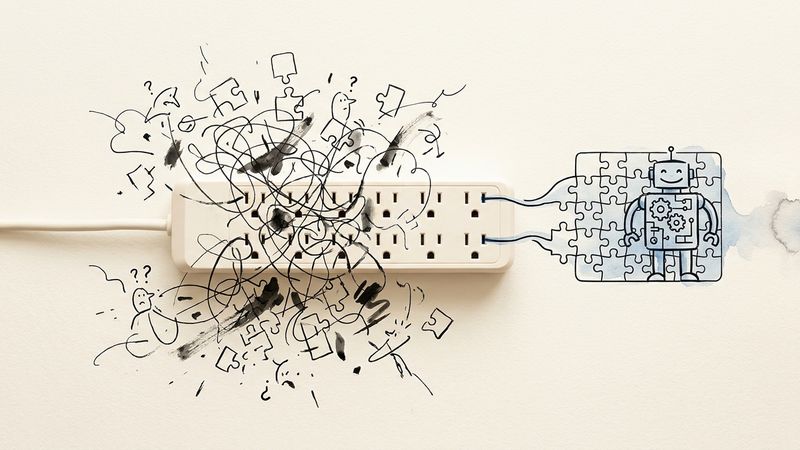
The warning: if your AI strategy consists of scattered experiments across content creation, ad optimization, and customer segmentation without a unifying system, you're probably burning budget. You might see local wins, but they won't scale. Your competitors who build integrated systems will eventually outpace you, not because they have better tools, but because their tools actually talk to each other.
The opportunity: marketing sits at the intersection of customer data, creative output, and revenue attribution. We're uniquely positioned to demonstrate what systemic AI adoption looks like. When personalization, campaign optimization, and customer journey mapping operate as one connected system rather than three separate experiments, the compounding effects become visible in ways the C-suite can't ignore.
From Pilot Purgatory to Production
So how do you make the jump from the 88% to the 12%?
First, stop celebrating pilots. A successful proof-of-concept means nothing if it can't scale. Before launching any AI initiative, define the path to production. What workflows need to change? Who owns the outcome? What does success look like in financial terms, not just efficiency metrics?
Second, consolidate your bets. BCG's data shows that leading companies focus on depth over breadth. They anticipate generating 2.1 times greater ROI by prioritizing fewer use cases and scaling them properly. Pick three initiatives that could genuinely transform how your team operates, then go deep.
Third, redesign before you deploy. McKinsey found that workflow redesign has the biggest effect on an organization's ability to see EBIT impact from AI. If you're layering AI onto broken processes, you're just automating dysfunction.
Fourth, get leadership skin in the game. Companies where the CEO oversees AI governance show significantly higher bottom-line impact. This isn't about micromanagement; it's about signaling that AI is a strategic priority, not a tech experiment.
The Klarna Caveat
One more thing about Klarna, because it's instructive. After aggressively cutting staff and automating customer service, CEO Sebastian Siemiatkowski admitted to Bloomberg that the strategy may have gone too far.
"As cost unfortunately seems to have been a too predominant evaluation factor when organising this, what you end up having is lower quality."
Sebastian Siemiatkowski
The company is now bringing humans back into the loop. Even the poster child for AI transformation learned that systems need balance. Efficiency without quality is just faster failure.
The 88/12 split isn't a technology gap. It's an execution gap, a strategy gap, a leadership gap. The tools are commoditized. Everyone has access to the same models, the same platforms, the same consultants. What separates winners from the pilot graveyard is the willingness to rebuild how work actually gets done.
Marketing is like dating, remember? You don't propose on the first ad impression. And you don't transform your organization with a handful of disconnected experiments. Build the system. Then watch the compounding begin.


