
Your search dashboard is lying to you. Not maliciously, but structurally. The metrics you've been tracking for years were designed for a search ecosystem that no longer exists.
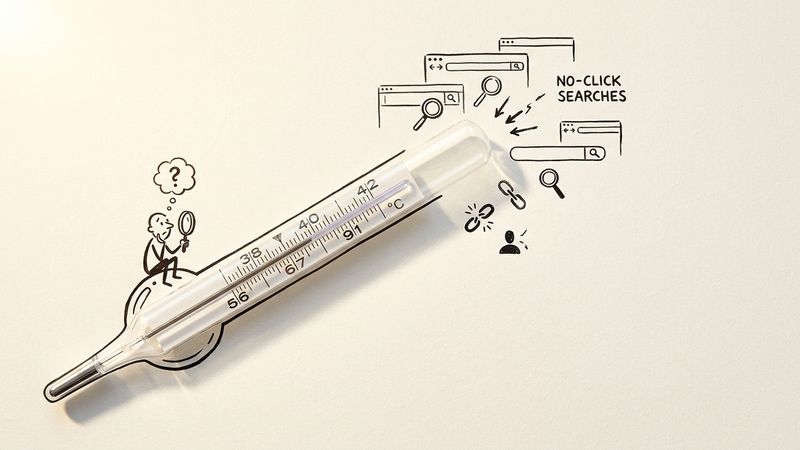
Here's the uncomfortable reality: 68% of Google searches now end without a click. That's not a typo. Two-thirds of your potential audience is getting what they need without ever visiting your website. And if you're still measuring success by traffic alone, you're essentially judging a DJ by how many people bought the album instead of how many danced.
The search game has changed. AI Overviews, featured snippets, and knowledge panels have turned Google into an answer engine, not a referral engine. Your content might be ranking beautifully while your traffic tanks. That's not a bug; it's the new architecture of search.
So how do you actually know if your search strategy is working? I've boiled it down to three questions that cut through the noise. Ask yourself these honestly, and you'll have a clearer picture of your real search performance than any dashboard can provide.
Are You Measuring Visibility or Just Clicks?
Most marketing teams still treat clicks as the gold standard. It made sense when clicks were the only way users could access your content. But AI Overviews now appear in roughly 48% of all search queries, and when they do, organic click-through rates drop by an average of 18%.
The question isn't whether your content ranks. It's whether your brand shows up in the answer layer.
Think about it this way: if someone searches "best B2B marketing automation tools" and your product gets mentioned in the AI Overview, that's brand exposure. That's trust-building. That's a prospect who might search your name directly next week. But your analytics will show zero traffic from that interaction.
Brand visibility now matters more than position one. The shift from click optimization to visibility optimization requires fundamentally different measurement frameworks. You need to track whether you're being cited in AI-generated answers, whether your branded search volume is growing, and whether your share of voice in your category is expanding.
The old funnel was: rank, get clicked, convert. The new funnel is: get cited, build recall, earn the branded search, convert. If you're only measuring the middle step, you're missing the story.
Is Your Data Even Accurate?
Here's something that should make every CMO uncomfortable: Google Search Console had a logging error that inflated impression data for nearly eleven months, from May 2025 through April 2026. That means every board presentation, every SEO case study, every year-over-year comparison that referenced impressions or CTR during that window was mathematically invalid.
Google quietly disclosed this in April 2026. The only metric that remained accurate? Clicks.
If your team has been celebrating "improved visibility" based on rising impressions, or panicking about "declining CTR" that was actually just a denominator problem, you've been making decisions on bad data. And Google isn't going to fix the historical numbers. They're just moving forward.
This isn't an isolated incident. It's a reminder that the data infrastructure we rely on is more fragile than we pretend. Understanding what each metric actually measures, how Google defines it, and where the data can mislead is the difference between making informed decisions and chasing ghosts.
The question to ask: When was the last time you audited your measurement methodology? Not your metrics, your methodology. Are you triangulating data sources? Are you building in sanity checks? Or are you just trusting the dashboard because it's convenient?
Are the Clicks You're Getting Actually Worth Anything?
Here's the counterintuitive finding that should reshape how you think about search: clicks that survive AI Overviews convert 23% better than clicks from queries without them.
Why? Because users who click through after reading an AI summary have already done their initial research. They're not browsing; they're investigating. They've self-qualified.
This means raw click volume is becoming a misleading metric for measuring search-driven business value. A 30% drop in traffic accompanied by a 25% increase in conversion rate might actually be a win. But you'd never know that if you're only looking at the top of the funnel.
The net effect of AI Overviews depends on what kind of content you publish and how you measure success. Informational pages built for top-of-funnel discovery are feeling the loss first. But pages targeting commercial and transactional intent, where users need to take action, are holding steady or even gaining.
The question isn't "how much traffic are we getting?" It's "what's the quality of the traffic we're getting, and what happens after they arrive?"
The Uncomfortable Math
Let me put some numbers to this. Bain's research found that 80% of consumers now rely on zero-click results in at least 40% of their searches, reducing organic web traffic by an estimated 15% to 25%. That's not a temporary blip. That's structural.
Meanwhile, AI search traffic is up 527% year over year. Some sites are now reporting over 1% of total sessions coming from platforms like ChatGPT, Perplexity, and Copilot. Small share, massive growth rate.
The brands that are winning aren't fighting this shift. They're adapting their measurement to match the new reality. They're tracking citation frequency in AI answers. They're monitoring branded search growth as a leading indicator. They're measuring conversion quality, not just conversion quantity.
What This Means for Your Strategy
If you can't answer these three questions with confidence, your search performance measurement is incomplete:
One: Are you tracking visibility in AI-generated answers, or just traditional rankings?
Two: Have you audited your data sources for accuracy, especially after the GSC logging error?
Three: Are you measuring the quality and conversion rate of your traffic, not just the volume?
The old playbook was simple: rank higher, get more clicks, win. The new playbook is messier but more honest: build authority that gets you cited, earn trust that drives branded searches, and convert the high-intent visitors who make it through.
Search isn't dying. It's redistributing. The question is whether your measurement framework can see where the value is actually flowing.


