
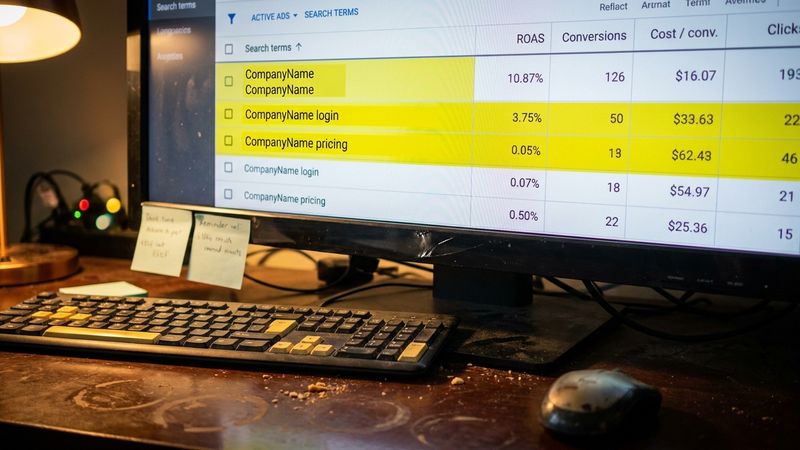
Your Performance Max campaign reports a 10x ROAS. The board loves it. Finance signs off on the budget increase. Then someone pulls the search terms report and discovers that 40% of those conversions came from people typing your company name directly into Google. PMax didn't create that demand; it intercepted buyers who were already yours.
This is the single most common way PMax inflates its own performance metrics while quietly cannibalizing your branded Search campaigns. According to Optmyzr's analysis of over 500 Google Ads accounts, 91% showed keyword overlap between PMax and Search, and in 56% of Search campaigns, PMax still triggered for the same terms. The math problem is straightforward: you're paying acquisition costs for customers who would have converted anyway.
The Mechanics of Brand Cannibalization
PMax bids on branded queries by default. Google's algorithm optimizes for conversions, and brand searches convert at rates that make non-brand inventory look anemic. From the algorithm's perspective, this is rational behavior: it found the cheapest, highest-converting traffic available. From your perspective, it's a budget leak.
GrowthSpree's Q1 2026 audit data puts the damage at 8-15% of total PMax spend going to traffic that would have converted organically, with apparent ROAS inflated by 15-30% from this cannibalization. The problem compounds when you're running a dedicated branded Search campaign alongside PMax. Both campaigns compete for the same query, and PMax often wins because it can bid more aggressively across inventory types.
Adalysis studied over 3,300 non-retail PMax campaigns and found that while the raw overlap rate was only 2.8% at the search term level, the performance gap when overlap occurred was significant: Search campaigns consistently outperformed PMax on the same queries. You're not just paying twice; you're paying more for worse results.
Diagnosing the Problem in Your Account
Start with the Insights tab in your PMax campaign. Google now surfaces search categories and top search terms, though the data remains aggregated. Look for your brand name, product names, and common misspellings in the top-performing queries. If branded terms dominate, you have a cannibalization problem.
Cross-reference with your branded Search campaign. Pull the search terms report and compare impression share, average CPC, and conversion rates for the same period. If your branded Search campaign shows declining impression share while PMax shows strong branded query volume, the campaigns are competing rather than complementing.
The cleaner diagnostic: run a geo-holdout test. Haus analyzed experiments from multiple brands and found that excluding brand terms drove 24% more incremental revenue on average across all tests. The win rate was 50/50 on total revenue, but when excluding brand won, it won decisively. When including brand won, the margin was smaller. This asymmetry suggests that for most accounts, brand exclusions improve true incrementality even when they reduce reported ROAS.
The Fix: Brand Exclusions Plus Dedicated Coverage
Google's brand exclusions for Performance Max apply to Search, Shopping, and YouTube search inventory. The setup lives in your campaign settings under "Brand exclusions," where you can select from existing brand lists or create new ones. The exclusions block your brand name, common misspellings, and branded searches in foreign languages.
The critical implementation detail that practitioners consistently flag: if you exclude your brand from PMax without a backup, your products disappear from branded searches entirely. You need a dedicated branded Search campaign (or standard Shopping campaign for retail) to catch that traffic. The architecture looks like this:
- PMax with brand exclusions handles prospecting and non-brand inventory
- Branded Search campaign with exact and phrase match captures high-intent brand queries
- Standard Shopping campaign (optional) covers branded product searches if you need that control
Expect a short-term drop in reported ROAS and a rise in CPA after implementing exclusions. This isn't performance degradation; it's clarity. You're finally seeing what your prospecting spend actually delivers without the branded traffic subsidy.
When Not to Exclude
Brand exclusions aren't universally correct. Kirk Williams at ZATO makes the case that PMax is designed to work optimally with maximum data, and every constraint you add reduces the algorithm's ability to optimize. If you're a new brand with minimal branded search volume, excluding those terms removes signal without meaningful budget savings.
The decision framework: exclude brand when you have an established brand with meaningful branded search volume, when you're running a dedicated branded Search campaign that you want to protect, and when you need clean incrementality data for budget allocation decisions. Keep brand in PMax when you're early-stage with limited brand awareness, when you don't have the bandwidth to manage a separate branded campaign, or when your branded Search campaign is already capturing 95%+ impression share and PMax is picking up the long-tail.
Measuring True Incrementality
The dashboard ROAS after brand exclusions will look worse. That's the point. The question is whether your total business outcomes improve when PMax focuses on incremental demand rather than capturing existing intent.
Measured's incrementality testing across 50+ brands found mixed results for PMax overall, but the brands that saw the strongest incremental lift were those with clean campaign segmentation: brand traffic in dedicated campaigns, prospecting traffic in PMax with exclusions, and clear measurement of each.
The CFO-safe version of this conversation: brand exclusions don't make your campaigns more profitable. They make your reporting honest. And honest reporting is the only foundation for defensible budget allocation. If PMax can't justify its spend on non-brand traffic alone, that's information you need before the next planning cycle, not after.


