
Most B2B marketing teams build campaigns in isolation. They guess at competitor positioning, estimate share of voice, and hope their creative stands out in a feed they've never systematically studied. Meanwhile, the data they need to make informed decisions sits in a free, public database that LinkedIn launched in June 2023 and almost nobody uses well.
The LinkedIn Ad Library is not a media planning tool. It won't tell you what your competitors spend or whether their campaigns convert. What it will do is show you every active sponsored ad on the platform, searchable by advertiser, keyword, country, and date range, with no login required. For a channel that now captures 41% of B2B paid social budgets globally, that's a significant intelligence gap most teams are leaving open.
What the Library Actually Contains
The Ad Library archives every ad that ran on LinkedIn after , and keeps each one searchable for one year after its last impression. You can see the creative, the copy, the format (single image, video, carousel, document, event, or job ad), the advertiser name, and the payer name. For ads targeted to the European Union, LinkedIn adds estimated impression ranges and top targeting parameters to comply with the Digital Services Act.
What you won't find: budget, spend, CTR, conversion data, or exact targeting for non-EU campaigns. As ZenABM's analysis notes, the library is a creative and messaging intelligence tool, not a performance dashboard. Treat it accordingly.
The practical implication is that you can see what competitors are saying to your buyers, but you cannot see whether it's working. That distinction matters. A competitor running the same ad for six months might be seeing strong results, or they might have forgotten to pause it. The library tells you what exists; your own testing tells you what converts.
The 15-Minute Competitive Audit
Here's a workflow that fits into a Monday morning before pipeline review. Start at linkedin.com/ad-library and search for your top five competitors by company name. For each, note three things: the dominant format they're using, the primary offer type (demo, content download, event, free trial), and the headline pattern.
Most B2B advertisers cluster around a small set of messaging angles. After reviewing 20 to 30 ads, you'll see the category's default positioning. That's useful because it tells you where the white space is. If every competitor leads with "AI-powered" and "enterprise-grade," those phrases have become noise. Your differentiation has to come from somewhere else.
For EU-targeted campaigns, the impression brackets (1K-5K, 5K-10K, 10K-50K, and so on) give you a rough sense of budget allocation. ZenABM's research across 2,828 ads found that 65% of top performers use specific offers, 59% use strong CTAs, and 47% feature real people rather than stock photography. Stock imagery appeared in 35% of low performers. That's a pattern worth testing against your own creative.
Where the Library Falls Short
The biggest limitation is the one-year retention window. If you're trying to understand how a competitor's messaging evolved over multiple product cycles, you're working with incomplete data. Ads that stopped running more than 12 months ago disappear from the archive.
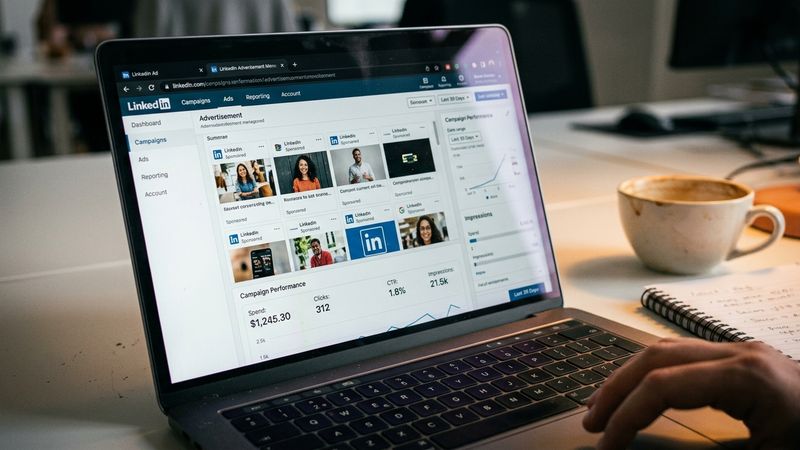
The second limitation is the absence of performance signals. As Hey Sid's comparison notes, neither LinkedIn's nor Meta's ad library tells you the two things that actually decide a B2B campaign: who your competitor is targeting at the account level, and whether the ad is converting. You're seeing creative output, not business outcomes.
The third limitation is search functionality. LinkedIn's native interface is built for compliance, not for teams running competitive research five times a day. You can search by advertiser, keyword, country, and date range, but you can't sort by how long an ad has been running, you can't export cleanly, and you can't estimate spend outside the EU impression brackets. Third-party tools like adlibrary.com have started filling these gaps, but they add cost and complexity.
Turning Intelligence into Testable Hypotheses
The value of competitive intelligence is not in copying what competitors do. It's in generating hypotheses you can test faster than you would have otherwise. If you see three competitors running document ads (a format Metadata's benchmark report found produces leads at $148 versus $358 for video in cold audiences), that's a format worth testing. If you see a competitor suddenly shift from product-focused messaging to problem-focused messaging, that's a positioning hypothesis worth exploring.
The discipline is to treat every observation as an input to your own experiment backlog, not as a template to copy. Your buyers are not identical to your competitor's buyers. Your product is not identical to theirs. What works for them may not work for you, and vice versa.
Build a simple tracking system: a Notion database or a shared spreadsheet where you log competitor ads, the hypothesis they suggest, and the test you ran against it. Over time, you'll develop a pattern library that's specific to your market and your buyers, not generic best practices from a blog post.
The CFO Question
When your CFO asks why you're spending time on competitive ad research instead of optimizing existing campaigns, the answer is time-to-learning. Every campaign you launch without understanding the competitive context is a campaign that might duplicate positioning that's already saturated, miss an obvious format opportunity, or test a message that three other vendors have already trained your buyers to ignore.
LinkedIn now captures 41% of B2B ad budgets, up from 39% the previous year. That two-point shift represents massive capital reallocation at enterprise scale. The buyers you're trying to reach are seeing more LinkedIn ads than ever, from more competitors than ever. Understanding what they're seeing before you add to the noise is not optional research; it's basic due diligence.
The Ad Library won't tell you what to run. It will tell you what's already running, which is the starting point for any campaign that needs to stand out rather than blend in.


