

AI Adoption and Marketers: The Couch Conundrum
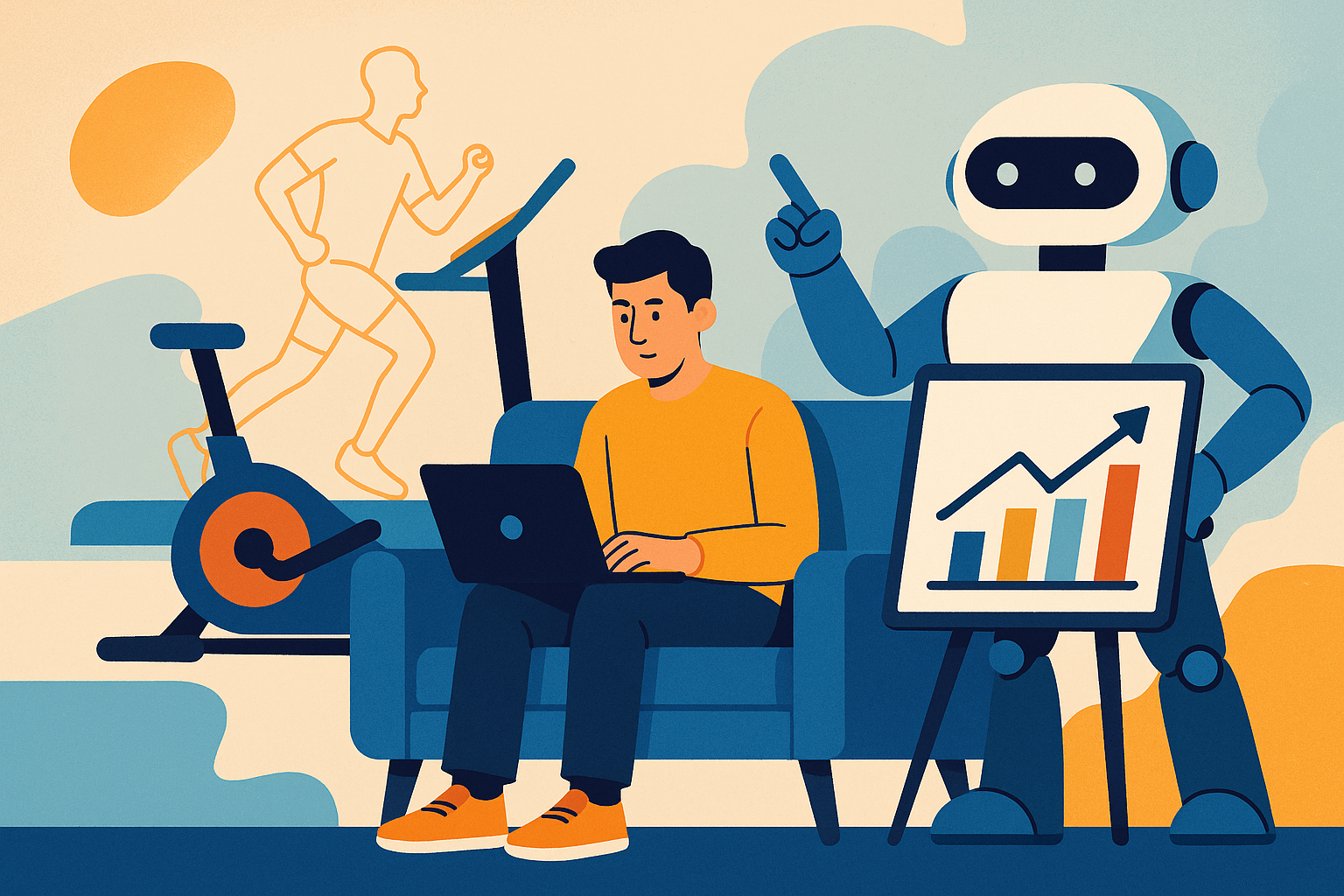
Let’s start with a confession: I once bought a Peloton, convinced it would turn me into a Tour de France contender. Three months later, it was a $2,000 coat rack. Turns out, buying the tool isn’t the same as using it — and using it isn’t the same as getting results. Marketers, welcome to your AI moment.
Here’s the headline that’s making the rounds (and, let’s be honest, triggering a few existential crises in C-suites everywhere): 82% of marketers are failing at AI adoption. Not “struggling,” not “finding it challenging,” but failing. That’s not a typo. If AI were a group project, four out of five marketers would be the ones who forgot to show up on presentation day.
It’s Not the Tech — It’s Us
But before you start blaming the robots, let’s get one thing straight: the problem isn’t the tech. It’s us. Or, more specifically, it’s the way we’ve organized ourselves to do marketing work. We’re still running assembly lines in a world that now expects pit crews.
Let me break it down. Most marketing teams are built like a relay race: insights team hands the baton to creative, who passes it to activation, who lobs it over to analytics, and so on. Every handoff adds friction, delays, and — let’s be honest — at least one “who owns this?” Slack thread. AI, meanwhile, is like a sprinter who wants to run the whole lap solo. It doesn’t need a baton. It needs a clear track.
The Rube Goldberg Machine of Marketing
So what happens when you drop AI into this Rube Goldberg machine of process? You get automation without judgment. You get campaigns optimized for the wrong KPIs. You get, as one retailer put it, chocolate that doesn’t taste like chocolate anymore. (And if you’ve ever tried sugar-free, fat-free, flavor-free chocolate, you know that’s a fate worse than a Q4 budget cut.)
Marketers See the Potential, But…
Here’s the kicker: most marketers see the potential. They’re experimenting with AI at home, using it to write birthday cards or generate memes. But at work? They’re stuck waiting for IT to bless the latest tool, for legal to sign off on data use, for someone to explain what responsible AI actually means. By the time the green light flashes, the campaign window has closed and the only thing left to optimize is the out-of-office reply.
The Fix: Positionless Marketing
Now, let’s talk about the fix — and it’s not another tool, dashboard, or AI Center of Excellence. It’s a rethink of how marketing teams operate. Enter Positionless Marketing. Imagine a world where a single marketer can access the data, generate brand-safe creative, and launch a campaign — all before their coffee gets cold. No more passing the baton. No more “waiting for the next sprint.” Just fast, focused, end-to-end execution.
This isn’t about turning marketers into lone wolves or killing collaboration. It’s about reserving the committee meetings for the big stuff — the Super Bowl ads, the rebrands, the “should we really use a llama as our mascot?” debates. For everything else, let the people closest to the customer run with it. Give them the tools, the guardrails, and the trust to move at the speed of AI.
Why Speed and Structure Matter
Why does this matter? Because the gap between AI’s promise and marketing’s reality isn’t closing on its own. The brands that win won’t be the ones with the fanciest tech stack. They’ll be the ones that can actually use it — quickly, safely, and with just enough human judgment to avoid the flavorless chocolate trap.
Here’s my take, as someone who’s seen more martech demos than I care to admit: AI isn’t a magic wand. It’s a force multiplier. But only if you clear the runway. If your team is still organized like a 1990s ad agency, you’ll get 1990s results — just with more expensive software.
Getting Unstuck: Practical Steps
- Start small. Pick a low-risk use case.
- Clean your data (seriously, clean your data).
- Give one marketer the keys and see how fast they can go.
- Measure lift, not activity.
- When you see results, codify the process and scale it.
- Rinse, repeat, retire the bottlenecks.
And if you’re worried about losing control, remember: the riskiest thing you can do right now is move too slow. In a world where customer behavior shifts by the week, speed isn’t a luxury — it’s survival.
Ask the Right Questions
So, next time someone pitches you an AI solution, don’t ask, “What can this tool do?” Ask, “How will this change the way we work?” If the answer is “not much,” save your budget for something that will.
Final Thoughts: Don’t Let the Treadmill Collect Dust
Because in marketing, as in fitness, the only thing worse than an unused gym membership is convincing yourself that buying the treadmill was the workout.
Now, if you’ll excuse me, I have a Peloton to dust off — and a marketing team to reorganize.