

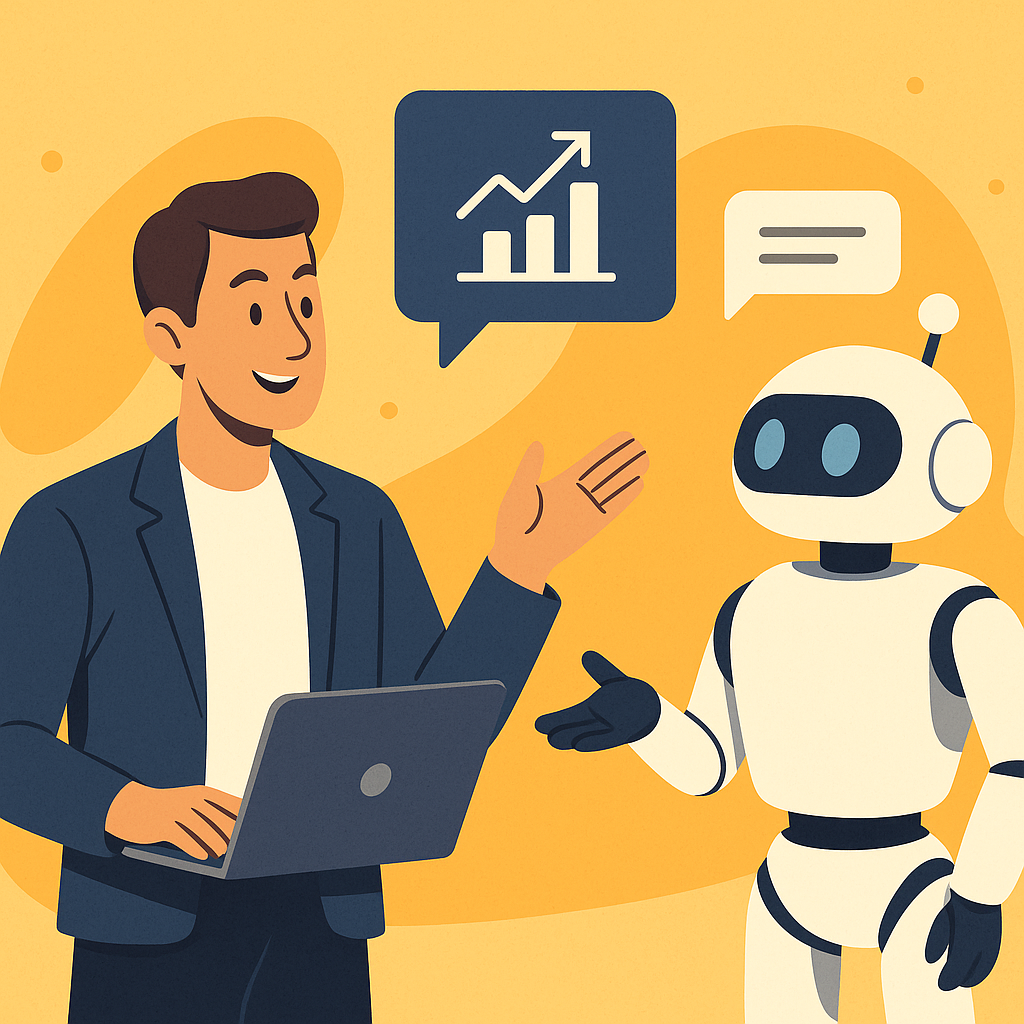
Agentic AI in Marketing: More Than Just Hype
The Evolution of Marketing Tools
Let’s be honest: if you’ve been in marketing longer than a TikTok trend lasts (so, more than 48 hours), you’ve seen your fair share of game-changers. Remember when QR codes were going to revolutionize everything? Or when Clubhouse was the next big thing, until it wasn’t? Well, today’s hot topic is agentic AI — and before you roll your eyes and reach for your “seen it all” mug, let’s talk about why this one actually deserves a seat at the grown-ups’ table.
- Agentic AI in Marketing: More Than Just Hype
- The Evolution of Marketing Tools
- Agentic AI Takes Center Stage at MarTech Conference
- Three Flavors of AI Agents
- From Scarcity to Abundance: The New Martech Reality
- The Catch: Efficiency vs. Experience
- Vibe Coding: No-Code on Steroids
- The Big Takeaway: A Shift in How Marketing Gets Done
- Winning in the Age of Agentic AI
- Final Thoughts: Balancing Human Touch and AI
Picture this: It’s 1985. You’re building a slide deck with actual slides, glue, and a prayer that you don’t sneeze on the acetate. Fast forward to today, and you can bark a prompt at an AI and have a polished, on-brand presentation in less time than it takes to explain what “synergy” means to your intern. That’s not just speed — that’s a seismic shift in what’s possible. And it’s the perfect metaphor for what’s happening in marketing right now.
Agentic AI Takes Center Stage at MarTech Conference
So, what’s the news? At the latest MarTech Conference, the conversation wasn’t about the next shiny tool or the latest privacy panic. It was about agentic AI — not just AI that crunches numbers or writes copy, but AI that acts, learns, and adapts like a junior marketer who never sleeps, never asks for a raise, and doesn’t need a kombucha tap in the break room. We’re talking about AI agents that don’t just automate tasks, but make decisions, run experiments, and — here’s the kicker — sometimes interact with your customers directly, or even represent them.
Three Flavors of AI Agents
Let’s break it down. There are three flavors of these agents:
- Agents for marketers: Think of these as your backstage crew. They’re the AI copilots inside your analytics dashboards, your campaign optimizers, your creative sidekicks. They help you move faster, see patterns, and avoid the “why did we spend $50K on that?” post-mortems.
- Agents exposed to customers: These are the chatbots, AI-powered SDRs, and email agents that talk to your audience. When they’re good, they make your brand look like it actually cares about response times. When they’re bad, they make your customers wish for the sweet release of a “press 0 for a human” option.
- Agents of customers: Here’s where it gets spicy. These are the AI assistants your customers use — the ChatGPTs, the answer engines, the digital gatekeepers that decide what your prospects see, summarize your emails, and maybe even negotiate on their behalf. You don’t control them. You can only influence them. It’s like SEO, but with the algorithm wearing sunglasses and refusing to tell you what it wants for lunch.
From Scarcity to Abundance: The New Martech Reality
Now, why does this matter? Because we’re moving from a world of scarcity (limited time, limited hands, limited ideas) to a world of abundance. The number of martech tools has exploded, and AI is flattening the curve between “I have an idea” and “I have a working prototype.” Suddenly, marketers aren’t just consumers of technology — we’re creators. You want a custom dashboard for a one-off campaign? You can build it with a prompt. Need a microsite for a flash sale? Done before your coffee gets cold. This isn’t just about doing more, faster. It’s about experimenting more, learning more, and — if you’re smart — failing faster and cheaper.
The Catch: Efficiency vs. Experience
But here’s the catch (there’s always a catch): Just because you can automate something doesn’t mean you should. The temptation is to let AI handle every customer touchpoint, every campaign, every decision. But if you’re not careful, you end up with the digital equivalent of a call center menu that makes people want to throw their phones into the bay. Efficiency is great, but not if it comes at the expense of experience. The best marketers will use agentic AI to serve both sides of the relationship — making life easier for the company and the customer. If you’re only optimizing for your own KPIs, you’re missing the point (and probably losing customers).
Vibe Coding: No-Code on Steroids
Let’s talk about “vibe coding” for a second — yes, that’s a real term now, and yes, I wish I’d trademarked it. The idea is that marketers can now create software, dashboards, and tools just by describing what they want in plain English. The AI does the heavy lifting, writing code behind the scenes. It’s no-code on steroids. This means more decentralized innovation, more hands-on experimentation, and a lot less waiting for IT to get back to you (sorry, IT friends — you’re still invited to the holiday party).
The Big Takeaway: A Shift in How Marketing Gets Done
So, what’s the big takeaway? Agentic AI isn’t just another tool in the stack. It’s a shift in how marketing gets done. It’s moving us from centralized, slow-moving processes to decentralized, rapid-fire experimentation. It’s giving marketers the power to build, test, and iterate without waiting for permission or budget cycles. And it’s forcing us to rethink what “customer experience” really means when the customer’s first interaction might be with an AI — theirs or ours.
Winning in the Age of Agentic AI
Here’s my take: The marketers who win in this new era won’t be the ones with the biggest budgets or the fanciest tech stacks. They’ll be the ones who know how to blend human creativity with AI horsepower, who use agents to amplify their instincts, not replace them. They’ll be the ones who remember that data tells you the what, but brand tells you the why. And they’ll be the ones who never forget that, at the end of the day, marketing is about connection — not just conversion.
Final Thoughts: Balancing Human Touch and AI
So, as you stare down your Q4 strategy and wonder whether to “agentify” your next campaign, remember: Marketing is a marathon with weekly sprints. Don’t get seduced by the shiny object syndrome, but don’t be afraid to experiment, either. The future belongs to the bold — and to those who know when to let the robots take the wheel, and when to grab it back.
And if all else fails, just remember: In a world full of AI agents, sometimes the most human thing you can do is pick up the phone, crack a joke, and remind your customers there’s still a real person behind the brand. Even if your AI wrote the punchline.