Organic traffic is down 10–40% at companies with perfectly healthy websites and excellent content. If that sounds familiar, the problem isn’t your strategy — it’s your scoreboard.
Forrester clients are watching organic and direct traffic fall 10–40% year-over-year. Not companies with thin content or technical debt. Companies with strong fundamentals, clean architecture, and content teams that know what they’re doing. The traffic is just… leaving.
The reflex is to panic. To audit everything, brief the board with apologies, and throw budget at whatever the agency recommends this week. That reflex is wrong — and the CMOs who understand why are pulling ahead fast.
## The Scoreboard Changed. Most Teams Are Still Playing the Old Game.
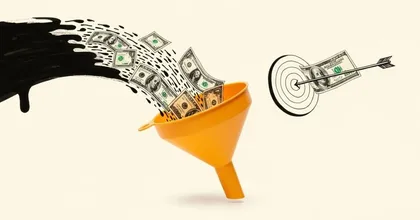
Google’s AI Overviews now appear in nearly 20% of all search results pages, up from 7% in 2023. The top organic click-through rate dropped 32% after their rollout — falling from 28% to 19% — and that shift is structural, not cyclical. Meanwhile, referral traffic from ChatGPT grew 44% and from Perplexity 71%. The traffic didn’t disappear. It moved.
Nikhil Lai, Principal Analyst of Performance Marketing at Forrester Research, puts it plainly: answer engine visitors convert at 2–4 times the rate of traditional search visitors. They spend three times longer on site. They arrive with 23-word queries — versus the 3–4 word searches of the past decade — which means they’ve already done substantial research before clicking anything. Sessions average 23 minutes and contain 5–8 follow-up questions. These aren’t casual browsers. They’re buyers.
So the real question isn’t “why is traffic down?” It’s “why are you still measuring success in sessions and clicks?”
## Before You Brief the CEO, Build the Right Narrative
This is where a lot of marketing leaders stumble. The traffic chart is going down. The CEO sees it. The board sees it. Without context, the obvious interpretation is that something broke.
Smart CMOs are getting ahead of this by pairing the declining volume data with the conversion rate improvement — showing a net performance gain, not a net loss. If fewer people are visiting but 2–4x more of them are converting, the business isn’t shrinking. The funnel is getting more efficient. That’s a different story, and it requires a different set of metrics to tell it.
33% of CMOs now prioritize share of AI voice over traditional search metrics (21%). That’s a meaningful shift in how marketing leadership defines visibility — and it reflects a recognition that the old KPIs no longer capture where demand is actually being shaped.
Citation share, mention share, and branded search volume are the metrics that matter now. The causal chain works like this: higher citation and mention share in AI-generated answers drives more branded searches. Branded searches convert at higher rates. That compounds into measurable market share gains. Lai identifies branded search volume as “the single strongest leading indicator of market share growth” — which means the CMO who owns citation share today owns pipeline in 12 months.
## What’s Actually Happening in the Buyer Journey
The mechanics of how answer engines work are fundamentally different from traditional search — and the difference matters enormously for demand generation strategy.
Traditional search captures existing, formed purchase intent. Someone searches “project management software for remote teams,” scans results, clicks through, evaluates. The intent was already there. The search just expressed it.
Answer engines operate earlier. A business buyer might ask ChatGPT: “What’s the best approach to managing distributed engineering teams across time zones when some are contractors?” That’s not a purchase query. It’s a research conversation. But by the time they exit that session — after 5–8 follow-up questions, 23 minutes of dialogue — they leave with specific brand associations formed. They search directly for those brands. The demand was generated inside the AI conversation, before your website ever appeared.
For B2B specifically, this isn’t a future concern. GenAI is already the number one source of information for business buyers evaluating purchases of $1 million or more — ranking ahead of customer references, vendor websites, and social media. The largest deals are being influenced by AI conversations before your sales team ever enters the picture.
AEO visibility, in other words, is a current-pipeline variable. Not a 2027 problem.
## The 85-90% Rule: Why You Don’t Abandon SEO
One of the cleaner findings from Forrester’s analysis: 85–90% of current SEO best practices remain fully valid for answer engine visibility. E-E-A-T, site architecture, mobile load speed, structured data, indexation hygiene — none of that goes away. In fact, 76% of AI Overview citations come from pages already ranking in Google’s top 10 organic results. The two strategies aren’t competing. Strong traditional SEO is the prerequisite for AI search visibility.
What changes is the scope. AEO adds natural-language FAQ optimization, off-site authority building, pre-rendering for less sophisticated bots, and a measurement framework built around share of voice rather than click volume. It’s an expansion, not a replacement.
One tactical detail worth acting on immediately: most answer engines outside Google draw primarily from Bing’s index. Pushing every sitemap update directly to Bing via the IndexNow protocol triggers Bingbot to crawl fresh content faster than organic discovery — and that fresh content feeds into Perplexity, ChatGPT, and the broader answer engine ecosystem. It’s a 15-minute technical change with compounding distribution benefits.
## Five Content Moves That Actually Produce Results
The long-form skyscraper content strategy — publish one exhaustive 5,000-word guide and wait — is no longer effective for answer engine visibility. What works is precise, specific answers to real questions, delivered in multiple formats that address the same topic cluster from different angles.
Claudebot crawls 38,000 pages for every referred page visit, compared to Googlebot’s 5:1 ratio. That gap reflects the sophistication difference between the two bots — and it means volume and variety of indexed content matters more than it ever did.
Five moves that Forrester’s data supports:
**Build surround-sound FAQ coverage.** Glossaries, FAQ pages, videos, blog posts — each addressing the same topic cluster from a different angle. Every indexed page signals topical authority. Multiple formats increase indexation opportunities across every engine.
**Publish direct competitor comparisons.** Users ask answer engines to compare brands. Honest, data-backed comparison guides are gaining prominent visibility in AI-generated answers. This format was previously considered taboo for brand content. It’s now a competitive requirement.
**Treat off-site syndication as the new backlinking.** Reddit AMAs, Quora answers, contributions to industry publications appearing in AI responses — these are the channels that answer engines weight most heavily. Bing evaluates credibility by weighting third-party mentions more heavily than a brand’s own claims. Reddit threads, Quora answers, Wikipedia entries, G2 reviews, and YouTube videos dominate AI-generated answers. Your PR and social teams now own channels that are critical to AEO performance.
**Pre-render pages for bot access.** Bots crawling sites lack the compute budget to render JavaScript-heavy pages. Pre-rendering a JavaScript-free version for bots — while serving the full experience to humans — ensures content gets indexed across every engine. More crawling and indexing means more visibility.
**Create genuinely distinctive content.** AI-generated answers cite brands that go into real detail — not just “this product is great” but why it performs differently at different temperatures, conditions, use cases. Long-tail specificity is what gets cited. Generic content gets skipped.
## The Organizational Question Nobody Wants to Deal With
AEO isn’t an SEO team project. It requires content, web development, paid search, PR, brand marketing, social media, community management, and reputation management working from a shared framework. That’s most of the marketing department, plus functions that historically haven’t sat in marketing’s lane at all.
Lai identifies two organizational models that work at scale. The first is a Center of Excellence — a senior SEO specialist who evolves into an AEO evangelist, publishes cross-functional standards (“every piece of content must answer these five questions,” “every page must include author schema”), and establishes governance across functions. The second is an AI Orchestrator — a dedicated hire who builds agents for repeatable AEO tasks, handles schema implementation, manages JavaScript reduction, creates FAQ content, and governs the cross-functional workflow.
The choice between them depends on organizational scale. But the structural decision itself needs to happen this quarter. Only 20% of marketers have adopted AEO despite 70% expecting major impacts soon — which means the competitive gap for early movers is real and closing. 90% of digital teams are increasing SEO investment in 2026, the highest surge in five years. The urgency is not manufactured.
## A 90-Day Framework Instead of a Strategy Deck
Forward-thinking CMOs are treating the AI search transition the way they’d treat a brand awareness investment: fund a 90-day experiment, measure directional results, then build the investment case for broader rollout.
The five steps are concrete. Audit current citation and mention share in one category using an existing SEO platform. Identify three high-intent FAQ clusters where the brand should be visible. Build surround-sound content for each — a dedicated FAQ page, a comparison guide, one off-site piece in a publication that appears in AI responses. Push fresh sitemaps to Bing via IndexNow. Track citation share and branded search volume at 30, 60, and 90 days.
Brands moving first capture the highest-quality traffic at the lowest incremental cost and set a citation baseline that becomes progressively harder for competitors to match. The window is real. Companies restructuring content with schema, FAQs, and short prompt-matching blocks have demonstrated traffic restoration within six weeks.
## The Measurement Gap Is the Real Risk
62% of CMOs report lacking resources to adapt to AI search changes. That’s a resource constraint problem, but it’s also a measurement problem — because without the right metrics, it’s nearly impossible to make the internal case for the investment.
The good news: Google is expected to add citation metrics to Search Console once AI Max adoption reaches critical mass, and OpenAI has signaled an Analytics product before year-end. Measurement infrastructure is coming. The CMOs who’ve already built the internal habit of tracking citation share and branded search volume will be positioned to use those tools immediately when they arrive.
The ones still optimizing for CTR will be explaining to their boards why traffic is down — again.
A traffic decline in 2025 and 2026 is not a crisis. It’s a reclassification. The demand is still there. The buyer is still researching, still building brand associations, still moving toward a purchase decision. The question is whether your brand is present in the conversations where that happens — or whether a competitor’s is. The CMOs treating this as a measurement and organizational challenge, rather than a content emergency, are the ones who’ll own the answer.